
American Perpetuals
Published September 14, 2026
Download PDF- A perpetual is a structurally simpler and more cost-effective way to hold continuous exposure. Dated futures create roll costs and slippage that perpetual futures sidestep.
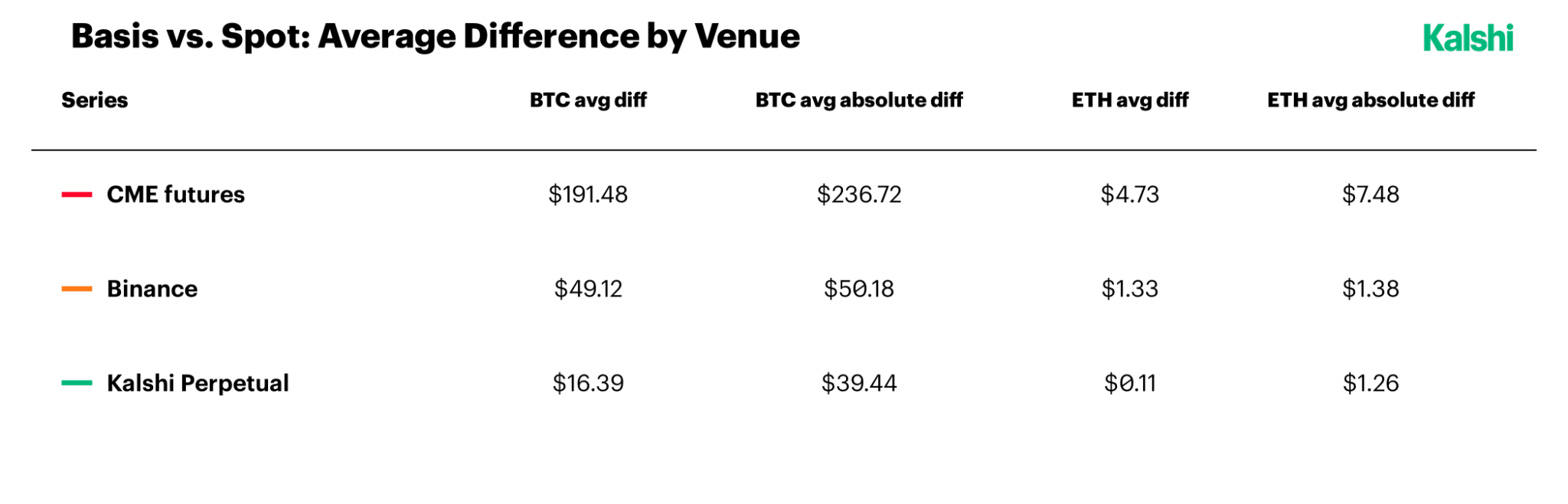
- Kalshi’s perps track spot closely and symmetrically. The average signed difference to spot on the Ether perp has been $0.11, against $1.33 on Binance. CME futures sit further above spot because a dated contract prices in financing to expiry; that premium is the roll cost a perpetual avoids, not a tracking error.
- Round-the-clock trading on gold and silver is now available, and where the structure makes the most sense. Silver’s term structure has been priced off physical scarcity rather than the cost of money, with one-month lease rates spiking toward 40% in October 2025 against a normal 0.3% to 0.5%, LBMA holdings down roughly 40% since 2021, and the curve in backwardation from late 2025. A cash-settled contract with no delivery mechanism gives price exposure without exposure to that plumbing, and it trades on weekends when COMEX does not.
The Cost of Standing Still
Any position that outlives a futures contract has to be rolled, and the cost of doing so decomposes into three parts worth keeping separate.
The first is carry, the term premium embedded in the price of the deferred contract. This is by a wide margin the largest component, and in a persistently upward-sloping curve a long who rolls forward pays it again at every expiry. The second is transaction cost: exchange and clearing fees plus the bid-offer on the calendar spread, paid at whatever size the book requires. The third is timing. The roll happens when the contract expires, not when the holder wants to trade, which means executing on a crowded date at a price other people are simultaneously being forced to take.
A perpetual contract removes the second and third outright. There is no expiry, so there is nothing to roll, no spread to cross more than once, and no calendar-driven execution. What it does to the first component is the more interesting part, and it is where the cheapness argument actually lives.
Because there is no settlement date to force convergence, the contract is anchored to spot by a funding rate: a payment exchanged directly between longs and shorts whenever the contract trades away from the index. When the perp trades rich, longs pay shorts; when it trades cheap, the flow reverses. The carry has not been abolished. It has been unbundled from the price and turned into an explicit cash flow that is recalculated daily (or more frequently).
That unbundling is what makes the perpetual cheaper rather than merely different. A dated futures holder pays the premium the curve demanded on the day of the roll, locked in for the whole life of the contract, whether or not that premium turns out to have been justified. A perpetual holder pays the premium that exists in each eight-hour window, and can exit any window. Term premium becomes a spot cost. The holder stops buying the market’s forecast of financing and starts paying financing.
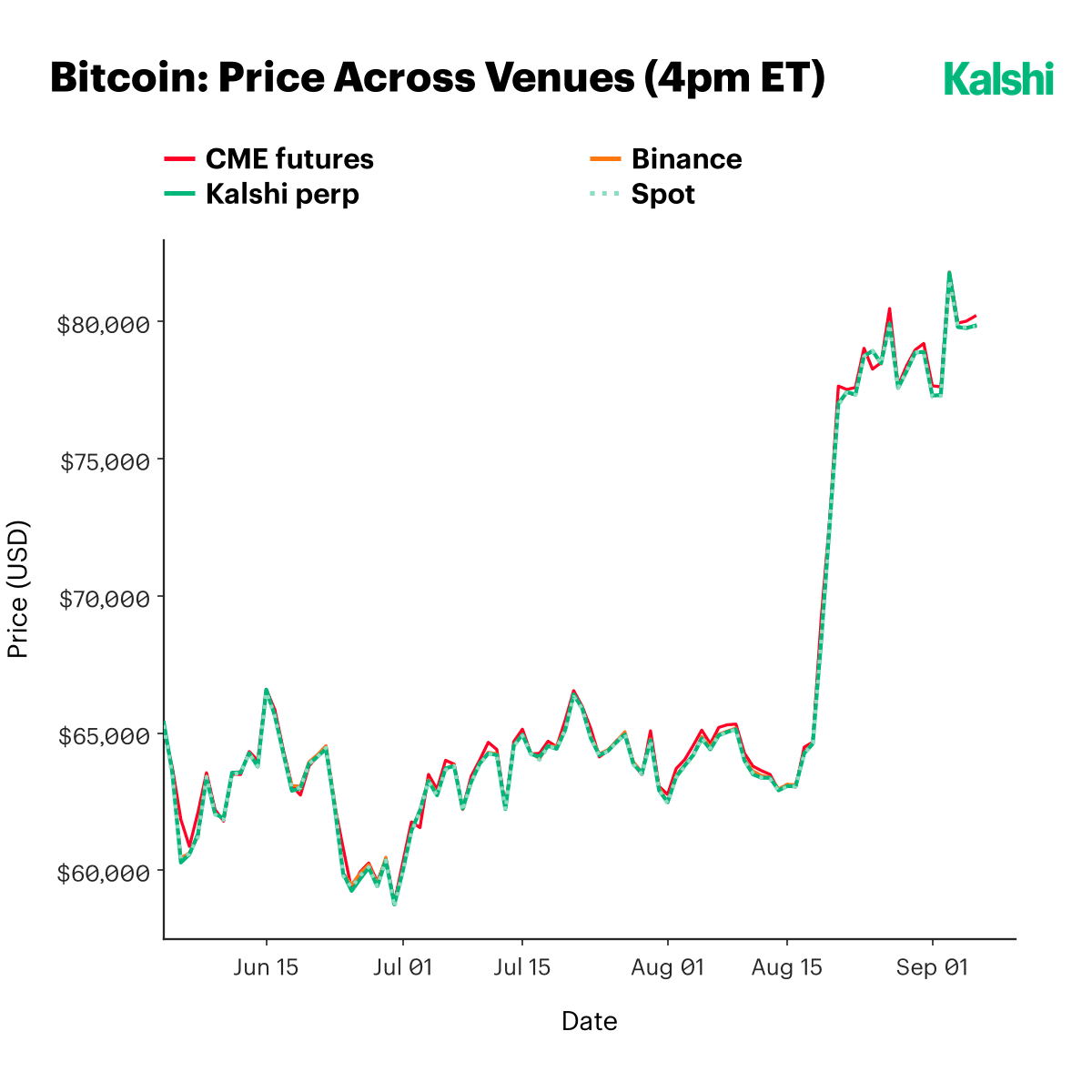
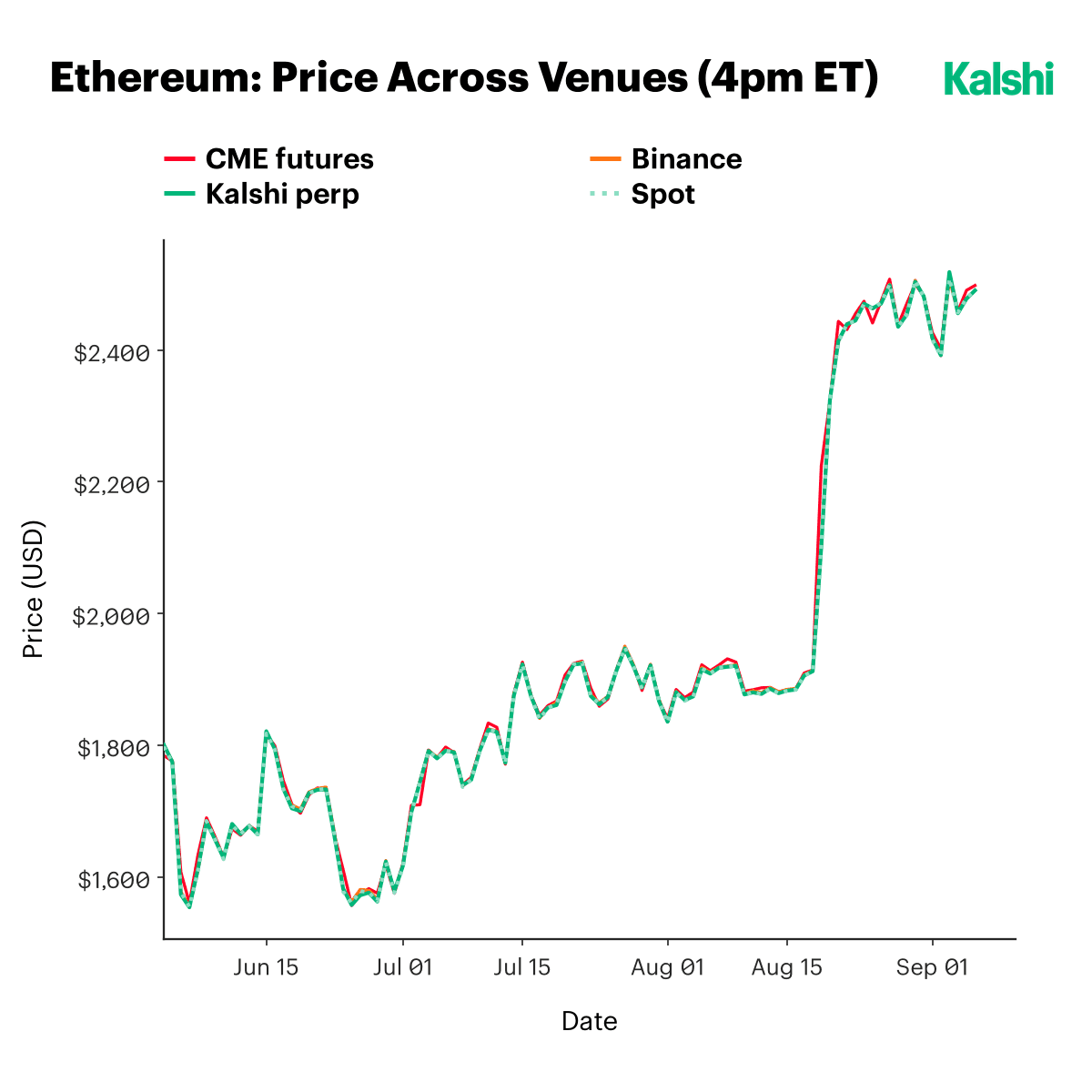
At the scale of those two panels the perp line and the spot line are indistinguishable across the entire sample, including the roughly 30% Ether and 20% Bitcoin repricing in the third week of August. That is the intended outcome and it is why the rest of this note works in basis and funding terms rather than in price.
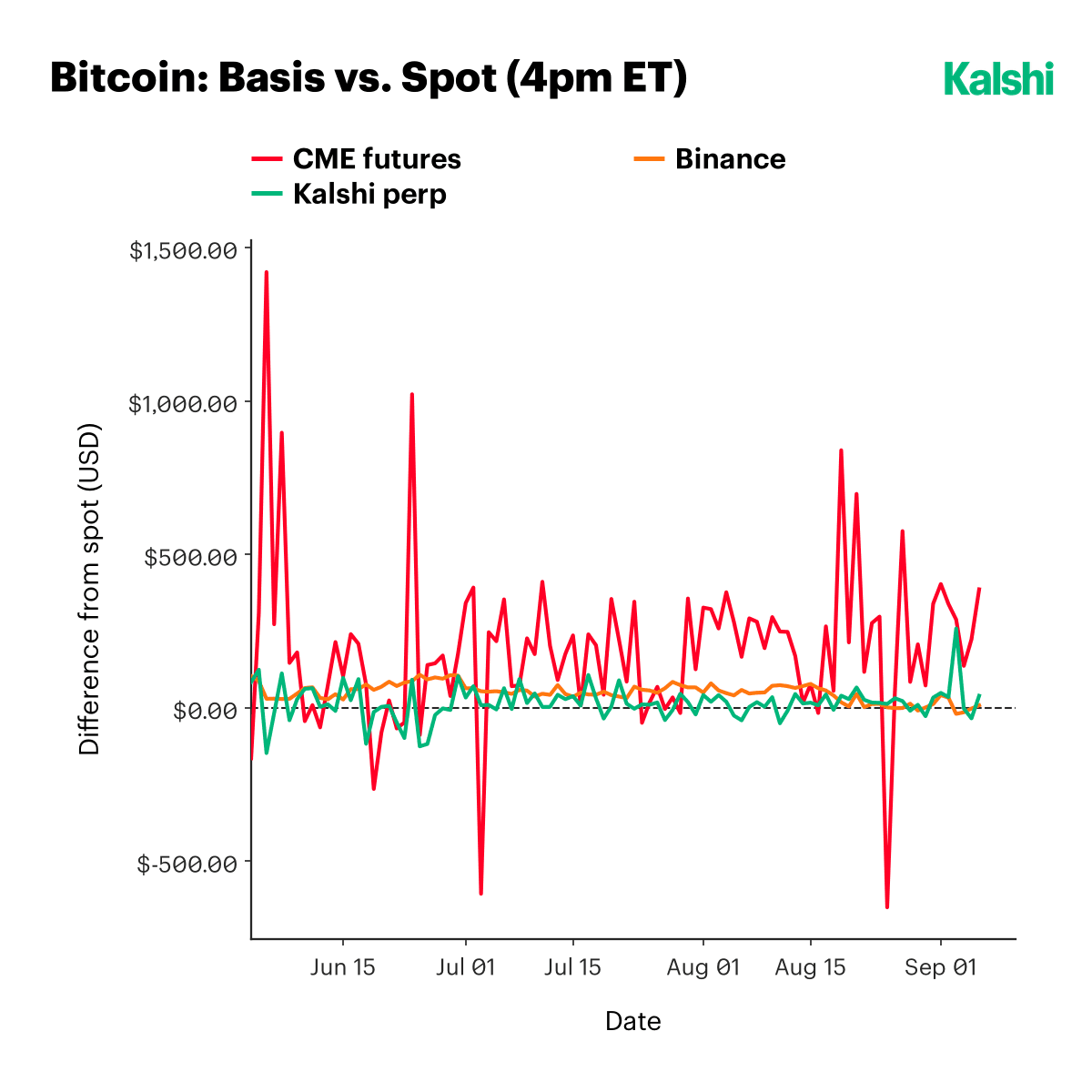
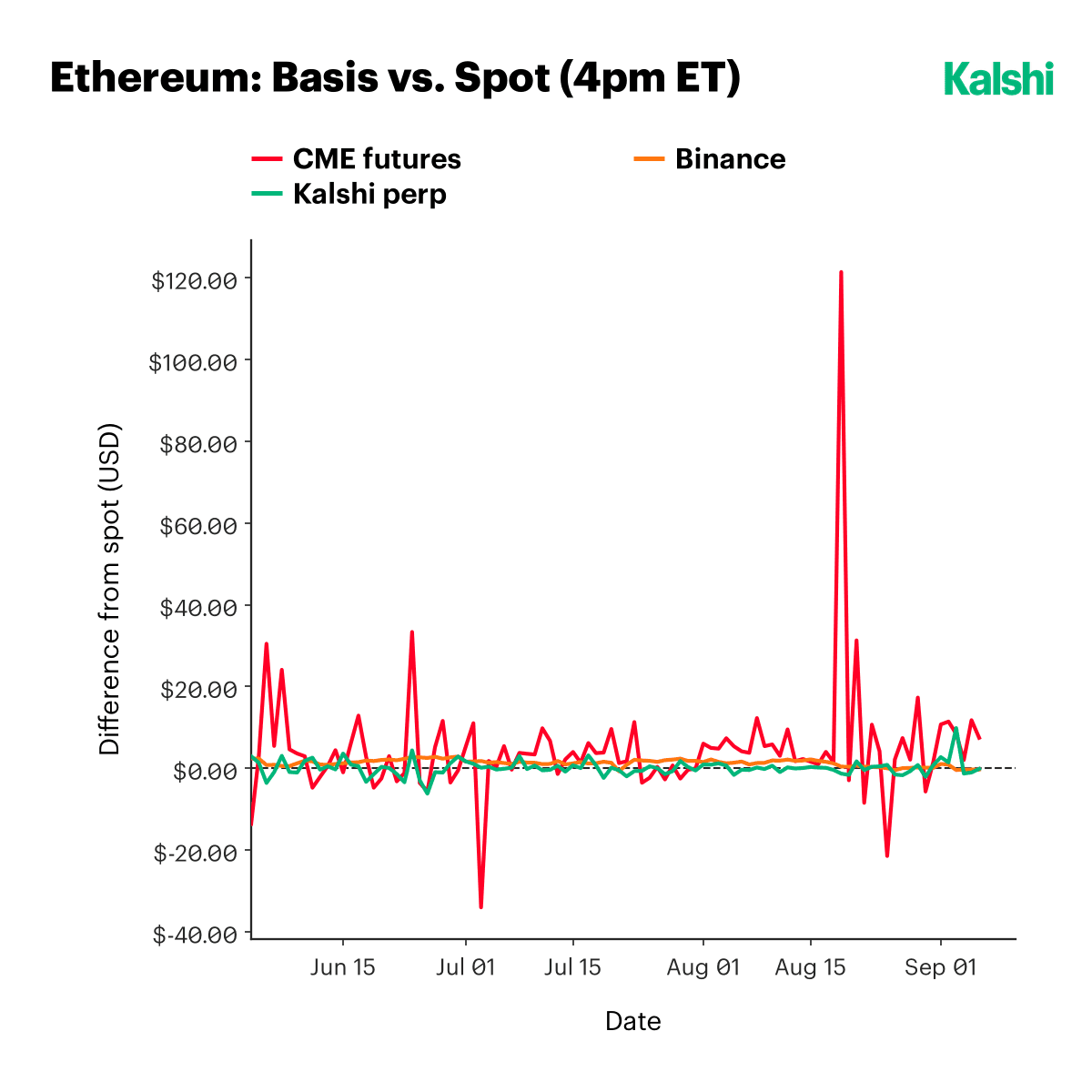
Start with Ether, where the comparison is cleanest because the funding rate barely moved.
Converted against approximate average price levels over the sample, CME’s average difference to spot works out to roughly 31 basis points and Binance’s to roughly 7. Kalshi’s is 0.6. The Kalshi holder paid close to nothing over the same window. Realized funding on the Ether perp has oscillated around zero since launch, including several negative episodes in which shorts paid longs. There is no theoretical argument required here: over June to September 2026, holding Ether exposure through the perpetual was materially cheaper than holding it through a rolled dated contract, because the term premium the dated contract charged did not materialize as a funding cost on the perp.
The signed-versus-absolute ratio explains why. Binance’s signed average is 96% of its absolute average on Ether and CME’s is 77%, meaning those contracts sit above the index nearly all the time. Kalshi’s ratio is 9%, which is the signature of symmetric noise around the index rather than a persistent premium. A contract whose basis is mean-zero is one where the funding mechanism and two-sided arbitrage flow are both working, and a mean-zero basis is the same thing as a near-zero average cost of carry for whoever holds it.
The same pattern holds on the Bitcoin side of the table, where Kalshi’s signed average of $16.39 compares with $49.12 on Binance and $191.48 on CME, and Kalshi’s absolute average of $39.44 is tighter than Binance’s $50.18. The venue ordering is identical across both assets, and the near-identity of the CME figures in percentage terms across two assets of very different volatility is the tell that what is being measured there is a common financing rate applied over a common tenor.
Two features of the basis panels deserve a mention. The CME Ether line spikes to roughly $120 in the third week of August, straight into the rally. That is the structural difficulty with dated contracts in one data point: the term premium widens exactly when directional demand is strongest, which is exactly when a long most wants the exposure. The Bitcoin panel shows the equivalent CME dislocations above $1,400 in late May and again around June 25, both consistent with roll-window pressure, although the chart does not isolate contract-month changes and that reading is an inference.
Funding Is a Cost You Only Pay While It Exists
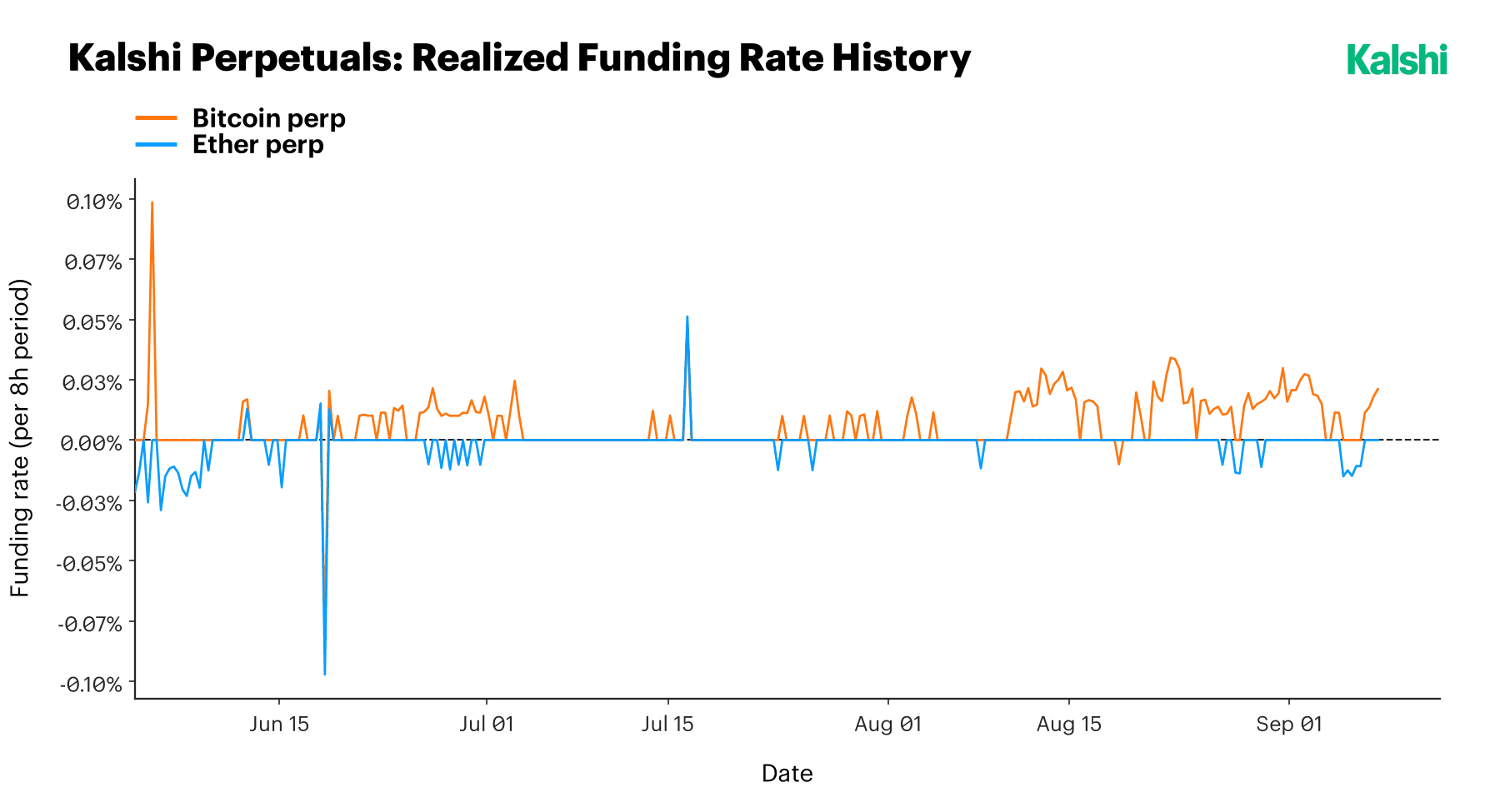
The Ether perp’s funding rate has hovered around zero since launch, with a negative print near minus 0.09% in mid-June and a positive spike above 0.05% in mid-July. One reading artifact belongs alongside that: the long flat stretches at exactly 0.00% are partly the 0.01% deadband, below which Kalshi sets the rate to zero and no payment is made. Those stretches are not periods of perfect alignment so much as periods where the misalignment was small enough that the exchange declined to transfer it. That is a deliberate design choice, and it means Ether holders were not even paying noise-level carry.
The Bitcoin perp has run differently, with funding persistently positive in a 0.01% to 0.03% band and firmer through late August. For context, CME’s own Spot-Quoted futures, the structurally closest product it offers, carry a daily financing adjustment the exchange describes as 0.01% to 0.04% of notional per day. Kalshi’s Bitcoin funding of roughly 0.03% to 0.06% per day sits above that band, which is the correct outcome rather than an unflattering one: Bitcoin longs on Kalshi have been paying for genuine, observable demand pressure on their own side of the book, in eight-hour increments they can see before they accrue and can exit between. A dated contract charges the same participants for that pressure too, only invisibly and in a lump.
New Kalshi Research, straight to your inbox.
Metals Are Where the Roll Actually Hurts
Perpetuals on precious metals – gold, silver – opened for trading at 10:00am ET Sep 10th 2026. Both are cash-settled in dollars with no expiry, reference Pyth Network prices, and trade 24 hours a day, seven days a week, including weekends and holidays when COMEX is closed.
The argument for perpetuals is stronger in metals than in crypto for three reasons.
The first is that the roll is more frequent and larger. Gold’s liquid COMEX cycle runs roughly six active months a year and silver’s five, so a two-year hold is on the order of a dozen roll events, each crossing a calendar spread in a contract sized at 100 troy ounces for gold, roughly $440,000 of notional at a spot price near $4,400, and 5,000 ounces for silver, roughly $325,000 at a spot price near $65. Even the micro contracts sit at $44,000 and $65,000. A perpetual referencing a fractional quantity collapses that to one round trip at a size a far broader set of participants can carry.
The second, and the more important one, is that the metals term structure has not been a financing curve. Silver’s has been priced off physical availability. One-month lease rates, normally 0.3% to 0.5%, spiked toward 40% during the October 2025 squeeze; LBMA silver holdings have fallen roughly 40% since 2021; COMEX warehouse stocks dropped from around 290 million ounces at the start of 2024 to below 210 million by October 2025; and the curve flipped into backwardation from late 2025. Anyone maintaining continuous silver exposure through dated futures over that period has had a roll cost set by delivery pressure they had no intention of participating in, swinging between deep contango and deep backwardation, and unpredictable in both magnitude and sign. Shorts had it worse still: COMEX silver open interest fell more than 22% between August and October 2025 as positions were closed early. A cash-settled perpetual carries none of that. Because there is no delivery mechanism, the funding rate reflects the balance of directional demand on the contract against a spot index and cannot be squeezed by scarcity of deliverable metal. Kalshi made this point in the filing itself, noting that a cash-settled contract cannot create delivery pressure. The corollary is that it cannot absorb it either, which is the whole benefit for a holder who wants the price and not the plumbing.
The third is the trading calendar. Silver lost 27.5% in a single week in early February 2026, its steepest weekly decline since 2011, and gold has moved through several sessions of 3% swings in the past fortnight, trading near $4,400 in the first week of September after a hawkish repricing of Fed expectations. Metals of that volatility currently go dark from Friday afternoon to Sunday evening. A contract that trades continuously through the weekend is the first exchange-listed, dollar-denominated way for eligible U.S. traders to adjust precious metals exposure on a Saturday. Liquidity outside standard hours will be thinner and prices may diverge from where COMEX reopens, which is a real limitation rather than a footnote, but the option to transact at all is new.
There is also a data consequence worth flagging for institutional readers. Gold’s cost of carry is a grounded number built from rates, storage and lease, and it has never been continuously and publicly marked in a form anyone can read without a dealer relationship. A gold perpetual’s funding series is exactly that number, published daily and currently free to observe. Whether it becomes a usable financing benchmark depends on the contract attracting two-sided arbitrage flow against COMEX; at low early volume, funding will reflect the positioning of whoever is in the book rather than the true cost of carrying metal, and the first weeks of prints should be read with that in mind.
Enjoying this? Get our next piece of research as soon as it's out.
Conclusion
The narrow question is settled by the data. Kalshi’s perpetuals track spot, and on the signed measure they track it more tightly and more symmetrically than either the dated CME contract or the offshore perpetual benchmark.
The broader claim follows from it rather than needing to be asserted separately. A contract whose basis is mean-zero is a contract whose holders are not paying a standing premium, and that is what makes the perpetual the cheaper way to carry continuous exposure. The dated alternative charges a term premium at every expiry regardless of whether it is realized, plus a spread crossing, plus execution on a date it selects. The perpetual charges a single round trip and then the financing that actually exists, in eight-hour slices any holder can observe and exit.
That gap is modest in crypto, where the offshore market already produced a continuous funding rate and the term premium is a straightforward financing number. It is much wider in metals, where the roll has lately been priced by lease rates and warehouse stocks rather than by the cost of money, and where a holder wanting the price of an ounce has had no way to avoid buying a claim on the delivery system alongside it. As of 10:00am last Thursday morning, they do.
The complex now runs to twenty contracts, eighteen in crypto and two in metals, with many more traditional financial assets to come.
About Kalshi Research
Signal-rich analysis of prediction markets. Questions, data access (currently free for institutional clients), or collaboration: research@kalshi.com
Disclaimer
This report is published by Kalshi Inc. (“Kalshi,” “we,” or “us”) for informational and educational purposes only. It is not investment, legal, tax, or trading advice, and it does not constitute a recommendation or solicitation to buy, sell, or hold any event contract, security, or other financial instrument. Nothing in this report creates a fiduciary, advisory, or professional-client relationship between Kalshi and the reader.
Kalshi operates a CFTC-regulated exchange. The event contracts and forward curves referenced herein are traded on or derived from Kalshi’s platform. The market prices, forward curves, and implied probabilities cited in this report reflect what market participants thought at a given moment; such data is subject to change without notice. These figures are not guarantees or predictions of actual outcomes. Past and current prices do not indicate future results. Data sourced from third parties is believed to be reliable but has not been independently verified. Third-party projections and estimates cited herein are subject to significant uncertainty and may not be realized.
Trading event contracts carries risk, including the risk that you may lose some or all of your invested capital. Event contract outcomes are binary and can result in the total loss of the amount paid for a contract. Every figure and probability here is current only as of the date of publication. Kalshi undertakes no obligation to update, revise, or correct this report after publication.
Kalshi, its affiliates, officers, directors, and employees may have financial interests in the contracts or markets discussed herein and may trade them at any time without notice to readers.
This report is not directed at any person in any jurisdiction where its distribution or the offering of event contracts would be contrary to local law or regulation. Before acting on anything in this report, consult your own independent legal, tax, financial, or other professional advisor.
This report is not insurance advice and does not constitute a recommendation regarding the purchase, renewal, or cancellation of any insurance policy or program. Comparisons between event contracts and insurance products are illustrative only and do not account for differences in regulatory protections, counterparty credit risk, claims processes, coverage scope, or policyholder rights that may apply to traditional insurance. Readers should consult a licensed insurance professional before making decisions about their insurance or risk-transfer arrangements.
Get new Kalshi Research publications and insights as they are released.