
Brazil at the Ballot Box: A Coin-Flip Runoff With the Fiscal Bill Coming Due
Published September 28, 2026
Download PDF- The market has flipped to Flávio Bolsonaro. Kalshi now prices Senator Flávio Bolsonaro at 57% to win the presidency against 43% for President Lula, close to a mirror image of mid-August, when Lula stood near 68%. Lula is still roughly 75% to finish first on October 4, but with only a 7% chance of anyone winning outright, the race will be decided in the October 25 runoff, where the right’s fragmented first-round vote consolidates.
- The right is priced to hold Congress and the economic heartland either way. The Liberal Party (PL) is 90% to win the most Senate seats, and Bolsonaro-aligned candidates are favored for governor across the South, Southeast, and Federal District. A fourth Lula term would likely govern against a legislature less friendly than the one he faces today, which matters for any fiscal adjustment that needs Congress to pass.
- A cyclically strong economy sits on a strained balance sheet. Unemployment is at a year-low 5.3%, inflation is back inside the target band at 4.22%, and Petrobras is producing at record levels. But gross debt has climbed to 82.5% of GDP and the interest bill runs at 8.67% of GDP. Whoever wins inherits this environment and its likely consequential policy constraints.
The Presidential Run-Off Is Getting Heated
On Sunday, October 4, Brazil’s 158.7 million registered voters (voting is mandatory for literate citizens aged 18 to 70) will choose a president, 54 of 81 senators, all 513 federal deputies, and governors in all 26 states and the Federal District. If no presidential candidate clears 50% of valid votes, the top two meet in a runoff on October 25, as has happened in every presidential race since 2002. Our markets price the chance of an outright first-round win at 7%.
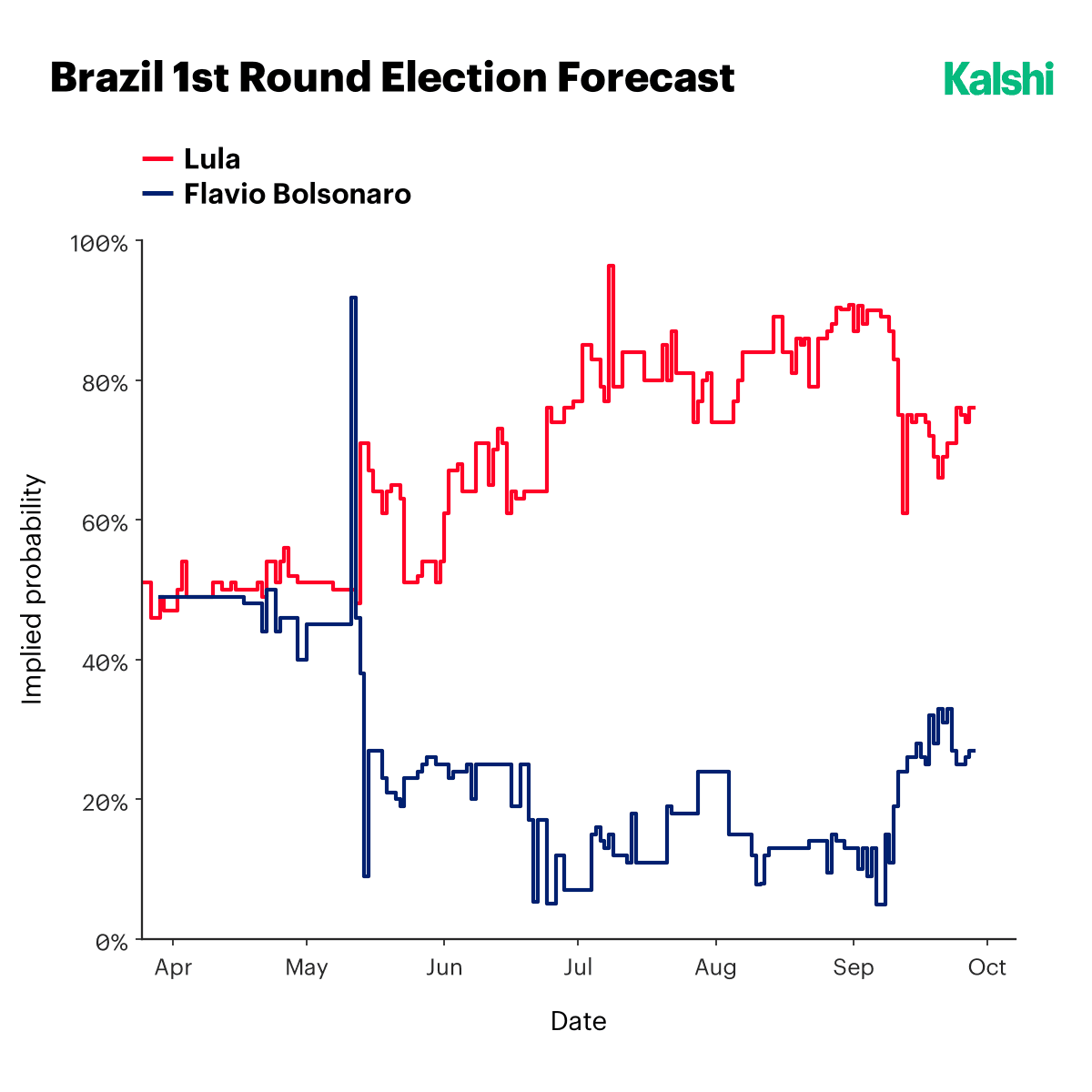
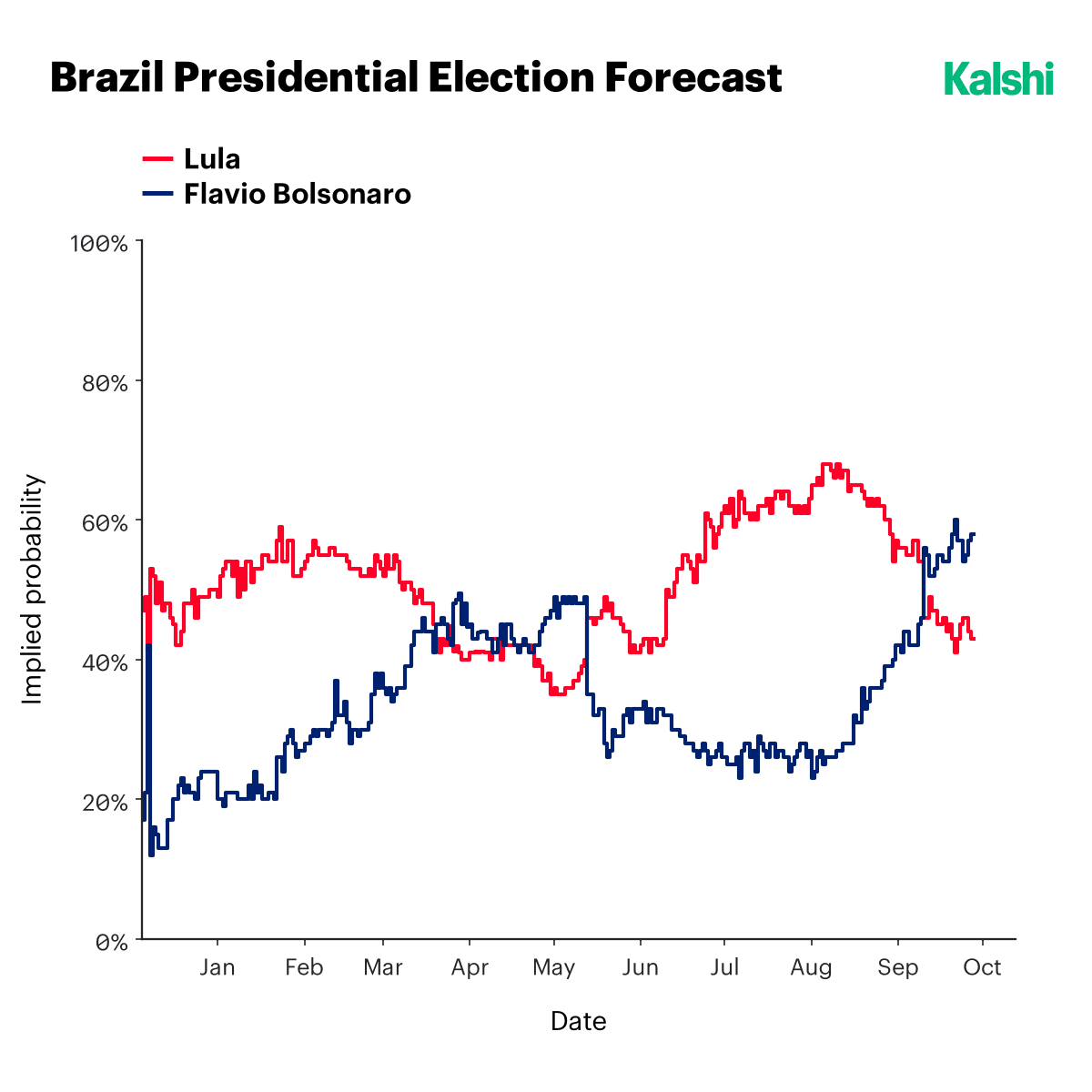
The two finalists are almost certain to be President Luiz Inácio Lula da Silva of the Workers’ Party (PT), who is seeking an unprecedented fourth, non-consecutive term and turns 81 two days after the runoff, and Senator Flávio Bolsonaro of the Liberal Party (PL), who is running in place of his father. Former President Jair Bolsonaro is serving a 27-year sentence for plotting a coup after the 2022 election and is barred from office until 2030. The rest of the field (Augusto Cury of Avante, Ronaldo Caiado of the PSD, Romeu Zema of NOVO, and Renan Santos of Missão, among others) is polling in single digits, but together it holds enough of the vote to decide the runoff.
Both platforms promise fiscal discipline, though their ability to execute on it appears dubious. Lula paired social spending with orthodox macro management in his first two terms, but his third term has been more interventionist. He replaced the constitutional spending cap and pushed primary spending to 19.55% of GDP, its highest this term. His campaign centers on a 40-hour workweek at unchanged pay, which would raise unit labor costs at a time when the central bank is already worried about services inflation. He also pledges a 1.3% primary surplus by 2030 and no change to the central bank’s autonomy. Flávio Bolsonaro runs on social conservatism, a hard line on crime, and alignment with Washington. His economic team, led by former Caixa president Daniella Marques, proposes a new debt-based fiscal anchor, closing at least ten ministries, reversing Lula-era tax increases, and selling federal property.
Looking Under The Hood At The Dealmakers
While it is the presidential race that captures headlines, the legislative results matter just as much for ever-relevant fiscal policy. Brazil’s Congress is fragmented and transactional, dominated by the so-called centrão, a bloc of center-right parties that trade votes for budget amendments and ministries. Every recent president has had to buy a working majority from it, and any serious fiscal adjustment, whether spending restraint or new revenue, has to pass through it.
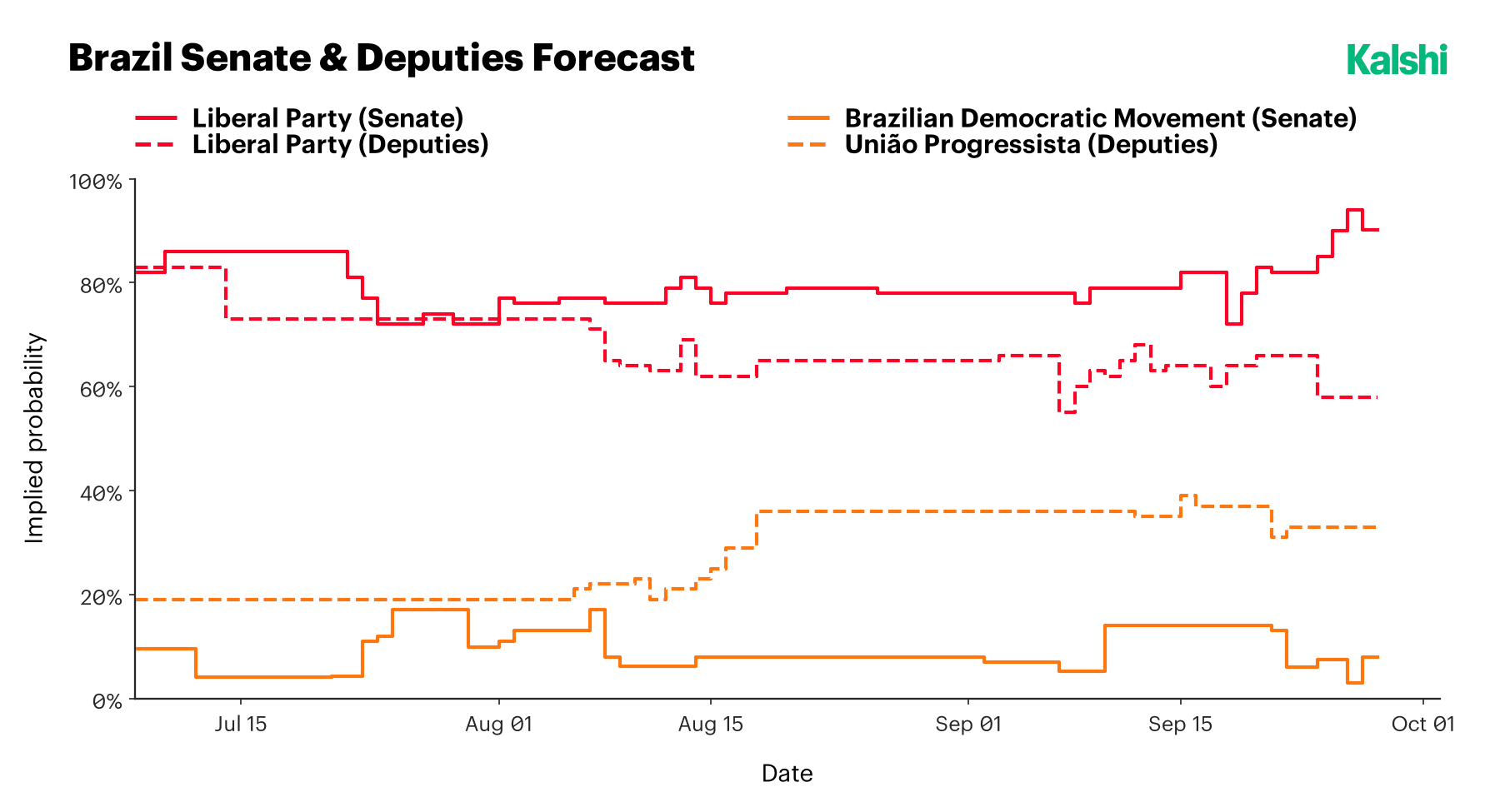
Our markets price the Liberal Party at 90% to win the most Senate seats, up from 82% in early July and just below a peak of about 94% last week; the Brazilian Democratic Movement (MDB), the traditional Senate powerhouse, trades at 8%. With two-thirds of the chamber (54 seats) up this year, the Senate race carries extra weight. The Senate confirms Supreme Court justices and is the body that would try any impeachment of one, which gives the de Moraes messages a direct legislative consequence.
The Chamber of Deputies is closer. The PL entered the campaign tied with the new União Progressista federation (União Brasil and Progressistas combined) at 97 deputies apiece after the April party-switching window. Kalshi’s probability that the PL wins the most seats has slid from 83% in early July to 58%, while União Progressista has risen from 19% to 33%, with most of that move coming in mid-August. That fight is within the right: União Progressista is a pillar of the centrão rather than a Bolsonaro vehicle. A Chamber led by the centrão rather than the PL would be a more negotiable counterpart for either president, and for a Flávio Bolsonaro administration in particular it would dilute the PL’s leverage over its own government’s agenda.
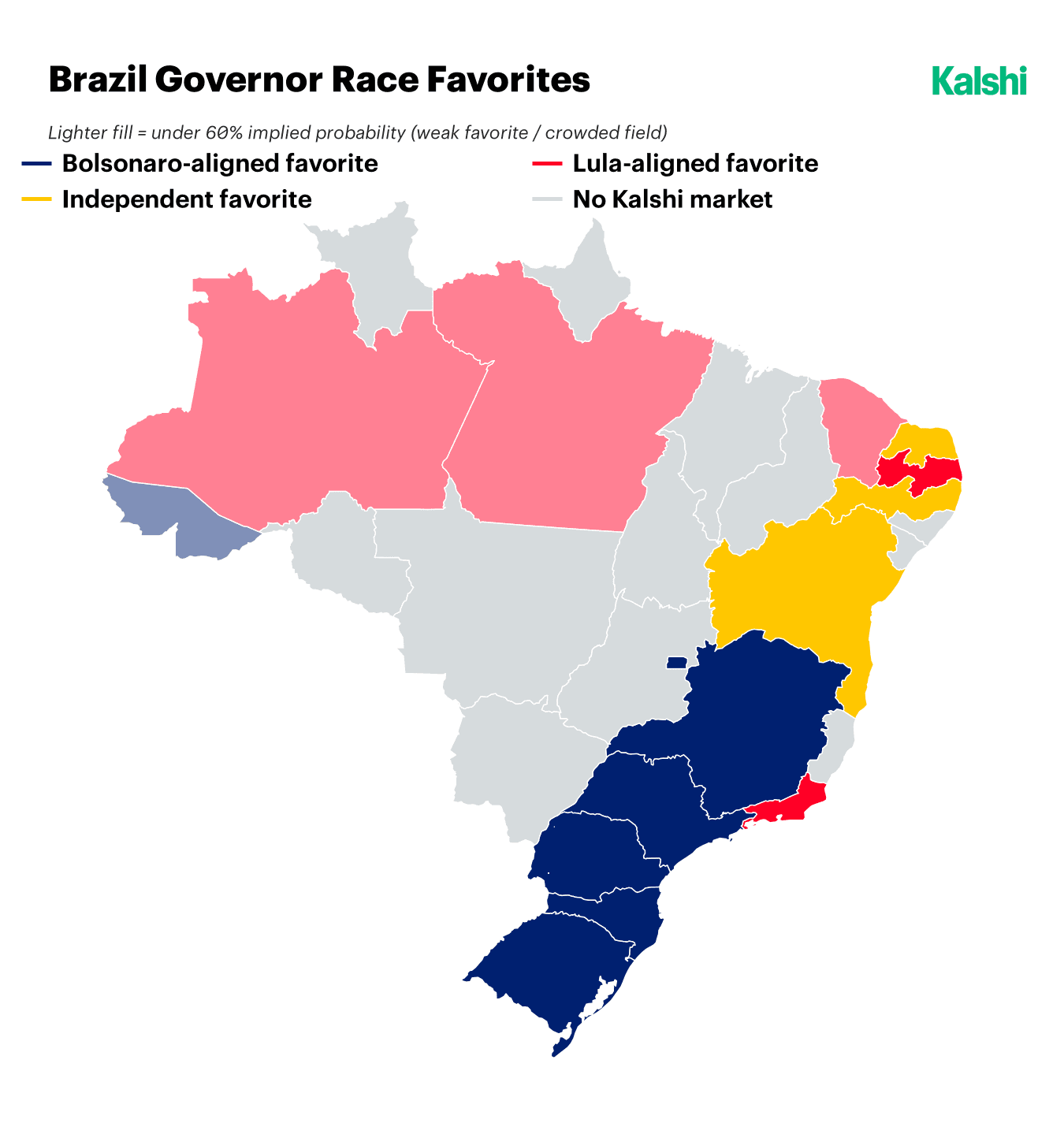
The governor markets draw the same map along regional lines. Bolsonaro-aligned candidates are favored across the South, Southeast, and Federal District: Tarcísio de Freitas at 97% in São Paulo, Cleitinho Azevedo at 92% in Minas Gerais, the PL at 96% in Santa Catarina, Luciano Zucco at 74% in Rio Grande do Sul, and Celina Leão at 89% in the Federal District. Together these states account for the bulk of Brazil’s GDP. Lula-aligned favorites are concentrated in the North and Northeast, where the favourites are less secure: Elmano de Freitas at 59% in Ceará and Omar Aziz at 54% in Amazonas, both below the 60% threshold the map shades lighter.
Two exceptions stand out. The first is Rio de Janeiro, the Bolsonaro family’s home base, where former Mayor Eduardo Paes (PSD), a Lula ally, is 88% to win. The second is the Northeast, Lula’s electoral heartland, where independents are favored in two of the largest states. Raquel Lyra (PSD) is at 60% in Pernambuco, Lula’s birth state, ahead of the PSB’s João Campos, and ACM Neto (União Brasil) is at 56% in Bahia, which the PT has governed since 2007. If both hold, Lula would have to win a fourth term with weaker state machinery in the region that has anchored his coalition for two decades.
Why the Map Splits: Income and Religion More Than Education
The regional pattern is real, but geography is mostly a proxy for income, religion, and the local economy. Income gives the clearest cleavage. In Datafolha’s September 1–3 survey, Lula led 47% to 27% among voters earning up to two minimum wages, while Flávio Bolsonaro led 42% to 31% among those earning two to five and 47% to 27% above five. Education is a weaker and less consistent guide than it is in the U.S. or Europe. Most pollsters find Lula strongest among voters with the least schooling (Nexus has him ahead 55% to 30% in that group) and Flávio Bolsonaro ahead among high-school graduates, but they disagree on college graduates: Nexus has them tied, while AtlasIntel has Lula ahead 50% to 31%. Religion is sharper. Evangelicals, roughly three in ten voters by most estimates, back Flávio Bolsonaro by a wide margin. These crosstabs rest on small subsamples, and the disagreements between pollsters should be read as a sign of real measurement uncertainty rather than noise to be averaged away.
Those patterns map onto the regions. The Northeast is Brazil’s poorest region and home to the largest share of Bolsa Família households, and it is Lula’s birth region; Nexus has him at 57% there. But that is well below the 69% he won in the region in 2022, which helps explain why independents are competitive in Bahia and Pernambuco. The South and Center-West, built on agribusiness, with higher formal incomes, fast-growing evangelical congregations, and a long-standing anti-PT vote, are Flávio Bolsonaro’s strongest ground; Nexus has him at 61% in the South. The Southeast, which holds more than 40% of the electorate, is the battleground. Datafolha’s August survey had Flávio Bolsonaro ahead in São Paulo (37% to 33%) and Rio de Janeiro (41% to 36%), where only 27% rated the government positively, but Lula ahead in Minas Gerais (37% to 31%).
The swing group is the lower-middle class earning two to five minimum wages, concentrated in the Southeast’s cities. Its members earn too much to benefit much from cash transfers and too little to benefit from a 13.75% Selic on their savings. They are the ones most exposed to the costs of tight money: revolving credit-card rates above 400% a year and real wages that have stopped rising.
But the governor map should not be read as a pure proxy for the presidential vote, either. Rio de Janeiro leans toward Flávio Bolsonaro for president while making Eduardo Paes, a Lula ally, the overwhelming favorite for governor. Minas Gerais leans toward Lula for president while favoring the Bolsonaro-aligned Cleitinho Azevedo for governor. In Pernambuco, Lula leads by 32 points, yet the favorite for governor is the independent incumbent Raquel Lyra, whose administration 68% of voters approve of.
The down-ballot markets narrow the policy range more than the presidential odds suggest. A Lula victory most likely produces a president facing a Senate led by his main opponent’s party and governors in the largest economies aligned against him. A Flávio Bolsonaro victory produces a friendlier legislature, but one in which the PL may not control the Chamber and must still bargain with the centrão. Neither outcome delivers a government that can pass a large fiscal package on its own terms.
New Kalshi Research, straight to your inbox.
Traditional Macro Indicators Are Looking Good, But Debt Is The Devil In The Details
By most day-to-day measures, Brazil’s economy looks healthy. Unemployment fell to 5.3% in the three months to July, the lowest reading this year, and Kalshi is pricing a further dip to 5.2% in the release due September 29. GDP grew 2.0% year-on-year in the second quarter, and Petrobras pumped a record 3.34 million barrels of oil equivalent per day, up 14.1% from a year earlier, with Kalshi expecting about 3.40 million in the third quarter.
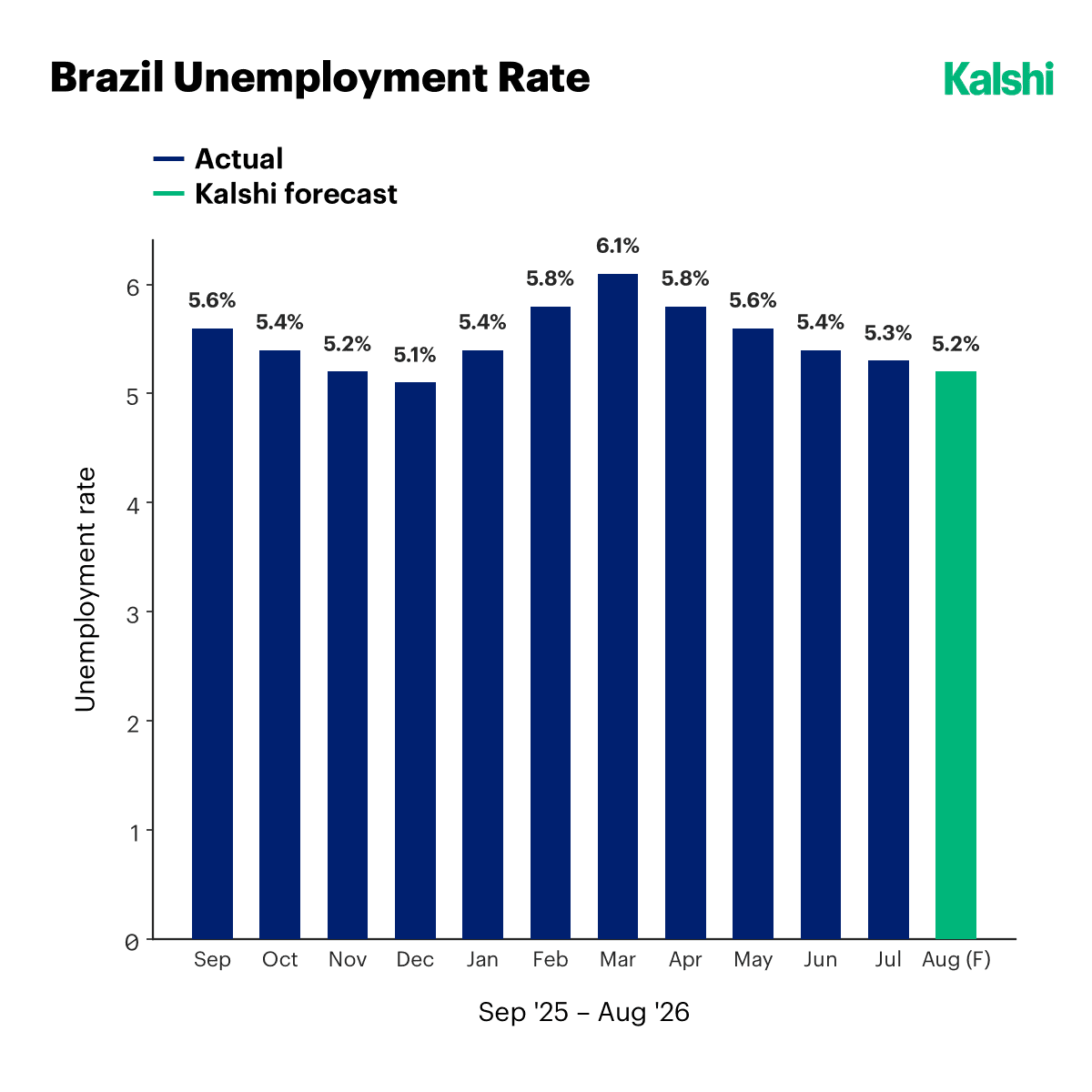
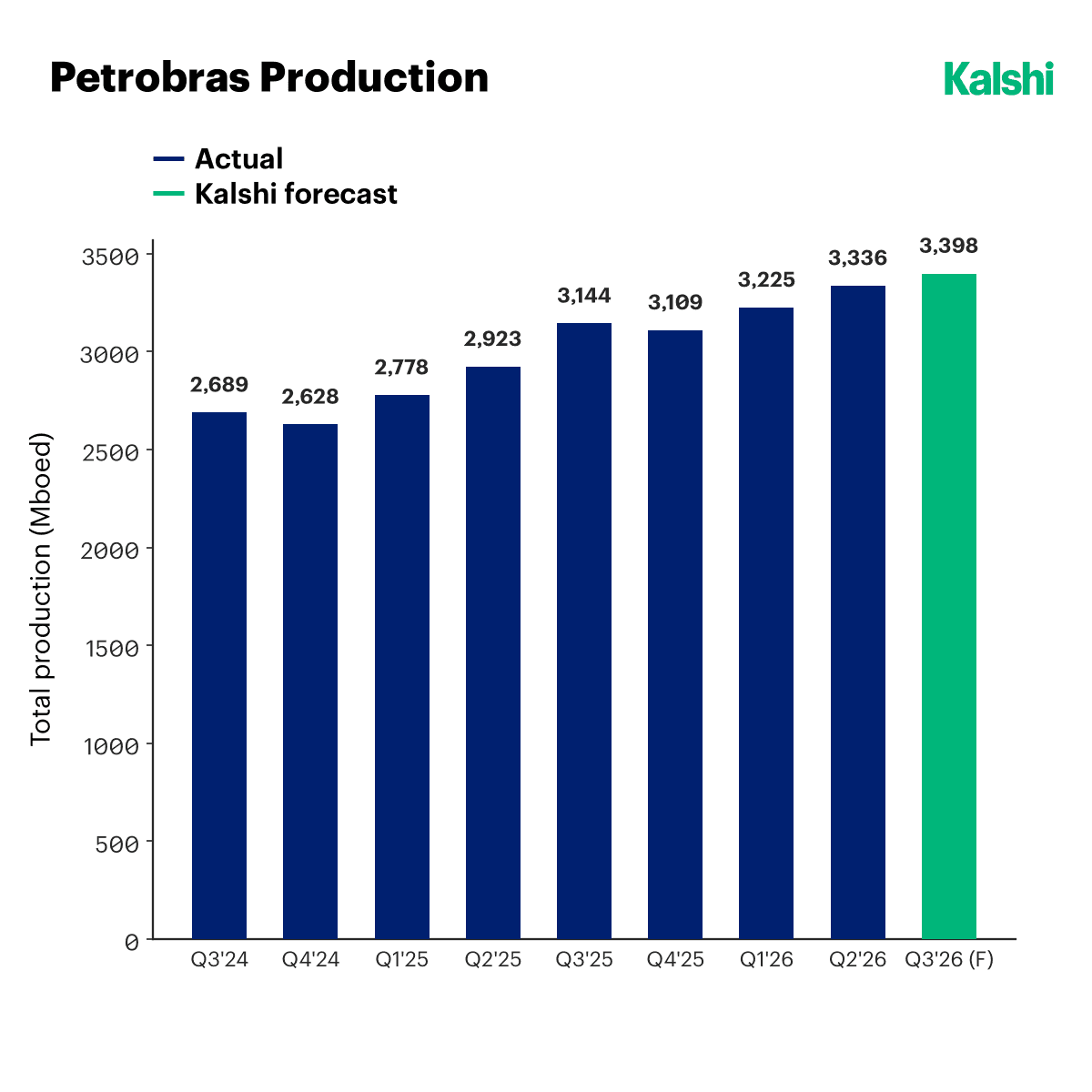
Look a little closer, though, and the picture is less rosy. Formal hiring is down 23.4% from last year (Jan-April), real wages have stopped rising, and household consumption actually fell 0.4% in the second quarter, which leaves growth leaning heavily on farms and oil fields. That goes some way to explaining why Lula isn’t getting much credit for low unemployment. AtlasIntel puts his disapproval rating at 53.8%.
The real problem is the government’s balance sheet. Gross debt reached 82.5% of GDP in July, and interest payments that month were large enough to turn a small primary surplus into a R$97.6 billion overall deficit. On September 24 the government widened its 2026 primary deficit forecast to 0.59% of GDP, well short of its target of a 0.25% surplus, with spending at its highest share of GDP of Lula’s current term. Election-year measures like the new income tax exemption for people earning up to R$5,000 a month have only added to the pressure. It would be a comfortably healthy economy if it weren’t carrying so much debt, and that debt is what the next president inherits.
The Selic Is Easing Into the Election, but November Is a Post-Election Paradigm
The central bank has cut rates five times since March, bringing the Selic down from 15% to 13.75% as inflation cooled to 4.22%. Even so, rates are still around 9.5% above inflation, which is among the highest real rates anywhere in the world. The Copom has also sounded more cautious with each cut. Its September statement warned of “a significant rise in uncertainty” and “expectations drifting away from the target,” and it offered no hint about November. On the same day, the Fed raised U.S. rates to an upper bound of 4%, shrinking the rate differential that had been supporting the real.
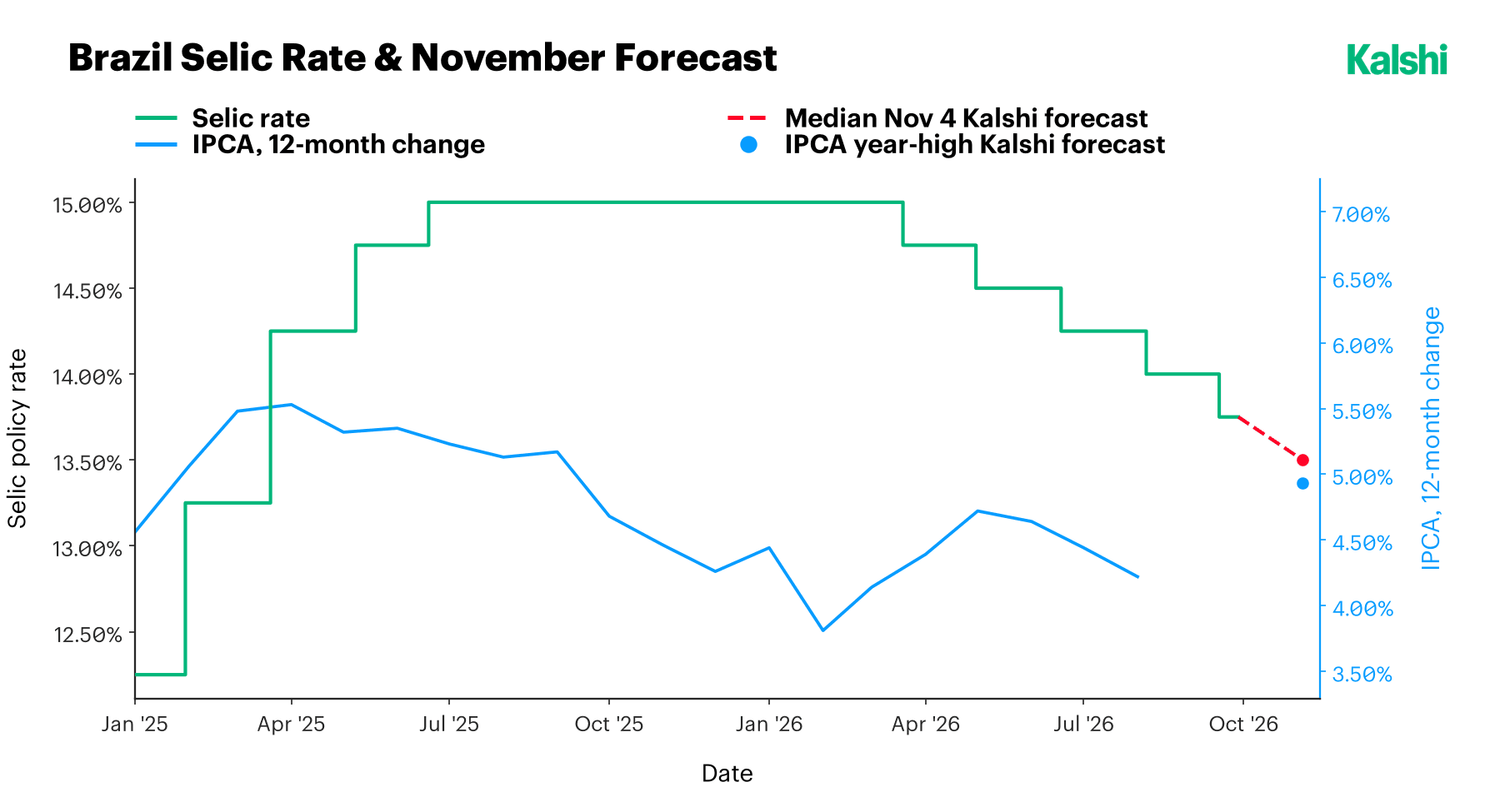
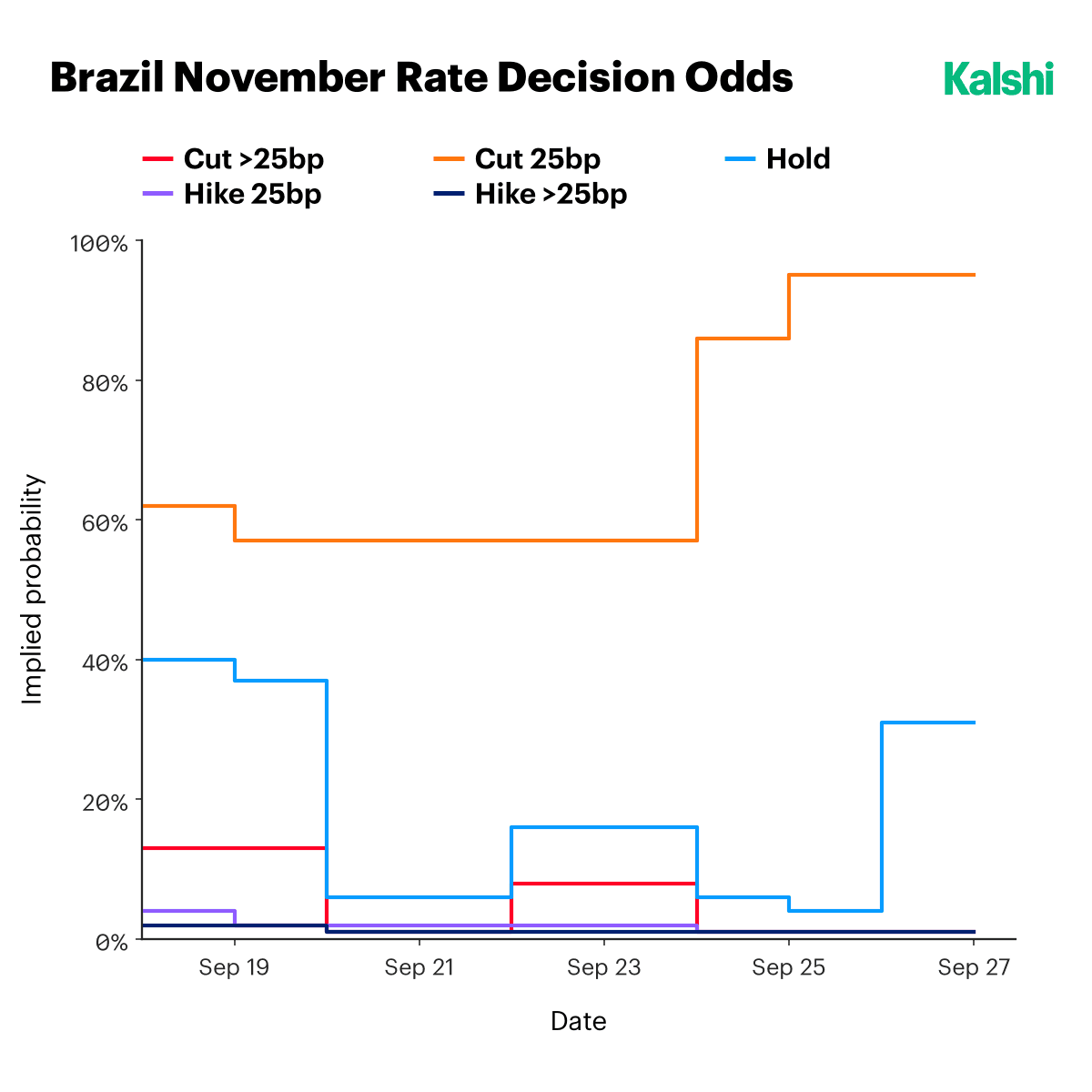
The next COPOM meeting on November 3–4 will be the first after the runoff. Our markets are pricing a 25bp cut at 95%, but the contract on a hold jumped to 31% over September 26–27. These contracts are separate and thinly traded at this stage, so we wouldn’t read too much into the exact numbers yet, but it does suggest some traders see the election as a real reason for the Copom to pause. If markets trust the winner on the budget, the central bank can keep cutting without the currency selling off. If they don’t, a weaker real pushes up import prices and inflation expectations, and cuts get harder to justify. Right now markets lean toward the first outcome with a Flávio Bolsonaro win and the second with a Lula win.
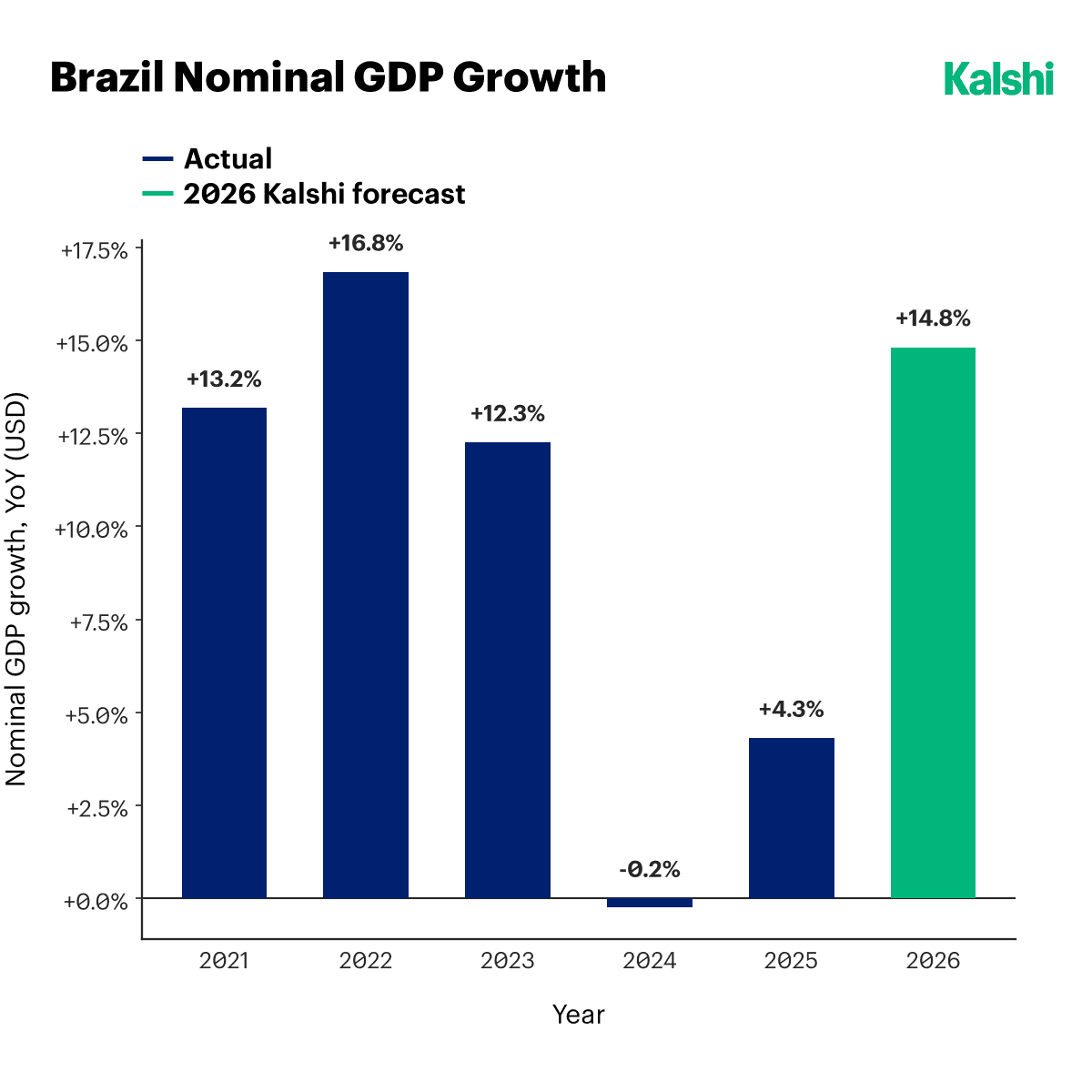
The currency is where all of this will show up first. Kalshi forecasts Brazil’s nominal GDP, measured in dollars, to grow 14.8% in 2026 after 4.3% last year. Only about half of that comes from actual growth and inflation. The rest is simply a stronger real, which is up about 5% this year to around 5.16 per dollar. That makes the dollar figure more a measure of how much Brazil weighs in global portfolios than of what the economy is producing, and it’s exactly what would take the first hit if markets sour on the fiscal outlook after October 25.
Mapping The Road Ahead
The next five weeks deliver three votes and one rate decision in quick succession.
- September 29: PNAD labor data (quarter to August). We price unemployment at 5.2%. Another record low reinforces Lula’s economic message, though weak income growth may moderate it.
- October 1: TV Globo presidential debate. The last debate before the first round, with Lula, Flávio Bolsonaro, Cury, and Caiado invited. Flávio Bolsonaro has now confirmed attendance, offering a direct challenge to his political rival. A strong showing from either man matters most for the 12% or more of the vote held by the minor candidates.
- October 4: First round, Congress, and governors. Watch Lula’s first-place margin (Kalshi: 56% for a zero-to-five-point lead) and the combined right-of-center share. A Lula lead of more than five points would challenge the runoff pricing; a narrow one would confirm it. Senate and Chamber results arrive the same night and will settle much of the post-election governability question.
- October 25: Presidential and gubernatorial runoffs. The decisive vote.
- Late October: Petrobras third-quarter production report. Kalshi’s market expects a record 3.40 million barrels per day, confirming the extractive sector as the main source of growth heading into 2027.
- October 30: PNAD labor data (quarter to September). The last labor print before the Copom decision.
- November 3–4: Copom meeting. The first rate decision with the election result known. A 25bp cut to 13.50% is the modal outcome at 95%, but the rebound in the hold contract suggests the result itself could still change the call.
Our markets are showing us that the October 4 result is less informative than it may appear on face. Lula is likely to finish first, and that will be widely reported as a Lula win. The more important numbers that night are the margin, the size of the minor-candidate vote, and the composition of the new Senate. After October 25, the question shifts from who won to whether markets believe the winner can shrink an 8.67%-of-GDP interest bill. Kalshi’s continuously updating contracts on the runoff, the Copom, and the macro prints will be among the fastest places to see that judgment form.
About Kalshi Research
Signal-rich analysis of prediction markets. Questions, data access (currently free for institutional clients), or collaboration: research@kalshi.com
Disclaimer
This report is published by Kalshi Inc. (“Kalshi,” “we,” or “us”) for informational and educational purposes only. It is not investment, legal, tax, or trading advice, and it does not constitute a recommendation or solicitation to buy, sell, or hold any event contract, security, or other financial instrument. Nothing in this report creates a fiduciary, advisory, or professional-client relationship between Kalshi and the reader.
Kalshi operates a CFTC-regulated exchange. The event contracts and forward curves referenced herein are traded on or derived from Kalshi’s platform. The market prices, forward curves, and implied probabilities cited in this report reflect what market participants thought at a given moment; such data is subject to change without notice. These figures are not guarantees or predictions of actual outcomes. Past and current prices do not indicate future results. Data sourced from third parties is believed to be reliable but has not been independently verified. Third-party projections and estimates cited herein are subject to significant uncertainty and may not be realized.
Trading event contracts carries risk, including the risk that you may lose some or all of your invested capital. Event contract outcomes are binary and can result in the total loss of the amount paid for a contract. Every figure and probability here is current only as of the date of publication. Kalshi undertakes no obligation to update, revise, or correct this report after publication.
Kalshi, its affiliates, officers, directors, and employees may have financial interests in the contracts or markets discussed herein and may trade them at any time without notice to readers.
This report is not directed at any person in any jurisdiction where its distribution or the offering of event contracts would be contrary to local law or regulation. Before acting on anything in this report, consult your own independent legal, tax, financial, or other professional advisor.
This report is not insurance advice and does not constitute a recommendation regarding the purchase, renewal, or cancellation of any insurance policy or program. Comparisons between event contracts and insurance products are illustrative only and do not account for differences in regulatory protections, counterparty credit risk, claims processes, coverage scope, or policyholder rights that may apply to traditional insurance. Readers should consult a licensed insurance professional before making decisions about their insurance or risk-transfer arrangements.
Get new Kalshi Research publications and insights as they are released.