
Global Macro Roundup
Published August 24, 2026
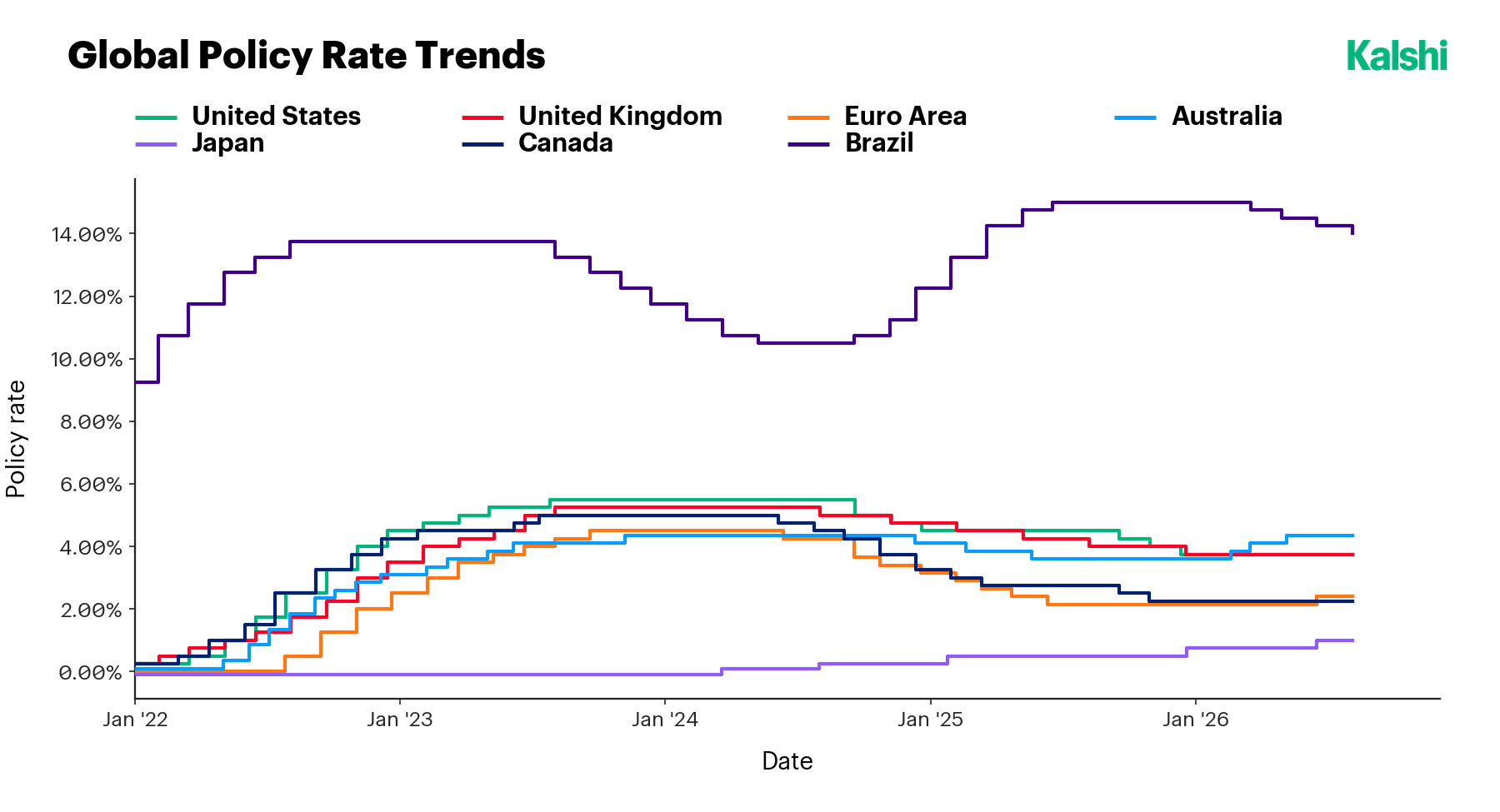
Download PDF- Central banks have split along energy and dollar exposure. Japan and the Euro Area are priced to hike in September because a weak currency is compounding an energy shock; the U.S., UK, Canada, and Australia are priced to hold; Brazil to cut.
- Yen defence shows policy has moved into currency markets. Bessent’s Treasury has already run an $85bn intervention to defend the yen – the natural funding currency for global carry trades. A September hike may drive a carry unwind that is worth watching.
- Brazil’s election has taken centre stage. Six weeks out, the Selic stands out as a fiscal-credibility instrument likely to come under scrutiny as polls open.
Interest rate decisions don’t exist in a vacuum. Outside of repricing borrowing costs, decisions and expectations around monetary positioning bleed into FX – both domestically and internationally.
The mechanism underneath all of this is simple: money moves toward wherever it earns the most, adjusted for risk. When a central bank raises rates, or is expected to, holding that country’s bonds and deposits pays more, so investors bid up the currency to get exposure to that higher return; when a central bank cuts, or turns dovish, the opposite happens and the currency tends to cede ground, all else equal. That single piece of logic is what connects an interest-rate decision in Washington to an exchange rate move in São Paulo, and it runs in both directions, which is why a Fed on hold doesn’t just leave U.S. rates unchanged, it changes the incentive every other central bank discussed here is responding to.
Japan is the cleanest illustration. Rates there remain the lowest among developed markets, which has kept the yen the default funding leg for carry trades globally. That’s not just a domestic issue; Japan is also the largest foreign holder of Treasuries, so a disorderly yen move forces unwinds that spill into dollar assets. The Fed doesn’t want that spillover any more than the BoJ does. It’s the reason Bessent’s Treasury ran an estimated $85 billion intervention to defend the yen rather than let it move freely.
In parallel, there exists another channel: a weaker currency raises the local-currency cost of imported energy on top of whatever international commodity pricing is already doing globally. That turns a commodity move into a larger inflation problem than the headline price suggests. It’s a real part of why the BoJ and ECB are leaning toward hikes that domestic conditions alone might not justify, and why FX intervention has come back into the toolkit rather than sitting as a 1990s relic.
Calibrated by individual exposure, then, we’re beginning to see divergence in major central bank treatment of policy decisions.
New Kalshi Research, straight to your inbox.
Central Banks Are Splitting Along the Fault Line of Energy and the Dollar
September rate decisions read less like a single global cycle and more like three separate stories. Japan and the Euro Area are priced to hike; the U.S., UK, Canada, and Australia are priced to hold; and Brazil is priced to cut. The common thread across the hikers is energy: both economies import a large share of what they burn, so the local-currency cost of that energy is a function of the global price and the exchange rate together. A weak yen / soft euro actively compounds the external shock into a domestic one, leading to hawkish expectations.
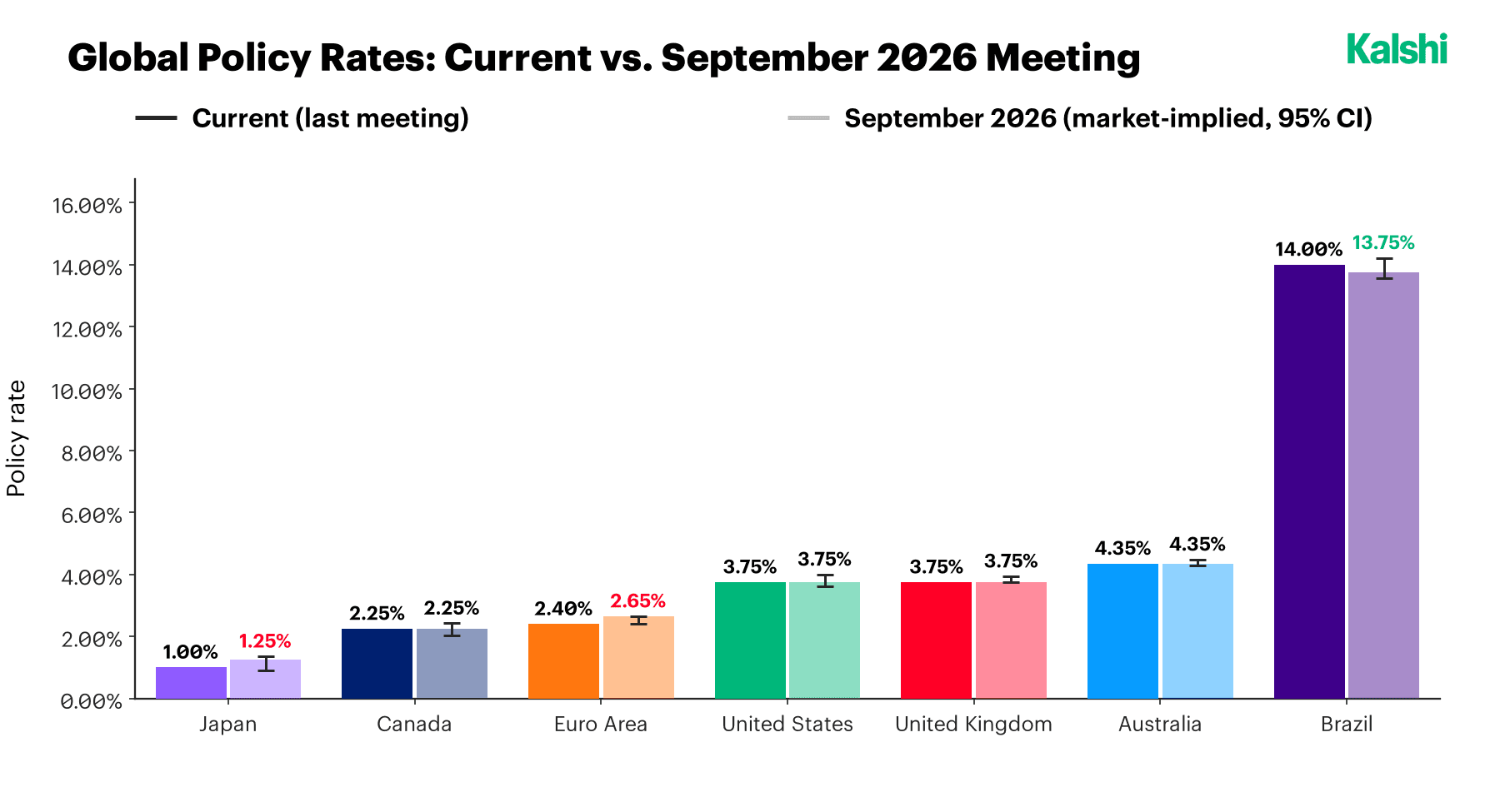
The Bank of Japan’s case has firmed the most. Core inflation reaching 1.8% in July, against a currency that has stayed weak, has pushed the market-implied hike probability from 60% in early August to roughly 85–90% now – a policy rate that would still sit at just 1.25%, but represents a meaningful move for an institution that spent a decade at zero. The ECB’s hike (2.40% → 2.65%) is smaller in relative terms but no less energy-driven. Against that, the English-speaking bloc’s hold conviction is uniformly high – above 90% for Canada, the UK, and Australia – with one exception: the United States.
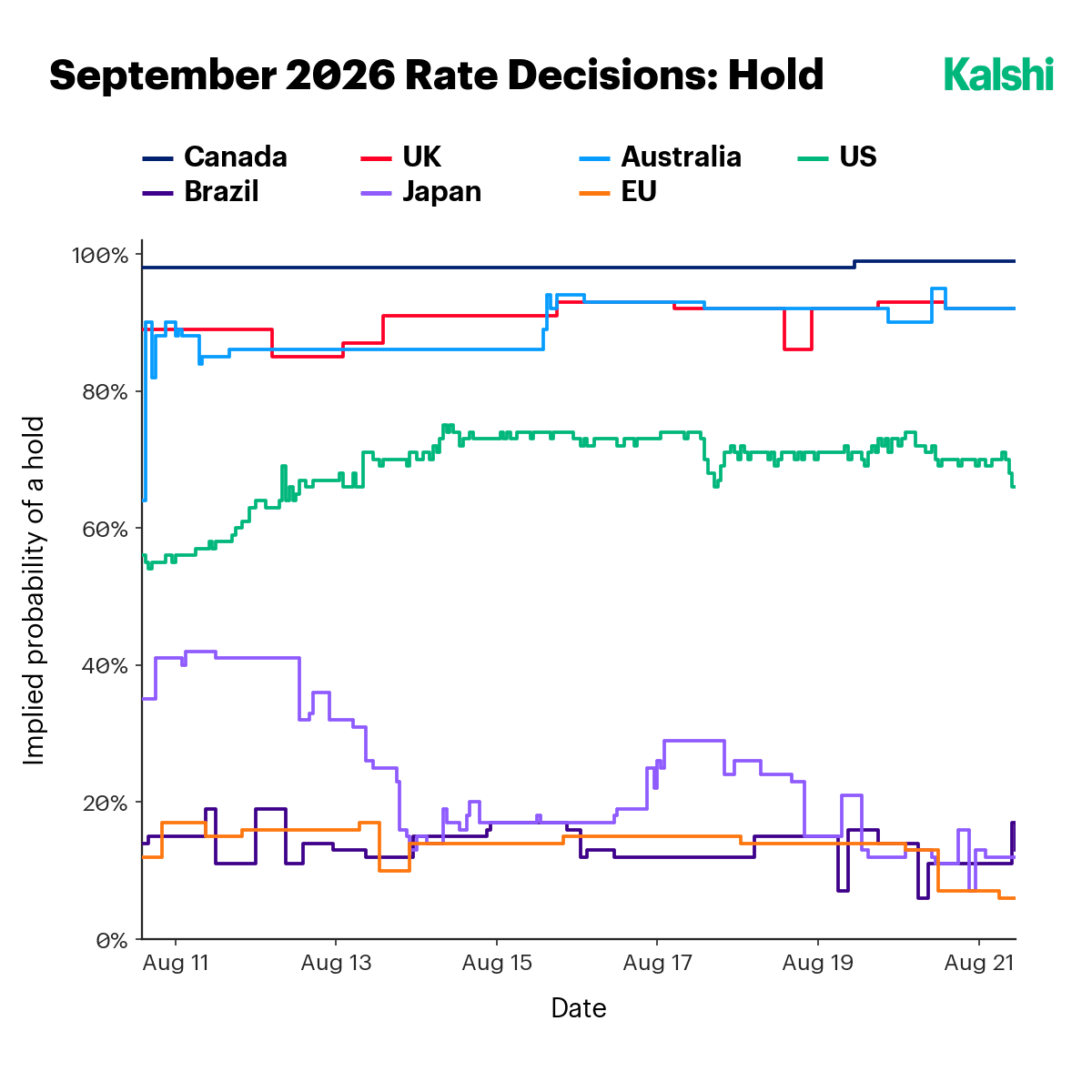
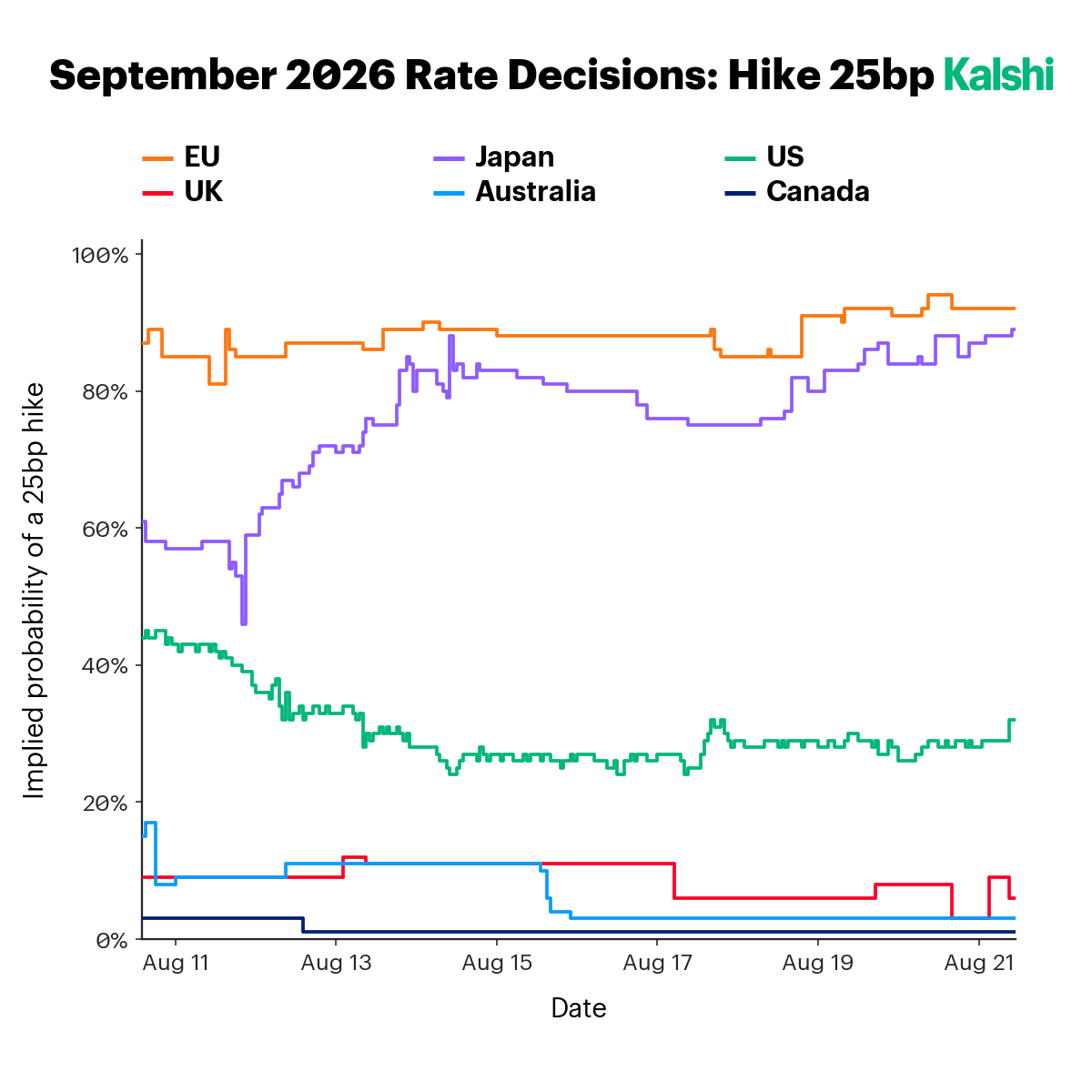
Kalshi markets are pricing a 68% probability of a hold against 31% for a hike in the United States: a materially wider spread than anywhere else in the developed world, and one that tracks the Fed’s own internal division more than it tracks the incoming data (more on this below). Brazil sits at the opposite pole entirely: COPOM is priced to cut 25bp (14.00% → 13.75%) as both inflation and activity cool, the one economy in this set easing rather than defending.
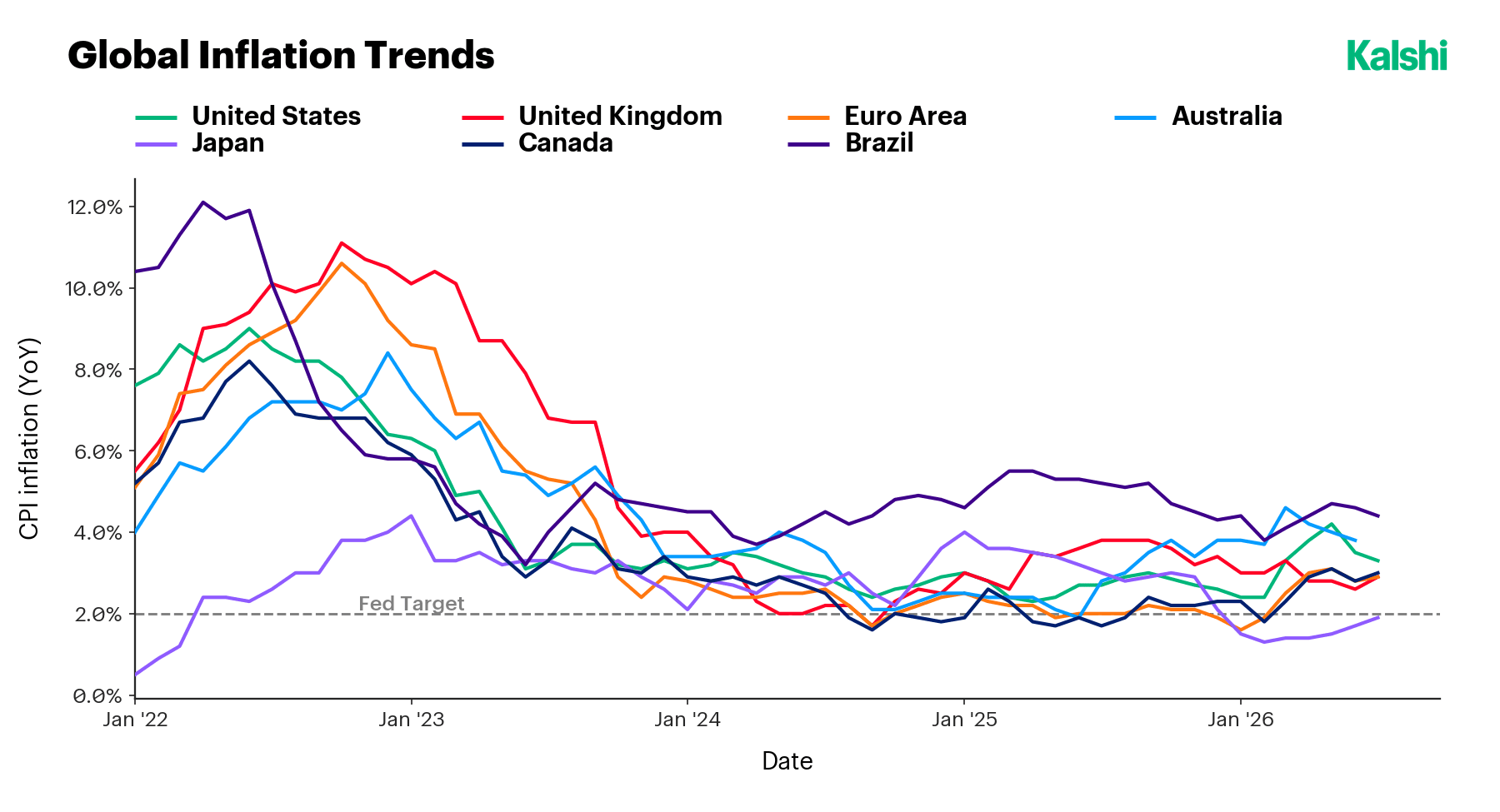
The U.S. Has Stopped Leading This Cycle, and That Has Consequences for Who Moves Next
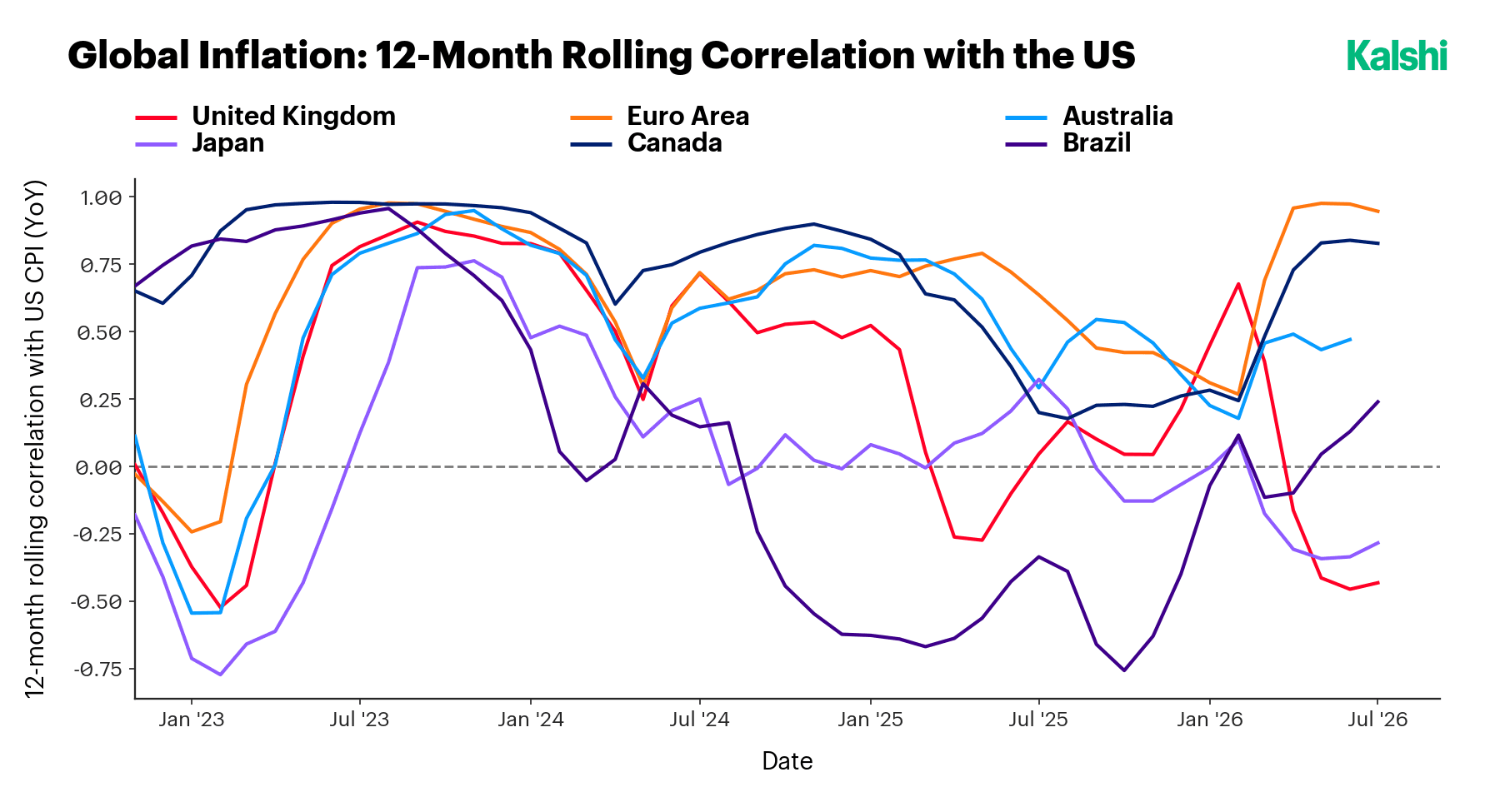
For most of the last four years, the U.S. set the pace for developed-market inflation and the rest of the world followed with a lag. The current re-acceleration breaks that pattern. Energy dependence, not historical lead-lag, is now appearing as the better predictor of who moves first. Japan, Australia, and the Euro Area have all been pushed toward hikes ahead of the U.S. this cycle, a reversal of the usual order.
The correlation data shows the same fracture from a different angle. The 12-month rolling correlation between U.S. CPI and the rest of the developed world spiked above 0.9 through most of 2023, when the post-pandemic inflation wave hit every economy in sync. That relationship has since come apart: the Euro Area and Canada remain tightly coupled to the U.S. cycle, with correlations near 0.85–0.97, while the UK and Japan have gone the other way entirely, running negative at roughly -0.5 and -0.3. Their inflation is now a domestic and currency story more than a shared one.
A Fed Hold Still Moves the World, Just Not Evenly
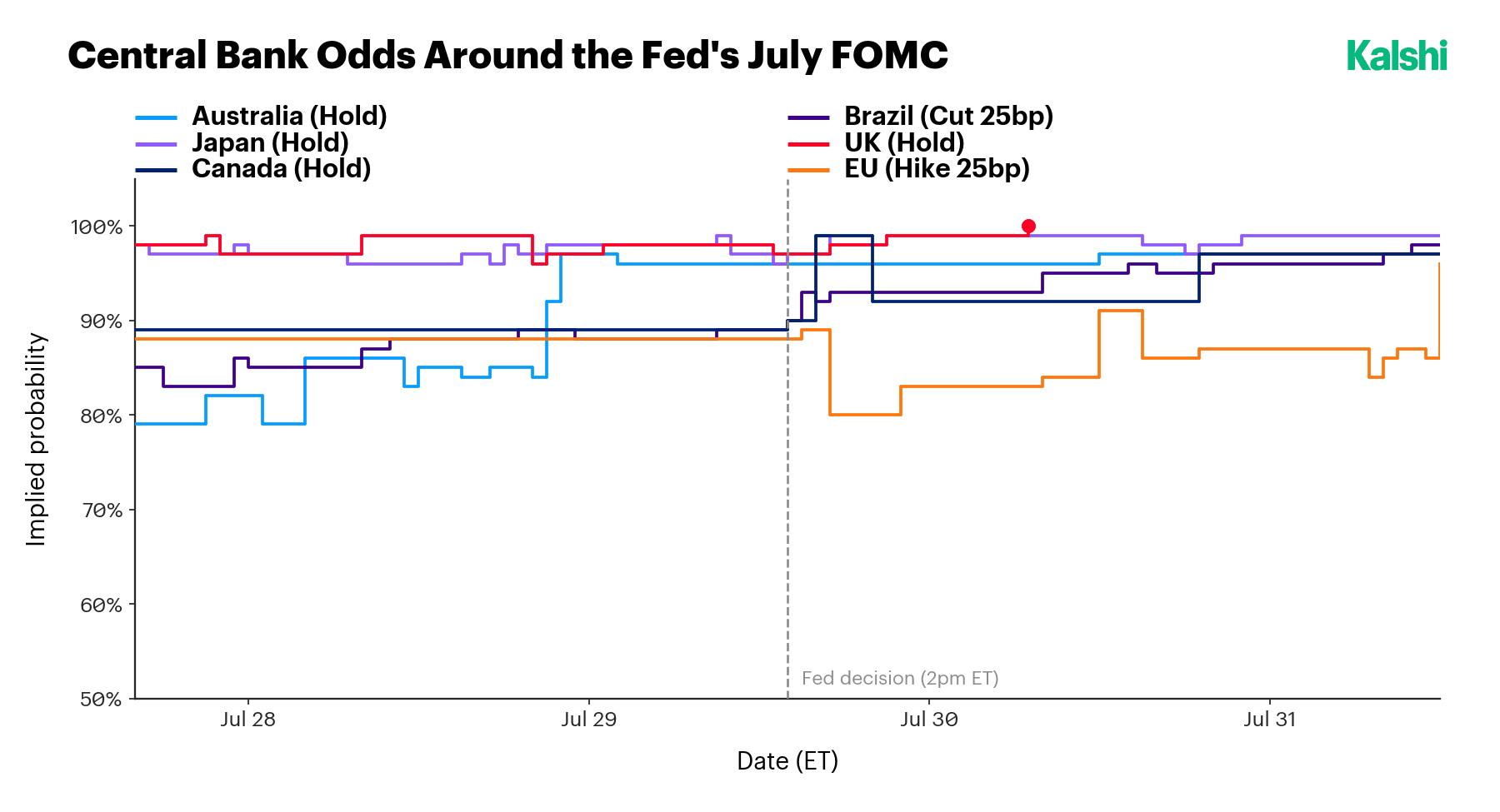
The Fed’s July 29 decision was a clean test of how much the dollar and rate-differential channel still matters, because the decision itself was close to fully priced, but the signal inside it appeared not to be. Three regional presidents (Cleveland’s Hammack, Minneapolis’s Kashkari, and Dallas’s Logan) dissented in favor of a hike, the most regional dissents in a single direction since September 2016. A dovish headline with a hawkish undertone still moved both rates and currencies meaningfully.
On the rates side, a Fed that isn’t hiking gives other central banks room to hold their own ground without inviting currency instability. Canada, Australia, and Brazil’s own hold or cut probabilities all firmed immediately after the decision. Canada’s hold jumped from roughly 89% to 97%, Brazil’s cut probability from roughly 92% to 98%. The ECB moved the other way, its hike odds dipping modestly right after the decision (from roughly 89% to 81%) before drifting back up over the following days, a sign the Euro Area’s hike case is being driven more by its own energy and inflation dynamics than by anything happening in Washington.
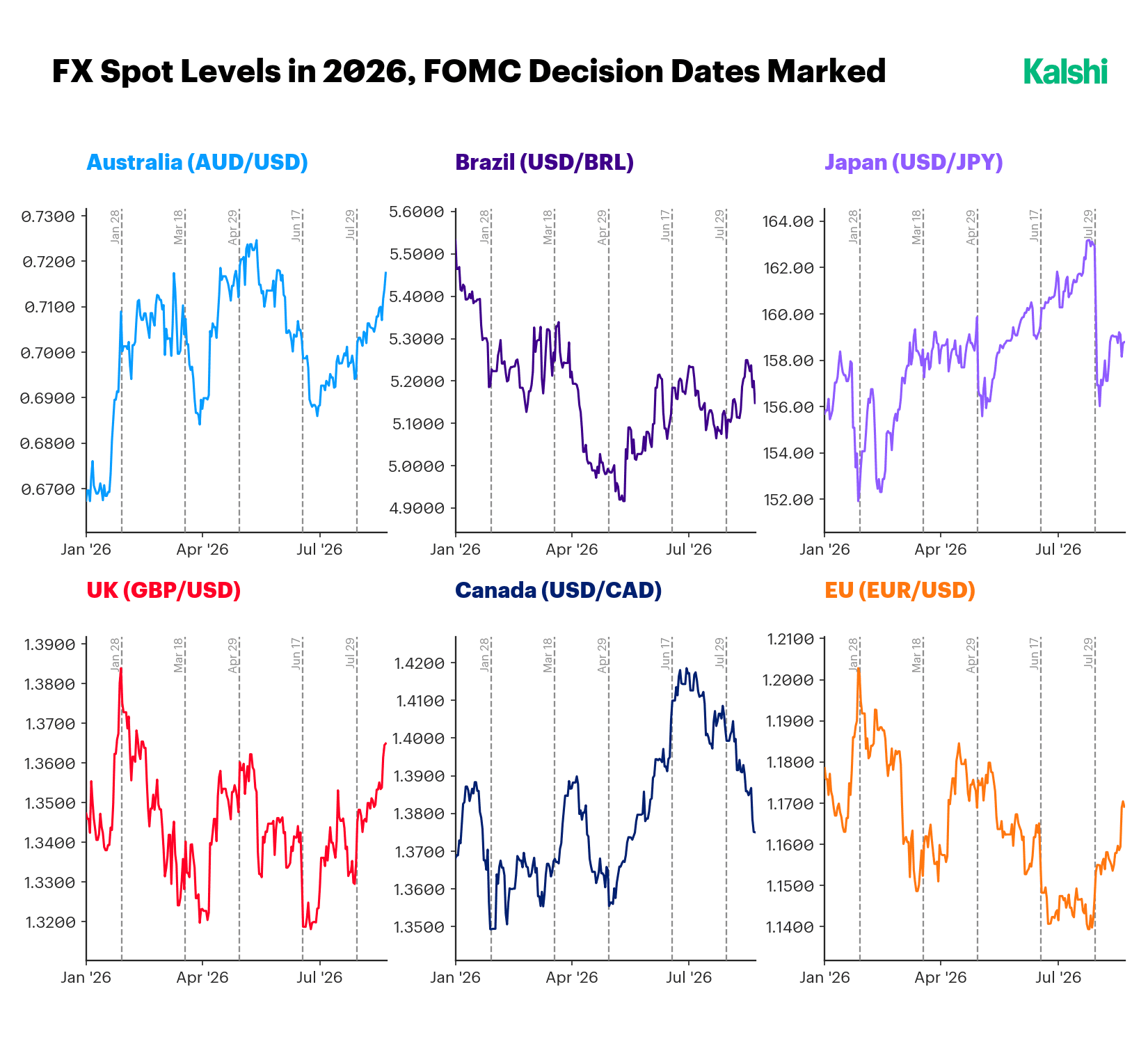
The currency reaction was broader still. In the 24 hours after the decision, the dollar weakened against AUD, GBP, EUR, JPY, and BRL alike, with the yen move the largest; USD/JPY fell roughly 3%. The Canadian dollar was the one exception, with USD/CAD actually firming close to 1% over the same window, a reminder that a strengthening domestic hold narrative can dominate a broader dollar move for an individual currency.
Enjoying this? Get our next piece of research as soon as it's out.
Zooming in on LATAM: The Brazil Story
Brazil is the clearest place in this cycle to watch the rate-currency feedback loop run in both directions. COPOM’s resolved August 5 cut is the anchor: Kalshi’s implied probability of that 25bp cut climbed from around 80% in late July to a near-certain ~100% heading into the decision. Over that same window, USD/BRL didn’t fall, as one might expect if a rate cut simply reflected good disinflation news, it rose, with the real weakening from roughly 5.10 into the 5.15–5.20 area as the cut became a certainty.
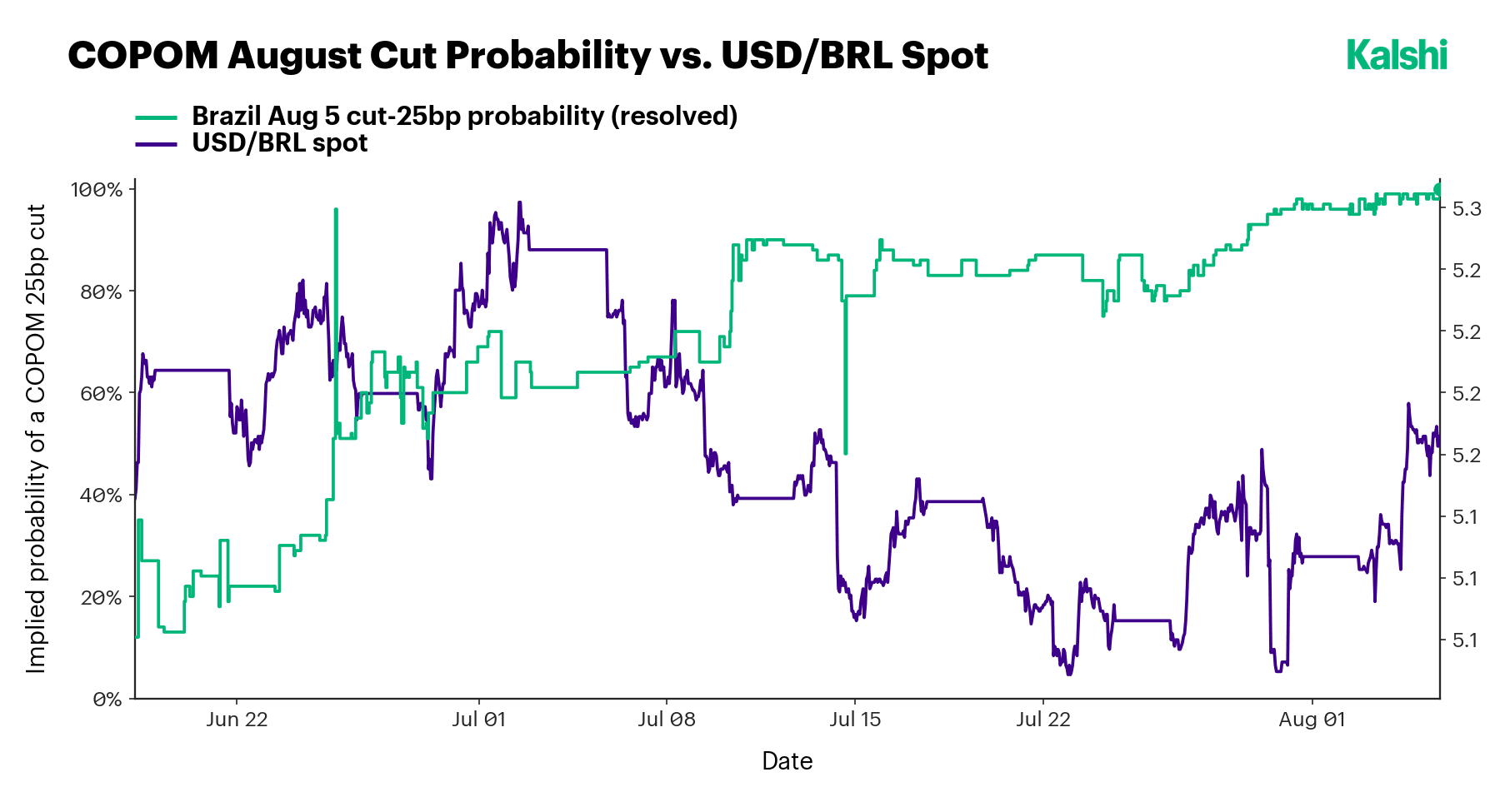
That’s the carry channel in isolation. A lower Brazilian policy rate narrows the yield pickup investors get for holding the real over the dollar, so the currency cedes ground even as the underlying macro backdrop improves. And the backdrop has genuinely improved: Brazil’s own peak inflation expectations have fallen hard over the same period, from a high near 6.05% in late June to roughly 4.9% today.
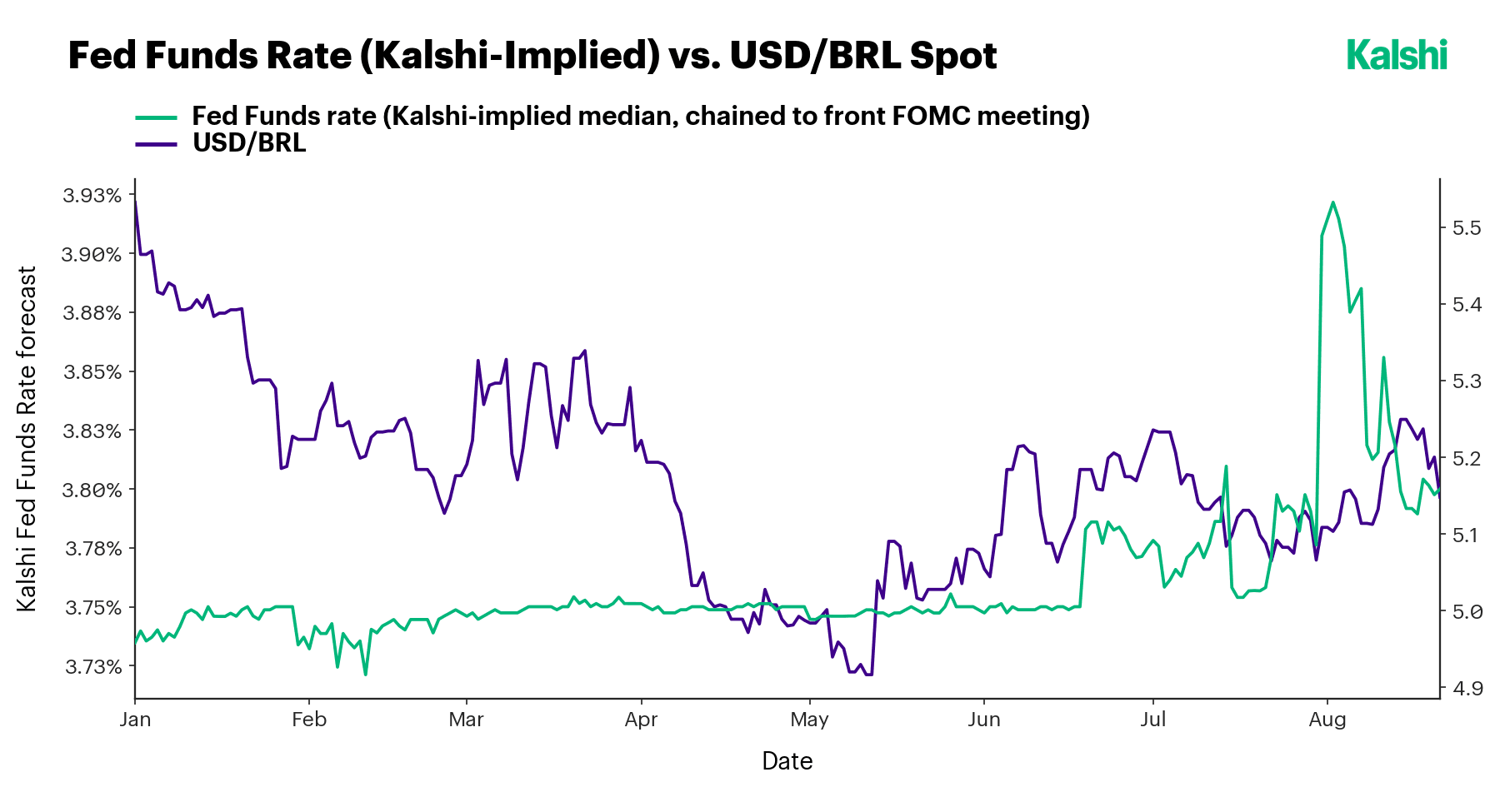
The real is also exposed to the other side of the equation: what the Fed does, not just what COPOM does. Kalshi’s Fed-hike-probability series shows a clear reaction around the July CPI release: the implied September hike probability ticked up and USD/BRL jumped from roughly 5.05 to above 5.25 in the days that followed, before both series partially retraced. A hotter-than-expected U.S. inflation print doesn’t have to change anything about Brazil’s own trajectory to still weaken the real, it only has to raise the odds the Fed stays higher for longer, narrowing the rate advantage BRL offers.
There is another variable in Brazil’s currency math that the carry and Fed channels above don’t capture on their own: the first round of Brazil’s presidential election is six weeks away, on October 4, with a runoff on October 25 if no candidate clears 50%, which has happened in every Brazilian presidential race since 2002. President Lula is seeking an unprecedented fourth term at 80; his main challenger is Senator Flávio Bolsonaro, standing in for his father Jair, who was convicted of plotting a coup after the 2022 election and is barred from running. Kalshi’s election market currently prices Lula’s re-election at 63%, Flávio Bolsonaro at 36%, and minor right-wing candidate Renan Santos at under 3%.
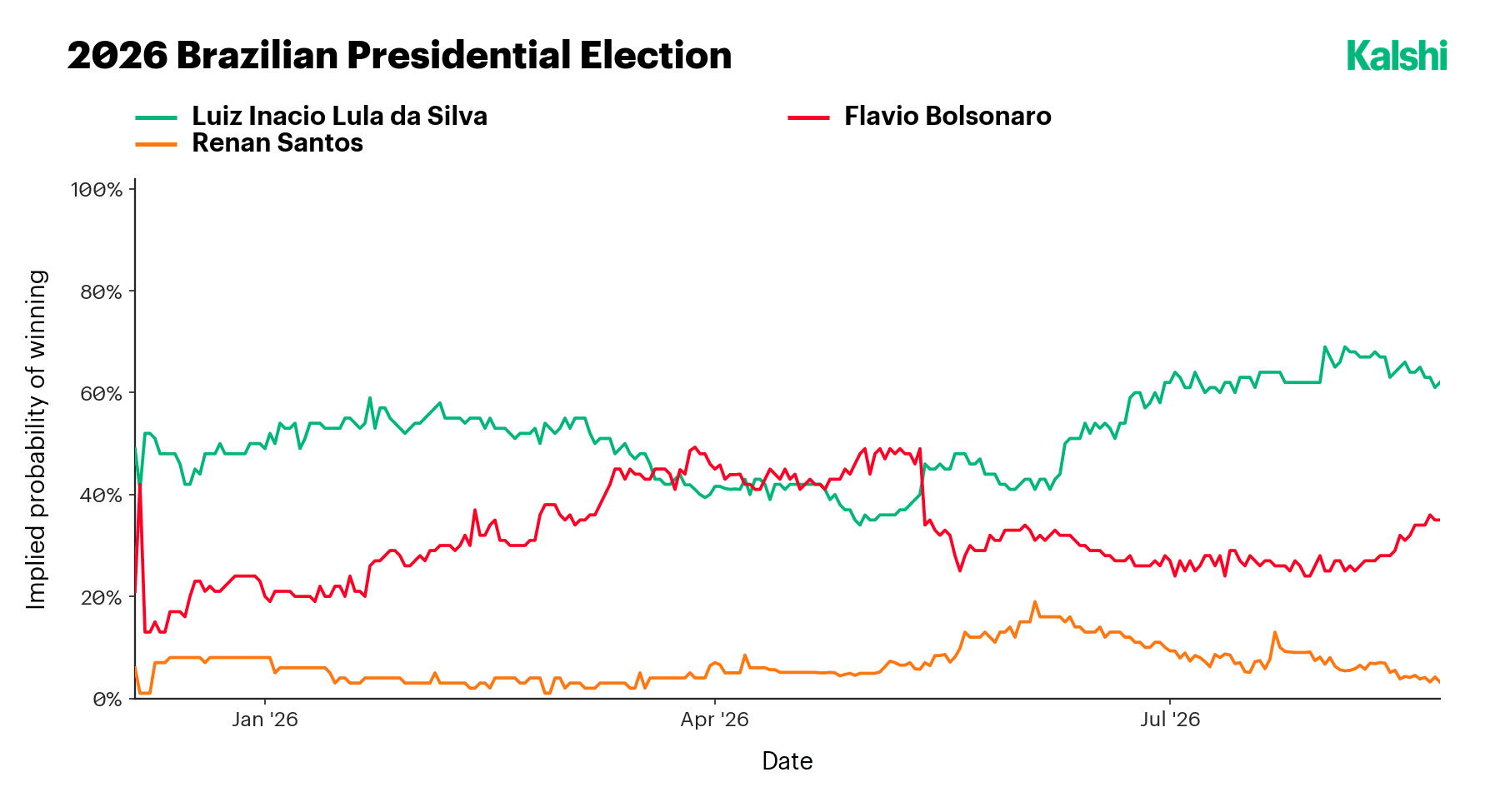
This matters for the currency because Brazil’s policy rate has been doing double duty all year: fighting inflation and defending fiscal credibility at the same time. COPOM held the Selic at 15% for an extended stretch before beginning to ease, and its own communication has framed the restrictive stance explicitly in fiscal terms: policy stays tight until credibility strengthens, not just until inflation prints improve. The current administration’s roughly R$144 billion package of new electoral-year spending measures, announced earlier this year, was read by markets as exactly the kind of fiscal slippage that keeps that risk premium elevated. A change in government is the outcome most likely to compress that premium, tightening sovereign spreads and offering the real room to strengthen, while a Lula re-election is viewed as the known quantity, carrying the same fiscal-slippage risk that has kept real rates high all year. That framing cuts both ways, and worth noting is that Flávio Bolsonaro himself has not been received by markets as a clearly reform-oriented alternative in the way a candidate like São Paulo governor Tarcísio de Freitas would have been, had he entered the race.
Practically, this means the BRL path between now and late October is more likely to be driven by polling swings and fiscal-package headlines than by the rate-differential mechanics we laid out above. A polling shift toward Lula, all else equal, should be read as fiscal-risk-premium-supportive for USD/BRL. This is not because a fourth Lula term is a bad outcome on its face, but because markets have already spent a year pricing it as the continuity case. A tightening race, or a strong debate performance from Bolsonaro, would be the more likely trigger for the kind of real rally that rate cuts alone haven’t been able to deliver. We’d treat the next two Kalshi election-market moves as a more reliable near-term signal for USD/BRL than the next COPOM decision itself.
The Calendar Ahead Will Tell Us Which Story To Believe
This week’s releases are a direct test of the framework above, not a separate story. Canada’s GDP print lands against a central bank already priced for a comfortable hold; a soft number reinforces that view, while a strong one tests the ~97% hold conviction currently priced. EU consumer confidence and Japan’s consumer confidence and unemployment data will help separate resilient domestic demand from pure energy and currency pass-through in each hiker’s case. This distinction determines whether September is the start of a cycle or a one-off adjustment. UK housing prices test how much of the BoE’s hold conviction can survive a housing-driven demand impulse. Brazil’s own unemployment and inflation data are the next checkpoint before markets fully price COPOM’s easing path continuing past August. And Australia’s inflation print, where consensus already expects a sizeable decline, is the most direct test of whether the recent break lower is durable enough to keep the RBA on hold into year-end.
Layered on top of all of it, Chair Warsh’s preference for shorter statements and less forward guidance means more of the Fed’s own reaction function has to be read through dissents, positioning, and market pricing rather than the text itself, which is exactly the environment continuously-updating, real-time markets like ours are built for.
About Kalshi Research
Signal-rich analysis of prediction markets. Questions, data access (currently free for institutional clients), or collaboration: research@kalshi.com
Disclaimer
This report is published by Kalshi Inc. (“Kalshi,” “we,” or “us”) for informational and educational purposes only. It is not investment, legal, tax, or trading advice, and it does not constitute a recommendation or solicitation to buy, sell, or hold any event contract, security, or other financial instrument. Nothing in this report creates a fiduciary, advisory, or professional-client relationship between Kalshi and the reader.
Kalshi operates a CFTC-regulated exchange. The event contracts and forward curves referenced herein are traded on or derived from Kalshi’s platform. The market prices, forward curves, and implied probabilities cited in this report reflect what market participants thought at a given moment; such data is subject to change without notice. These figures are not guarantees or predictions of actual outcomes. Past and current prices do not indicate future results. Data sourced from third parties is believed to be reliable but has not been independently verified. Third-party projections and estimates cited herein are subject to significant uncertainty and may not be realized.
Trading event contracts carries risk, including the risk that you may lose some or all of your invested capital. Event contract outcomes are binary and can result in the total loss of the amount paid for a contract. Every figure and probability here is current only as of the date of publication. Kalshi undertakes no obligation to update, revise, or correct this report after publication.
Kalshi, its affiliates, officers, directors, and employees may have financial interests in the contracts or markets discussed herein and may trade them at any time without notice to readers.
This report is not directed at any person in any jurisdiction where its distribution or the offering of event contracts would be contrary to local law or regulation. Before acting on anything in this report, consult your own independent legal, tax, financial, or other professional advisor.
This report is not insurance advice and does not constitute a recommendation regarding the purchase, renewal, or cancellation of any insurance policy or program. Comparisons between event contracts and insurance products are illustrative only and do not account for differences in regulatory protections, counterparty credit risk, claims processes, coverage scope, or policyholder rights that may apply to traditional insurance. Readers should consult a licensed insurance professional before making decisions about their insurance or risk-transfer arrangements.
Get new Kalshi Research publications and insights as they are released.