
Hedging Sports Risk: A World Cup Case Study
Published July 23, 2026
Download PDFBy 2050 the total value of the sports industry is expected to top $8.8 trillion. As it grows, the financial exposures of participants, sponsors, and hosts grow in parallel. Both pricing and mitigating such risks has traditionally been expensive, and in many cases, impossible. Kalshi markets provide an accessible alternative with both deep pools of liquidity and well-calibrated forecasts that offer the potential for a 16.5–50% cost saving on existing risk hedging channels.1
New Kalshi Research, straight to your inbox.
The 2026 FIFA World Cup was the biggest financial event that sports has seen to date. Fox and Telemundo paid $1 billion for broadcasting rights combined, companies spent $10.5 billion on ad placements, and 6.8 million fans watched live from stadiums across the U.S., Canada, and Mexico, a World Cup attendance record. The GDP impact of the event was projected by analysts to be $40.9bn across the three host nations, and Kalshi markets transacted over $27bn on the World Cup alone – entirely unlevered.
An event this large carries both significant financial upside opportunity and substantial exposures. FIFA took in roughly $15bn, double its Qatar haul, against 500 million ticket requests and a ~2 billion-viewer final; Fox cleared $200k–$300k per 30-second slot, spiking to $750k for late-stage US matches, with hydration-break inventory alone worth ~$250m. Locally, per the NYNJ Host Committee and Gov. Hochul’s office, New York fan spend hit $1.2bn in June against $2.1bn total impact, while CoStar showed NYC hotel revenue up 20.6% Y/Y and revenue per room up ~90% in Kansas City and 55% in San Francisco. But gains were lumpy and back-loaded: as late as April, 80% of US operators reported bookings below forecast, with Seattle and New York initially calling it a non-event. Host cities absorbed $100–200m each in infrastructure and security while FIFA retained ticketing and media revenue, leaving municipalities to recover costs indirectly, as with NJ Transit’s $98 round-trip to MetLife.
On the ground, top kit manufacturers recorded $500 million in team sponsorships. There, risk profiles looked binary: of the 12 teams that Nike sponsored, for instance, not one reached the final, which Adidas dominated.
Traditionally, risks related to sporting performance have been both difficult and expensive to hedge, largely taking the form of exotic products or outcome-contingent insurance. This means that brand sponsors have been left largely unprotected both from downside-risk (i.e. a sponsored team not making it to the final) and upside-risk (i.e. a sponsored team winning the championship and requiring a large lump-sum success-contingent payout).
Prediction markets offer binary contracts on match outcomes, total goals, group rankings, and individual player performance. This may serve as a direct hedge for performance-contingent liabilities. Sponsorship structures increasingly embed such contingencies: a boot deal (for Messi, let’s say) may trigger a $10m payment on a semi-final hat-trick, with further tranches on team game and/or tournament victory. These are not costs but probability-weighted exposures; a $10m obligation on a player priced at 5% to score in this way carries a mark of $500k pre-match, repricing on team news and fitness updates. The execution channel is material to cost. For a $10 million success-contingent payout obligation with a 5% assigned probability, insurers quoting 20%–100% margin imply an all-in cost of $600,000 to $1 million, compared to a prediction market’s $500,000 to $510,000.
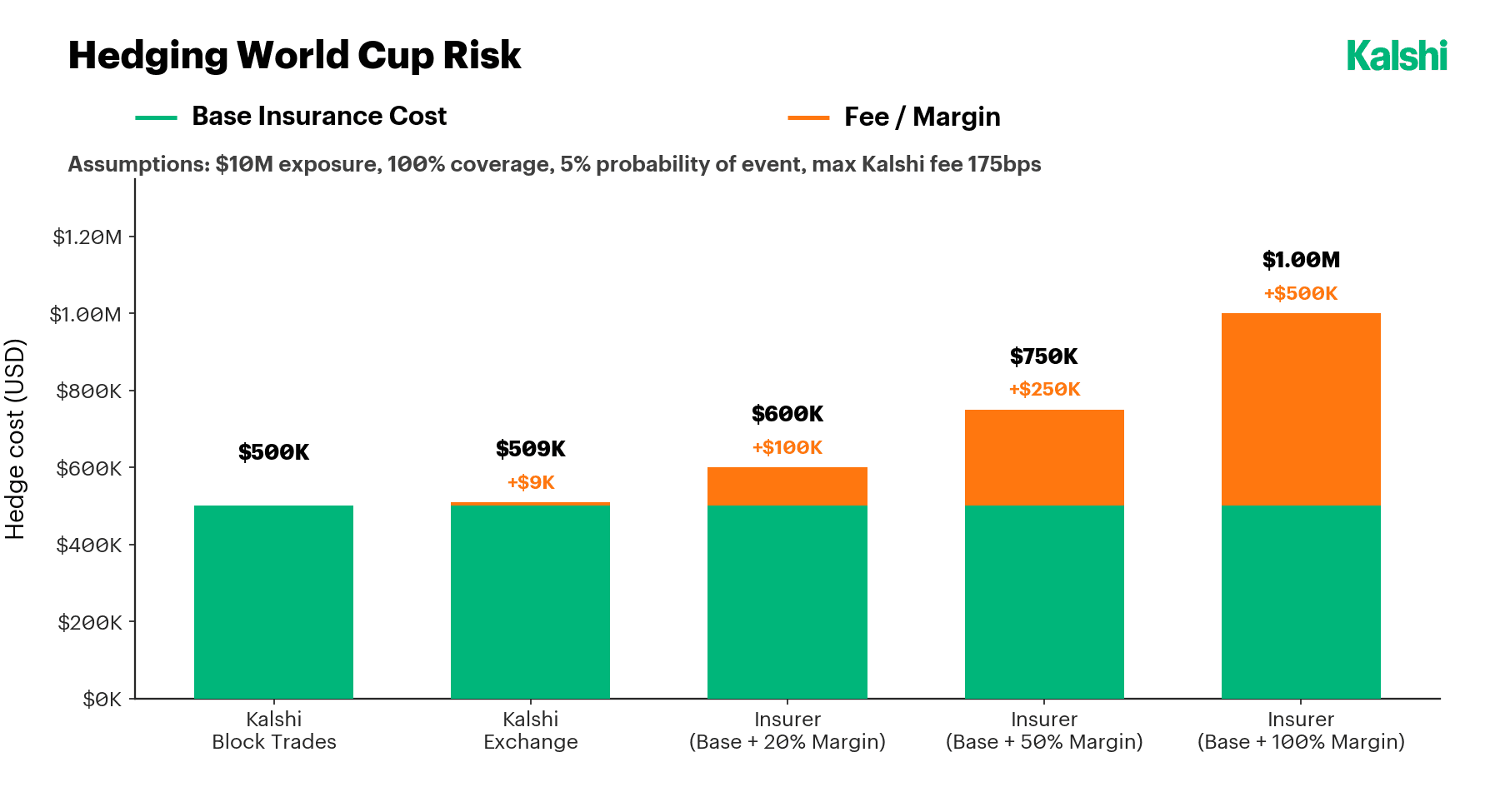
NB: The Exchange fee above represents the maximum fee levied at 50% probability. At 5% probability, this fee is lower, at 34bps.
The same dynamic extends to risks outside direct sporting outcomes – event delay or cancellation, and weather severe enough to affect stadium access or fan travel – which have historically carried few hedging options. Prediction-market contracts can be structured on a bespoke basis, tailored to specific dates, thresholds, or venues, rather than following the standardized terms of an exchange-listed insurance product. Block trades referencing prediction-market pricing currently carry no incremental trading fee, unlike the margin structure applied to traditional contingency insurance.
This World Cup, sportswear brand Forme and watch brand AxiaTime used Kalshi contracts to hedge their money-back promotions for specific team performance. Bars across D.C., Chicago, and San Francisco used Kalshi to hedge their promotional campaigns during several knockout games. In one case, a D.C. bar offered generous discounts to customers when the U.S.A beat Paraguay decisively. Axios reported that the bar had fully hedged out this outcome with Kalshi contracts that paid out at more than 10x odds.
Enjoying this? Get our next piece of research as soon as it's out.
Price Discovery on Kalshi
Independent of hedging, Kalshi markets provide high-fidelity baseline event probabilities. Kalshi featured more than 30,000 markets on the World Cup. They covered game outcomes, total goals, group rankings, and player performance. Across a sample of 32,997 World Cup markets, accuracy reached 85.7% one day before a game. By contrast, investing in the favourite for each market would have recorded a win-rate of 73.45%.
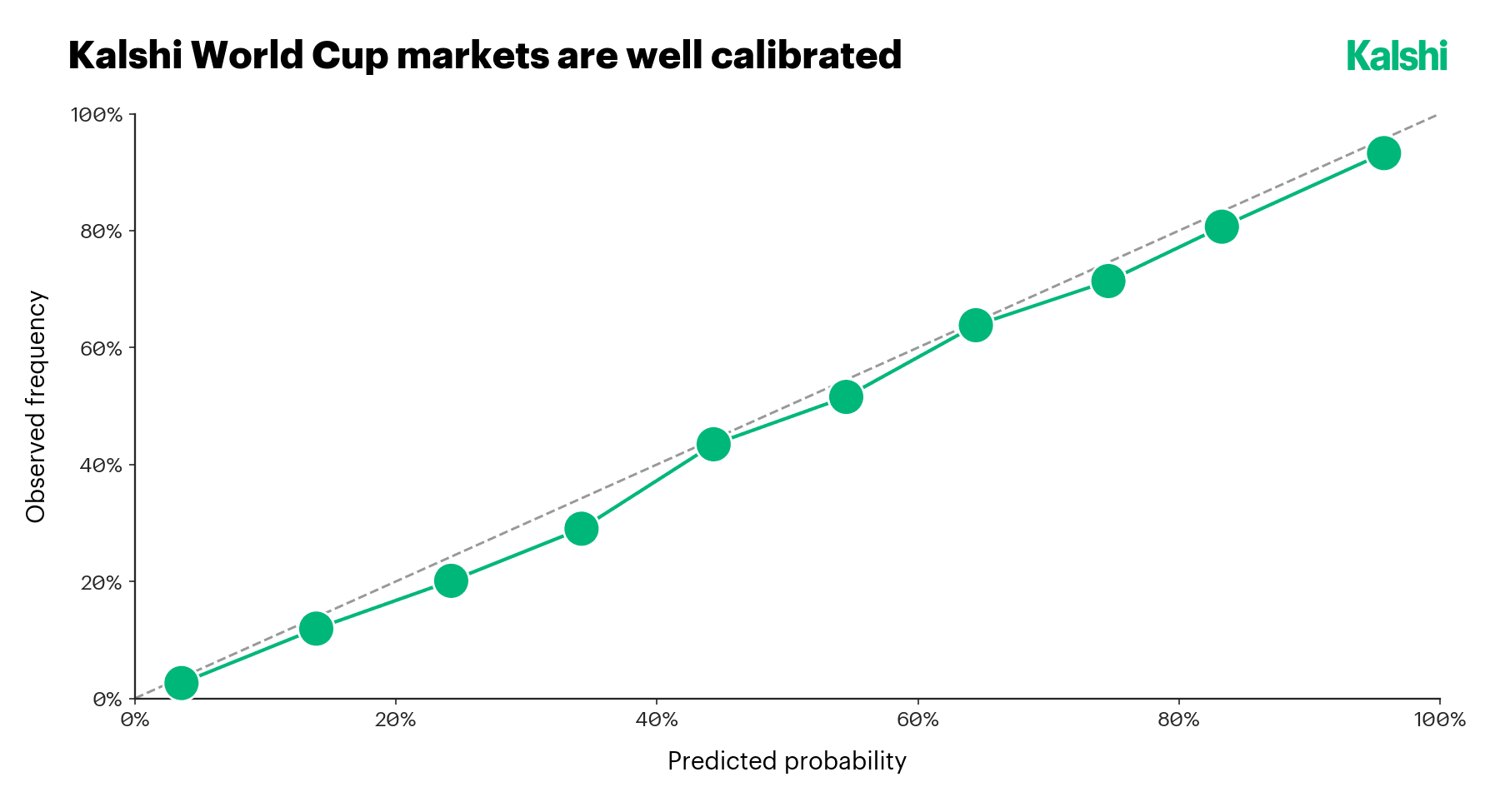
When assessing calibration – i.e. the idea that an event with 70% probability should happen 70% of the time – the predictive performance of Kalshi markets looked even better. The chart below shows how closely predicted probabilities tracked actual results. The calibration error, measuring the average distance between the predictions and the perfect 45 degree line that would represent an oracle forecast, was only 1.96% one day before a game, underlining Kalshi markets as a robust source for insurance price-basis, too.
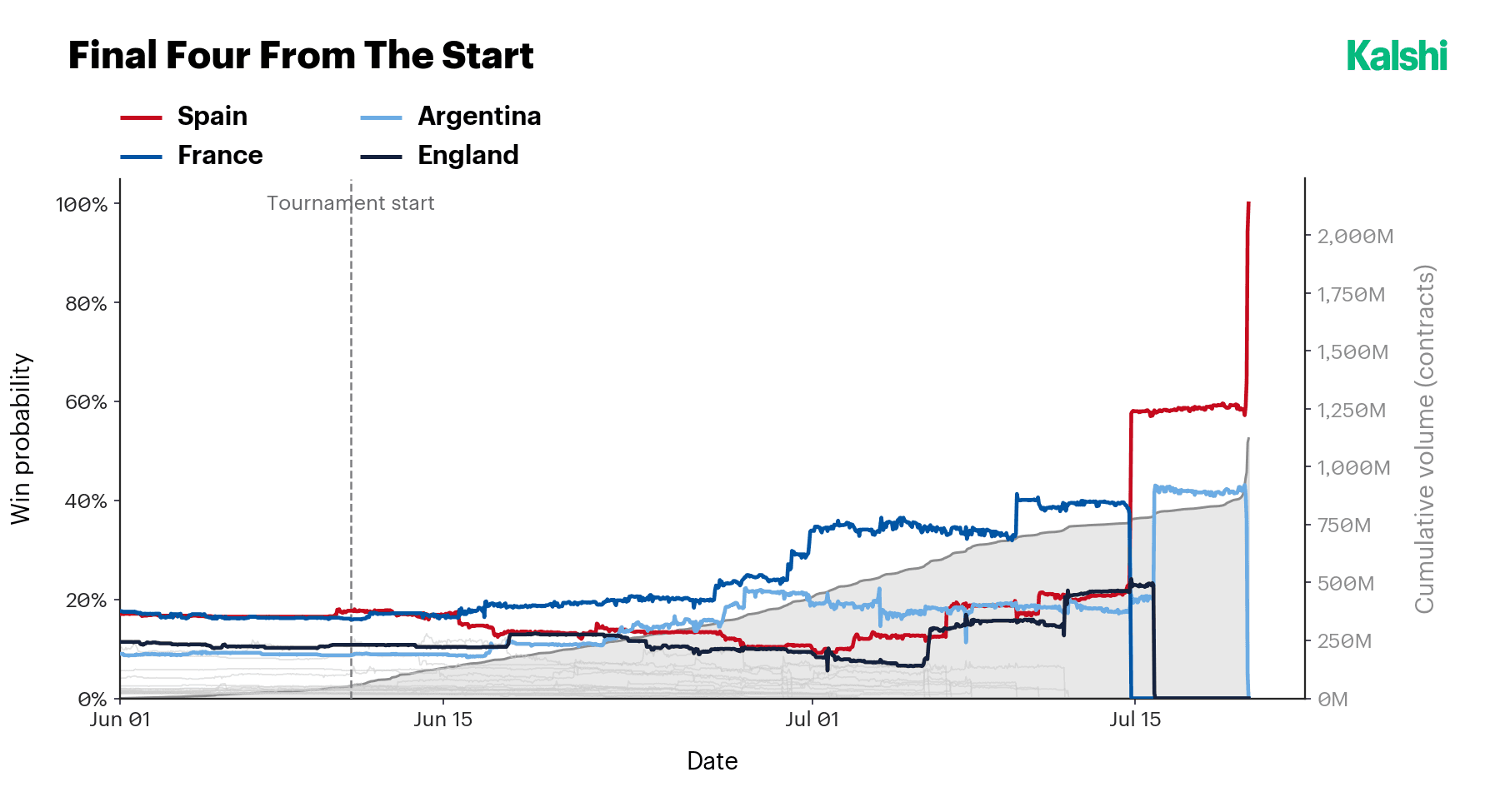
Zooming out to the start of the tournament, Kalshi markets correctly priced both the eventual tournament winner – Spain, but also the other three semi-finalist nations. Even at this stage, brands and corporations seeking partnerships would be able to access an indicative well-ranked read on tournament outcome.
The Economic Consequence of Sports
The World Economic Forum projects the global sports economy to reach $8.8 trillion by 2050, up from $2.3 trillion today. As the industry grows, prediction markets stand ready to offer a multi-billion-dollar liquidity pool to hedge sports-related economic risks. These markets have also proven to be accurate and well calibrated. The next major sports event is the US Open in August. The tennis tournament is expected to surpass last year’s 3 million viewers and $1.2 billion in economic activity. Kalshi already has markets on it, giving Jannik Sinner 54% odds of winning the trophy.
About Kalshi Research
Signal-rich analysis of prediction markets. Questions, data access (currently free for institutional clients), or collaboration: research@kalshi.com
Reference Material
- Goldman, David. "Was the World Cup Worth It?" CNN Business, July 20, 2026. https://www.cnn.com/2026/07/20/business/was-the-world-cup-worth-it
- Melville, Doug. "America's World Cup Notches a Record 6,810,966 Fans, Nearly Double Old Mark." Forbes, July 20, 2026. https://www.forbes.com/sites/dougmelville/2026/07/20/americas-world-cup-notches-a-record-6810966-fansnearly-double-old-mark/
- Danziger, Pamela N. "Behind the $10.5 Billion Brand Spending Spree at the 2026 FIFA World Cup." Forbes, June 5, 2026. https://www.forbes.com/sites/pamdanziger/2026/06/05/why-brands-are-investing-billions-in-the-2026-fifa-world-cup/
- Bellinazzo, Marco. "Technical Sponsors Have Provided Over $500 Million to the 48 Teams in the World Championship." Il Sole 24 Ore, July 5, 2026. https://en.ilsole24ore.com/art/over-500-million-dollars-from-technical-sponsors-48-teams-worldwide-AId6VllD
- Shaw, Lucas, and Sharon Waxman. "Fox, Telemundo Pay Staggering $1B Total for World Cup Rights (Exclusive)." TheWrap, October 21, 2011. https://www.thewrap.com/fox-snags-fifa-world-cup-broadcast-rights-espn-32056/
- Insurance Business Magazine. "World Cup 2026: Why Standard Policies Fall Short." June 3, 2026. https://www.insurancebusinessmag.com/us/news/hospitality/world-cup-2026-why-standard-policies-fall-short-577607.aspx
- Insurance Business Magazine. "World Cup Final Puts $1 Billion Event Insurance Market in Focus." July 17, 2026. https://www.insurancebusinessmag.com/us/news/breaking-news/world-cup-final-puts-1-billion-event-insurance-market-in-focus-582784.aspx
- Kaye, Danielle. "Nike Out of World Cup Contention as Adidas-Outfitted Teams Head to Final." Reuters, July 16, 2026. https://www.reuters.com/sports/soccer/nike-out-world-cup-contention-adidas-outfitted-teams-head-final-2026-07-16/
- Marsh. "FIFA World Cup 2026: What Event Organizers Need to Know About Cancellation Insurance." May 12, 2026. https://www.marsh.com/en/services/international-placement-services/insights/world-cup-2026-event-cancellation.html
- Moore, Andrew. "The Economics of the FIFA World Cup: Who Really Profits?" NC State University, College of Natural Resources, June 24, 2026. https://cnr.ncsu.edu/news/2026/06/fifa-world-cup-economic-impact/
- Nguyen, Bert. "The US Open: A Grand Slam for New York City's Tourism Economy." Flynde, August 2025. https://www.flynde.com/blog/usopen
- SponsorFlo. "FIFA World Cup 2026 Sponsorship Guide." February 8, 2026. https://www.sponsorflo.ai/blog/fifa-world-cup-2026-sponsorship-guide
- O'Neill, Conor. "What's the Most Unpredictable Sport?" The Athletic, September 24, 2025. https://www.nytimes.com/athletic/6653998/2025/09/24/most-unpredictable-sport-golf-tennis-soccer-nfl/
- United States Tennis Association. "2025 US Open Celebrates Competition Milestones and Shatters Fan Records." USOpen.org, September 15, 2025. https://www.usopen.org/en_US/news/articles/2025-09-15/2025_us_open_celebrates_competition_milestones_and_shatters_fan_records.html
- World Economic Forum. Sports for People and Planet. In collaboration with Oliver Wyman. Geneva: World Economic Forum, January 15, 2026. https://www.weforum.org/publications/sports-for-people-and-planet/
- FIFA. "2019-2022 Investments/Expenses." Annual Report 2022. https://publications.fifa.com/en/annual-report-2022/finances/2019-2022-cycle-in-review/2019-2022-investments-expenses/
- Myson, Chris. "Who Will Win the 2026 FIFA World Cup? The Opta Supercomputer Predictions." Opta Analyst, June 1, 2026. https://theanalyst.com/articles/who-will-win-2026-fifa-world-cup-predictions-opta-supercomputer
- ESPN Staff. "World Cup Predictions: Champions, Golden Ball, Breakout Stars and More." ESPN, June 10, 2026. https://www.espn.com/soccer/story/_/id/49011009/world-cup-2026-bold-predictions-winners-awards-golden-ball-breakout-stars-best-matches
- Tinsley, David Michael, Joe Wadford, Liz Everett Krisberg, Vanessa Cook, Taylor Bowley, and Lynelle Huskey. "Consumer Checkpoint: Consumers Hit the Back of the Net." Bank of America Institute, July 10, 2026. https://institute.bankofamerica.com/content/dam/economic-insights/consumer-checkpoint-july-2026.pdf
- Krisberg, Liz Everett, and David Michael Tinsley. "Daily Insights: Highs and Lows for Fans, but Host Cities Continue to Win." Bank of America Institute, July 9, 2026. https://institute1.bofa.com/C/?q=daTz2gD8n1U
Disclaimer
This report is published by Kalshi Inc. (“Kalshi,” “we,” or “us”) for informational and educational purposes only. It is not investment, legal, tax, or trading advice, and it does not constitute a recommendation or solicitation to buy, sell, or hold any event contract, security, or other financial instrument. Nothing in this report creates a fiduciary, advisory, or professional-client relationship between Kalshi and the reader.
Kalshi operates a CFTC-regulated exchange. The event contracts and forward curves referenced herein are traded on or derived from Kalshi’s platform. The market prices, forward curves, and implied probabilities cited in this report reflect what market participants thought at a given moment; such data is subject to change without notice. These figures are not guarantees or predictions of actual outcomes. Past and current prices do not indicate future results. Data sourced from third parties is believed to be reliable but has not been independently verified. Third-party projections and estimates cited herein are subject to significant uncertainty and may not be realized.
Trading event contracts carries risk, including the risk that you may lose some or all of your invested capital. Event contract outcomes are binary and can result in the total loss of the amount paid for a contract. Every figure and probability here is current only as of the date of publication. Kalshi undertakes no obligation to update, revise, or correct this report after publication.
Kalshi, its affiliates, officers, directors, and employees may have financial interests in the contracts or markets discussed herein and may trade them at any time without notice to readers.
This report is not directed at any person in any jurisdiction where its distribution or the offering of event contracts would be contrary to local law or regulation. Before acting on anything in this report, consult your own independent legal, tax, financial, or other professional advisor.
This report is not insurance advice and does not constitute a recommendation regarding the purchase, renewal, or cancellation of any insurance policy or program. Comparisons between event contracts and insurance products are illustrative only and do not account for differences in regulatory protections, counterparty credit risk, claims processes, coverage scope, or policyholder rights that may apply to traditional insurance. Readers should consult a licensed insurance professional before making decisions about their insurance or risk-transfer arrangements.
Get new Kalshi Research publications and insights as they are released.