
July CPI Print Preview: A Tale of Upside Risk
Published August 10, 2026
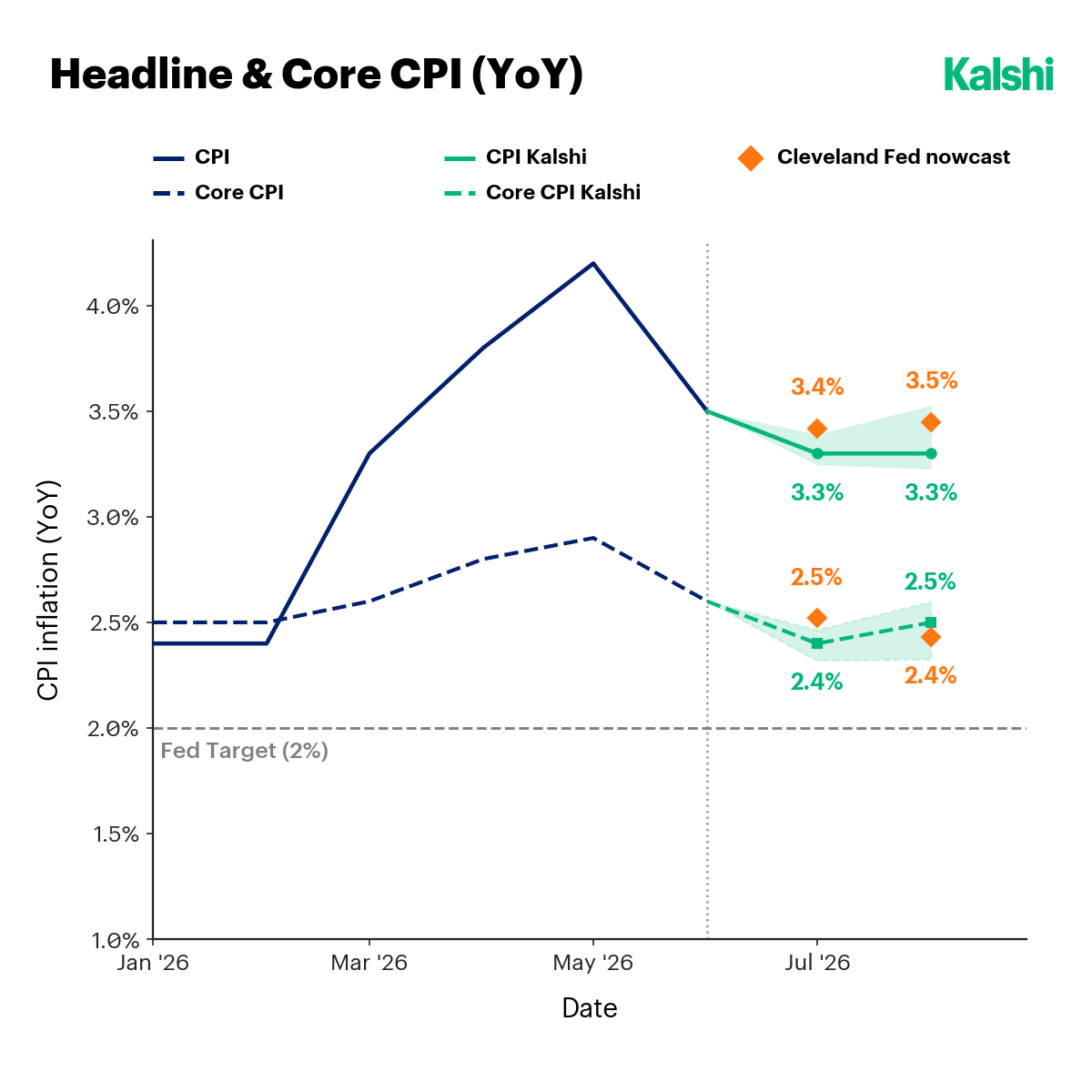
Download PDF- Market forecasts rest just under consensus. Kalshi market-implied CPI forecasts have converged to 3.3% Headline YoY / 2.4% Core YoY, sitting narrowly below external estimates with the Cleveland Fed Nowcast and consensus projections of 3.4%/2.5% YoY.
- It’s an Iran story. Kalshi market-implied distribution skews to the upside, reflecting an uncertainty around the resolution of conflict in the Middle East and significant disruption to shipping channels likely to hit Core CPI through supply chains.
- Market divergence is worth watching. Over a three-year look-back window, Kalshi markets display lower error relative to consensus estimates at points of divergence from expectations, indicating differentiated expectations that validate its use as a corroborating tool.
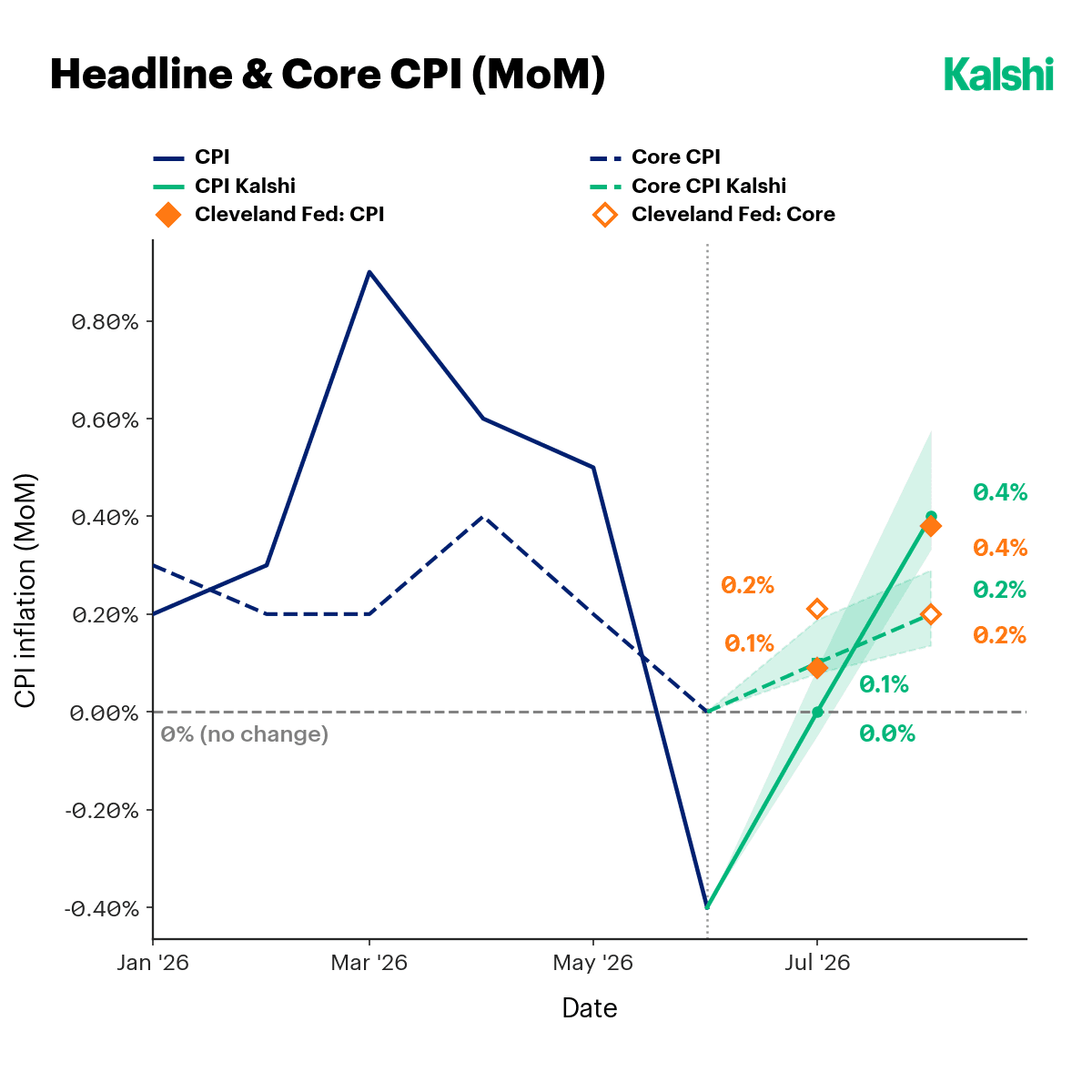
July CPI is due Wednesday morning against a softening backdrop: June’s downside surprise, followed by a weaker-than-expected July employment report (nonfarm payrolls -23,000 vs. consensus +83,000). Kalshi’s market-implied estimates sit a tick below both the Cleveland Fed Nowcast and consensus, at 3.3% headline and 2.4% core CPI, respectively, on a year-over-year basis. The implied distribution remains skewed to the upside, driven by two factors: (1) gasoline prices, contingent on the resolution of the Middle East conflict, and (2) tariff- and Hormuz-related freight costs, which continue to build within core.
New Kalshi Research, straight to your inbox.
It's an Iran Story
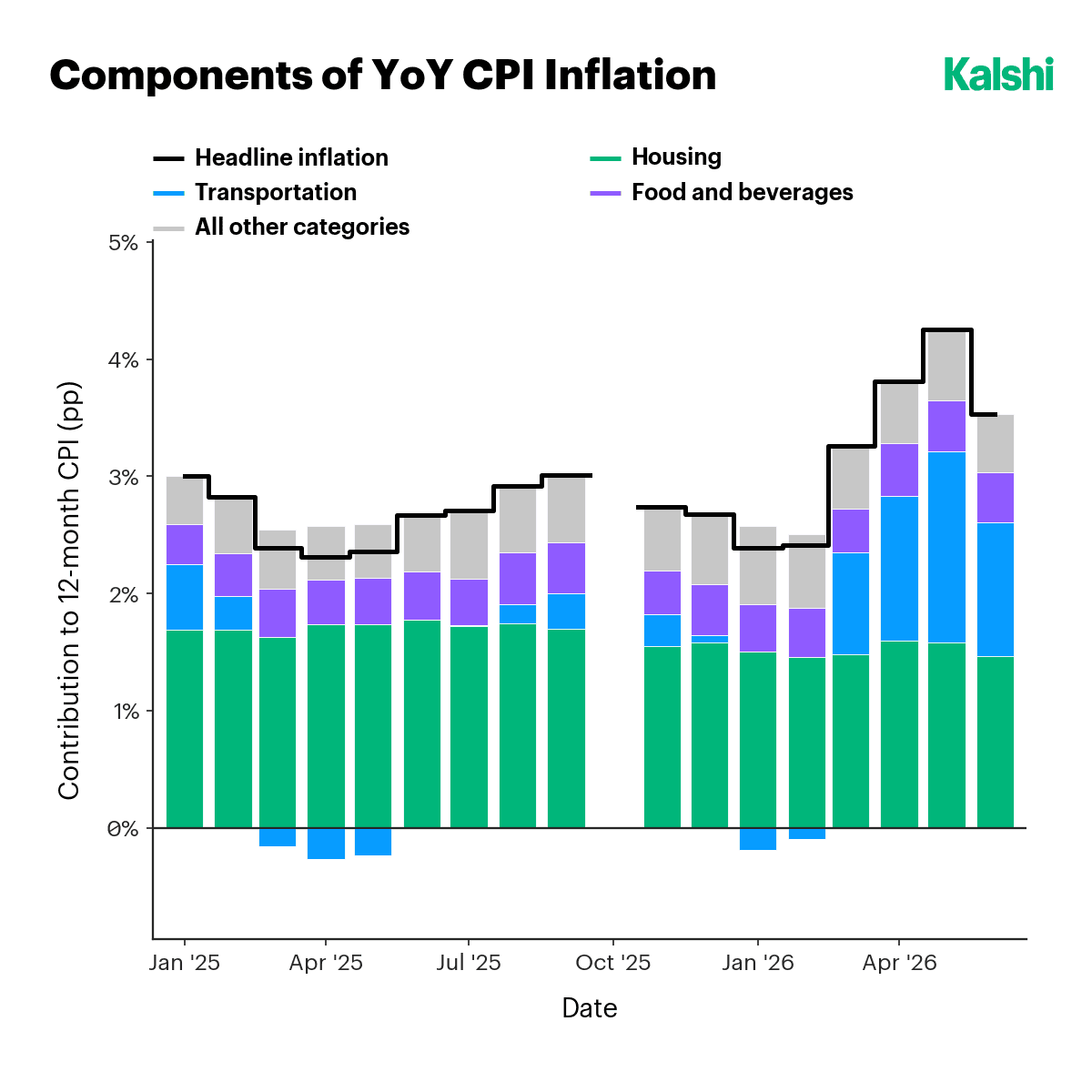
Transportation accounts for the entirety of the 2026 acceleration: a modest drag through most of 2025, it is now by far the largest single driver of the move higher. Weighting gasoline’s 2.9% CPI share by its own year-over-year swing, from -7.5% in January to a roughly 40% peak in May, explains approximately three quarters of the total increase in headline CPI over that period.
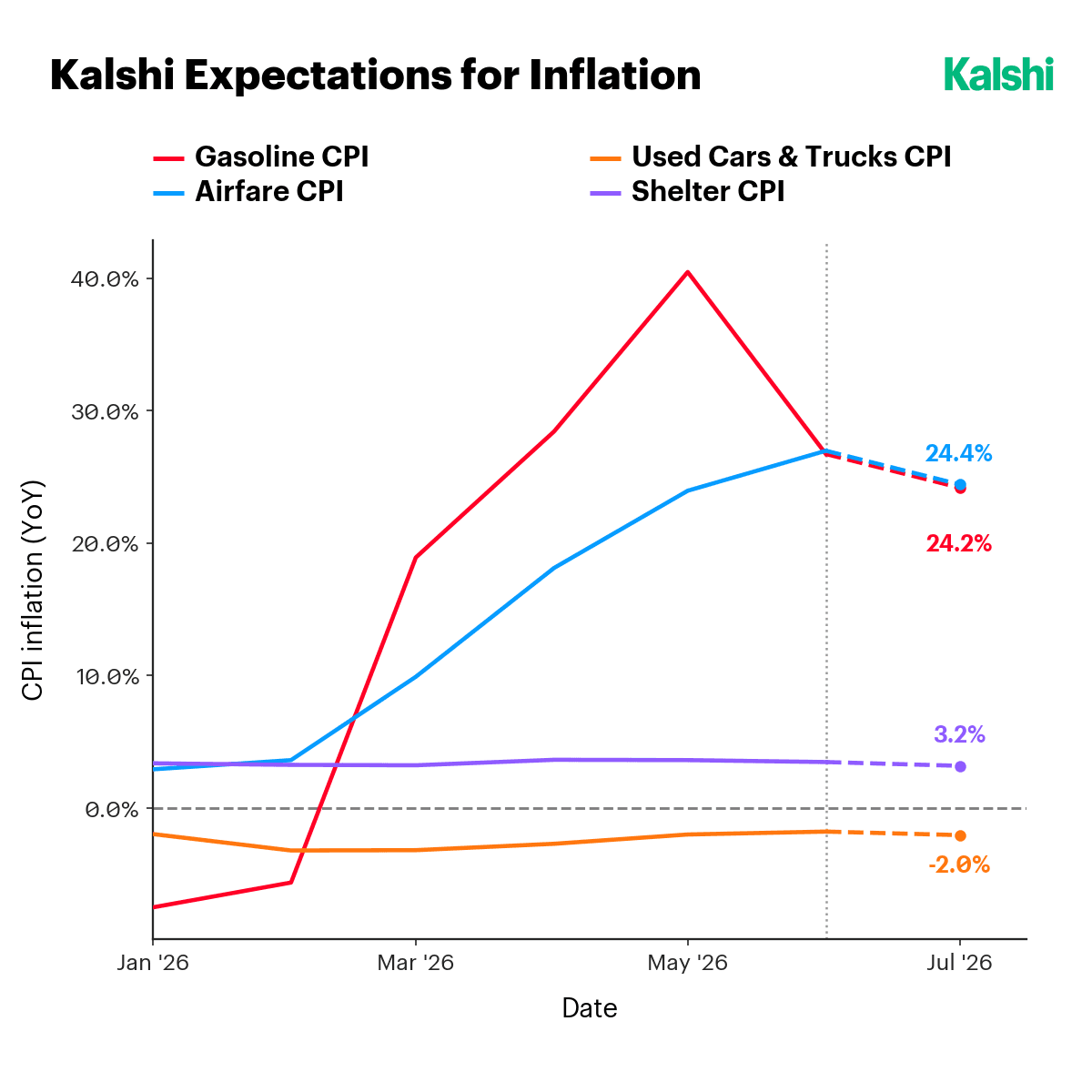
Eyes now turn to the potential for resolution and/or escalation in the region. A ceasefire announced in early April briefly calmed prices before fighting resumed in July, and as of early August, Iran and Oman are still negotiating whether shipping through the Strait reopens. Kalshi’s confidence bands reflect that uncertainty, skewing to the upside heading into the fall.
Airfare shares gasoline’s root cause and adds a second, distinct channel. Jet fuel is also a crude derivative, and its price move has been comparably sharp: the global average rose from roughly $2.50 a gallon before the conflict to $3.93 within days, with IATA’s fuel monitor showing an additional 18% week-over-week increase in mid July as fighting re-escalated, pushing fuel’s share of airline operating costs from roughly a quarter to nearly a third.
The Iran conflict’s reach into core inflation extends well beyond the pump. The Strait of Hormuz carries roughly a fifth of the world’s oil and liquefied natural gas, and its closure since late February, combined with renewed Red Sea disruption, has forced container and tanker traffic to reroute around the Cape of Good Hope, pushing freight rates higher even on routes with no direct Middle East exposure. Asia to US ocean rates were still up 29% in April. Layered on top of tariffs, which researchers at the Dallas Fed estimate have added close to 0.8 percentage points to core inflation on their own, that freight shock moves through a similar seven-month pass-through window, meaning costs from the worst of the closure are still reaching shelves now. The Gulf is also a major exporter of fertilizer inputs, so a prolonged disruption may also represent a slower-moving risk to food prices.
A Fed That Says Less, Even As Inflation Says More
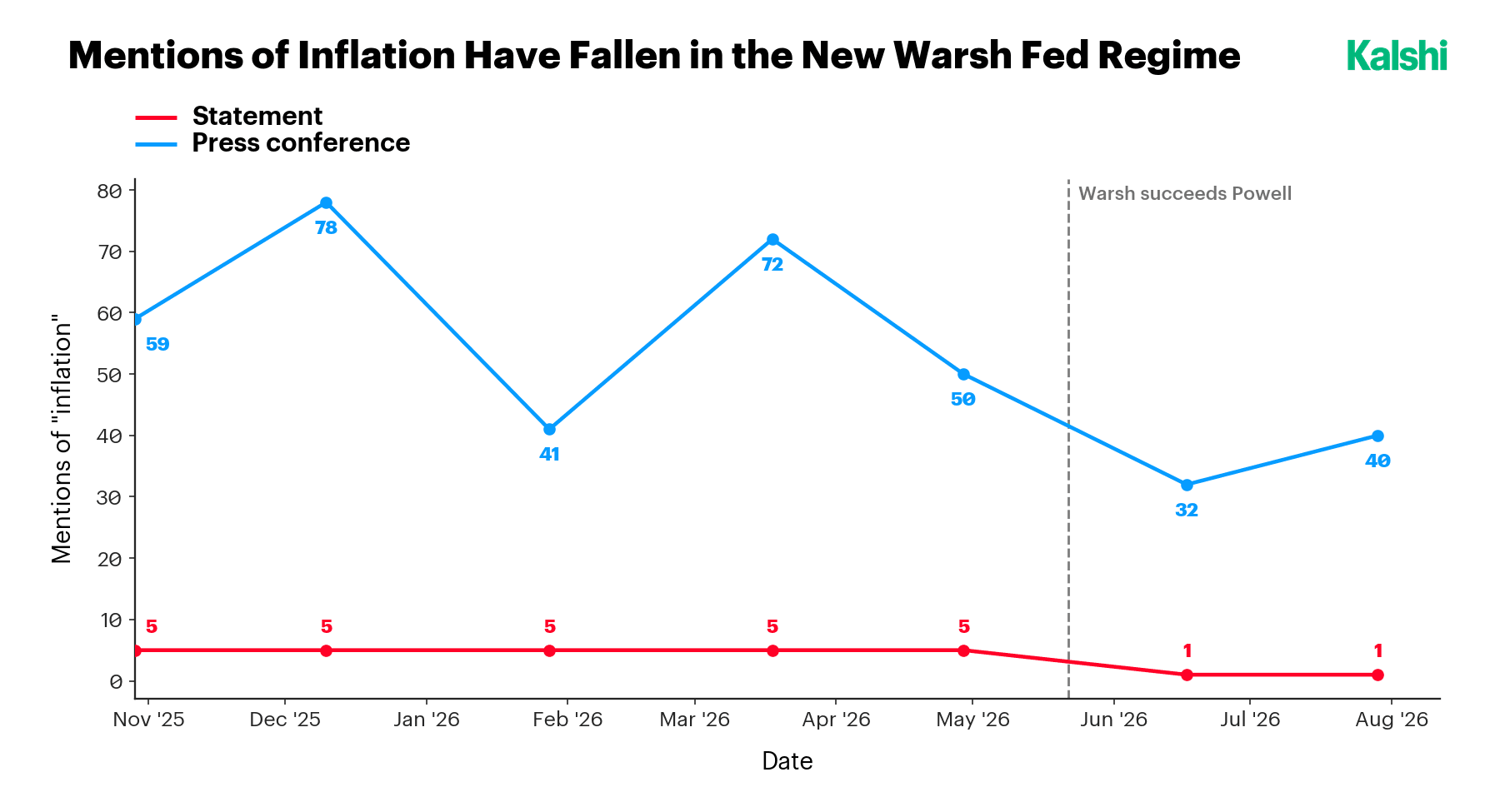
Mentions of “inflation” during FOMC press conferences have fallen from a peak of 78 at the December meeting to just 40 at the July 29 press conference, even as the underlying data has, if anything, become louder, and the Committee more worried. This is undoubtedly a reflection of Chair Warsh’s explicit preference for shorter statements and less forward guidance. The July decision itself, a 9-3 hold, with Cleveland’s Hammack, Minneapolis’ Kashkari, and Dallas’ Logan all dissenting in favour of a hike, marked the most regional-president dissents in a single direction since September 2016. If this print comes in above expectations, it would all-but-guarantee a hike at the next FOMC meeting in September.
Kalshi Markets Outperform Consensus Inflation Estimates
Why do Kalshi inflation estimates matter?
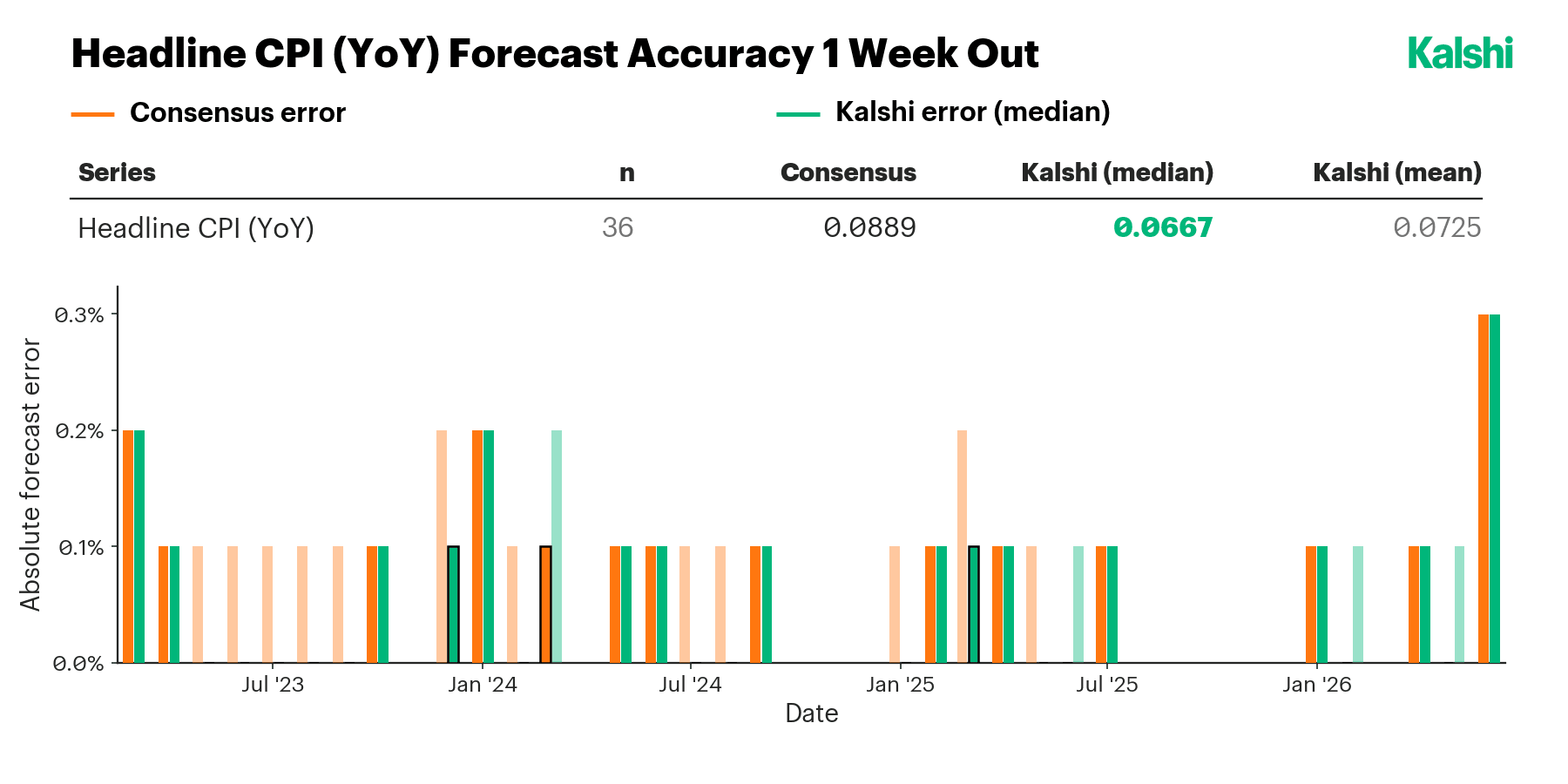
Across 36 one-week-ahead observations, Kalshi’s median forecast error on headline CPI (YoY) comes in at 6.7bp against an 8.9bp consensus error (mean: 7.3bp), a gap corroborated independently by the Federal Reserve’s own research staff, whose February 2026 FEDS paper (Diercks, Katz, and Wright) found Kalshi’s headline CPI (YoY) expectations to be a statistically significant improvement over the Bloomberg consensus. This implies that market traders are trading on differentiated knowledge and may offer value to moderate and/or corroborate views in times of uncertainty.
Enjoying this? Get our next piece of research as soon as it's out.
Zooming Out: The Global Inflation Picture
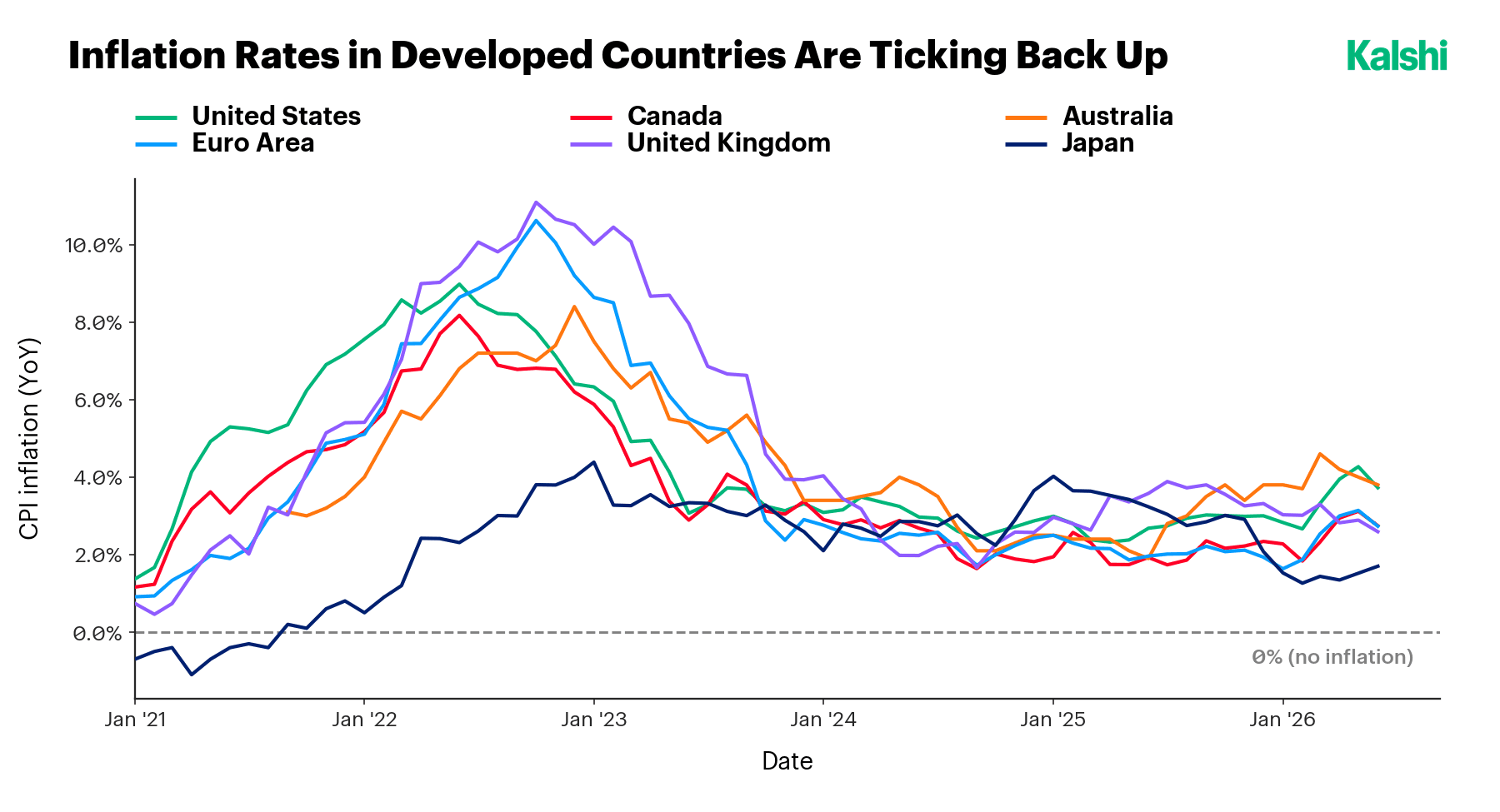
Inflation across developed markets, which had converged into a fairly tight 2 to 4% band by 2024, is now ticking up in near lockstep. The US, UK, Canada, and Australia have all moved higher since late 2025, clustering around 3 to 4%. Notably, Japan, which has run persistently below the rest of the group for years, is showing the same upward inflection, climbing back toward 2%. The synchronicity is the key point: the global energy crisis emanating from the Middle East is clearly affecting all regions of the world, and all eyes are on the Fed’s path back to 2%.
Conclusion
The single most significant current determinant of inflation, and thus Fed decisions, is what happens in Iran – both through direct impact on crude oil pricing and supply chain disruption likely to filter through to goods inflation. Reignited tensions deriving from recent failures in negotiation have skewed future estimates upward, implying the potential for stickier inflation that would force the hand of the FOMC when it next meets in September.
About Kalshi Research
Signal-rich analysis of prediction markets. Questions, data access (currently free for institutional clients), or collaboration: research@kalshi.com
Disclaimer
This report is published by Kalshi Inc. (“Kalshi,” “we,” or “us”) for informational and educational purposes only. It is not investment, legal, tax, or trading advice, and it does not constitute a recommendation or solicitation to buy, sell, or hold any event contract, security, or other financial instrument. Nothing in this report creates a fiduciary, advisory, or professional-client relationship between Kalshi and the reader.
Kalshi operates a CFTC-regulated exchange. The event contracts and forward curves referenced herein are traded on or derived from Kalshi’s platform. The market prices, forward curves, and implied probabilities cited in this report reflect what market participants thought at a given moment; such data is subject to change without notice. These figures are not guarantees or predictions of actual outcomes. Past and current prices do not indicate future results. Data sourced from third parties is believed to be reliable but has not been independently verified. Third-party projections and estimates cited herein are subject to significant uncertainty and may not be realized.
Trading event contracts carries risk, including the risk that you may lose some or all of your invested capital. Event contract outcomes are binary and can result in the total loss of the amount paid for a contract. Every figure and probability here is current only as of the date of publication. Kalshi undertakes no obligation to update, revise, or correct this report after publication.
Kalshi, its affiliates, officers, directors, and employees may have financial interests in the contracts or markets discussed herein and may trade them at any time without notice to readers.
This report is not directed at any person in any jurisdiction where its distribution or the offering of event contracts would be contrary to local law or regulation. Before acting on anything in this report, consult your own independent legal, tax, financial, or other professional advisor.
This report is not insurance advice and does not constitute a recommendation regarding the purchase, renewal, or cancellation of any insurance policy or program. Comparisons between event contracts and insurance products are illustrative only and do not account for differences in regulatory protections, counterparty credit risk, claims processes, coverage scope, or policyholder rights that may apply to traditional insurance. Readers should consult a licensed insurance professional before making decisions about their insurance or risk-transfer arrangements.
Get new Kalshi Research publications and insights as they are released.