
FOMC Preview: July 29 Meeting
Published July 27, 2026
Download PDFNew Kalshi Research, straight to your inbox.
Overview
Kalshi markets are pricing a rate hold at 3.50%–3.75% for the forthcoming FOMC meeting on July 29. This would represent the fifth consecutive meeting at which rates remained unchanged. Inflation remains elevated, but June’s print came in materially softer than expected – at 3.5% YoY over consensus of 3.8% YoY. That said, upside risk persists, as the latest leg-down was driven primarily by declines in Energy and Gasoline (-5.7% m/m and -9.7% m/m, respectively) – volatile residuals of geopolitical conflict in the Middle East. On the other side, the jobs picture is mixed but uncompelling in either direction: June payrolls: +57,000. Consensus was 115,000. April and May revised down a combined 74,000. Unemployment: 4.2%, down from 4.3%.
The new Fed era of Warsh’s leadership comes with an accompanying promise for less forward guidance, which he referred to as ill-suited for the current policy environment. On the back of that, real-time signals and projections have become substantially more important, and Kalshi markets, which trade 24/7, offer potentially meaningful and differentiated information for market participants.
The Kalshi forward curve, constructed by chaining real-time Fed Funds Rate predictions, suggests one further hike in September of this year, before easing into 2027.
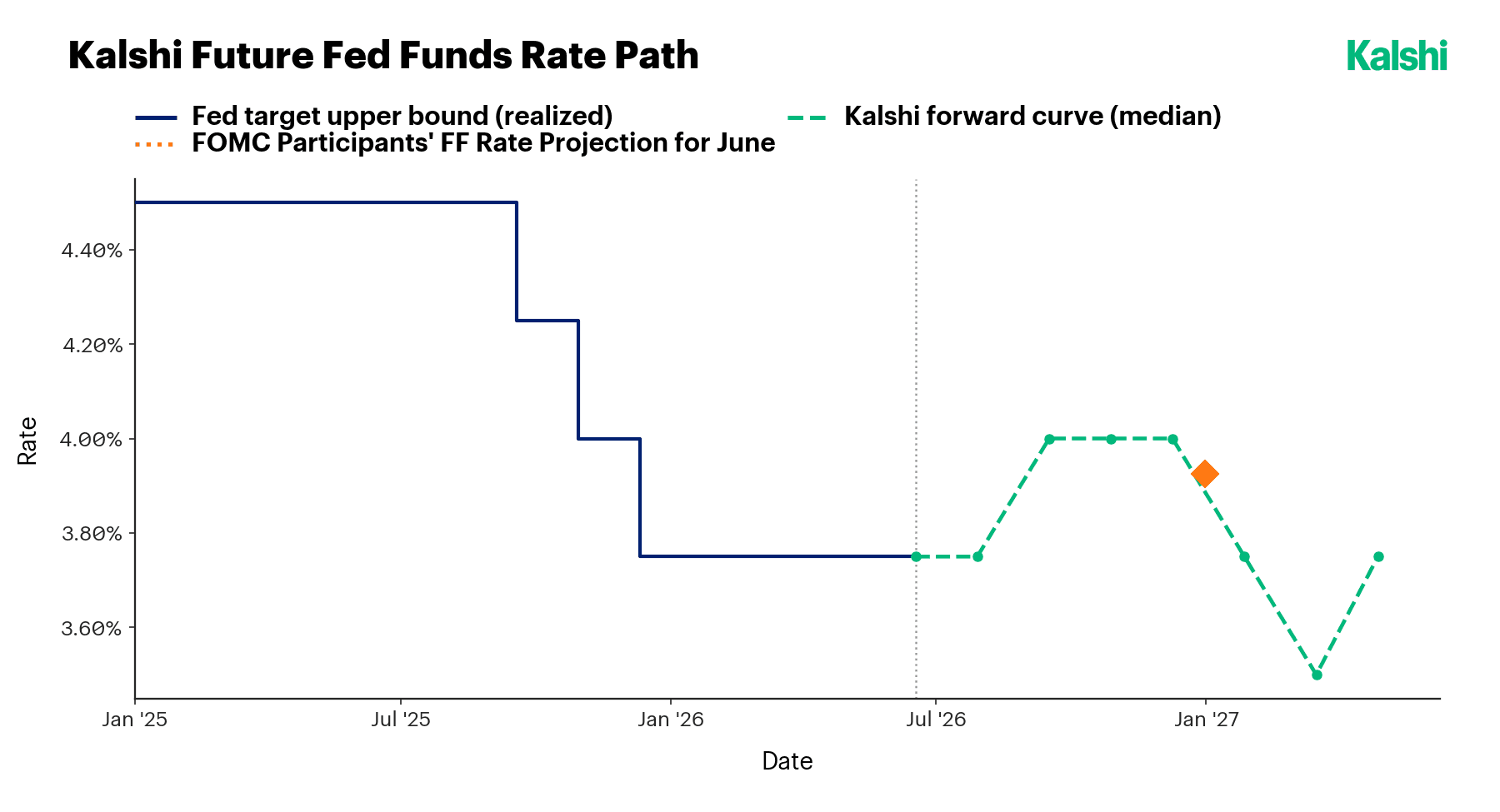
- A fifth straight hold. Kalshi markets are pricing rates to remain on hold at 3.50%–3.75% for a fifth consecutive FOMC meeting. They do so with higher conviction than Fed Funds Futures.
- Upside inflation risk, Middle East–driven. Inflation risk remains skewed to the upside, a by-product of renewed tension in the Middle East.
- Signals may fill the guidance vacuum. Kalshi’s continuously updating markets offer a higher-frequency, more granular signal on Fed policy than traditional alternatives.
Zooming Into July
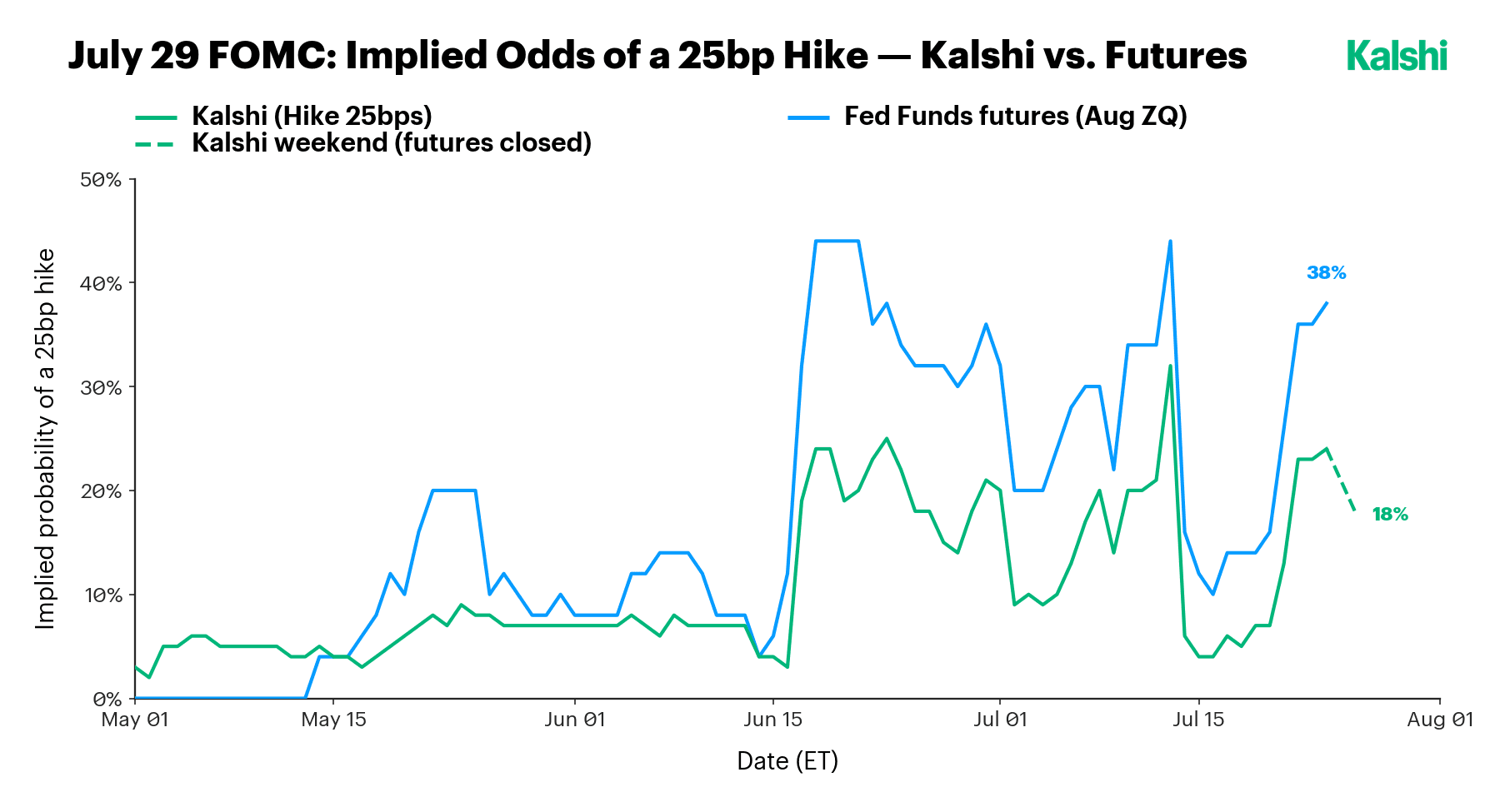
Kalshi Markets vs. Fed Funds Futures: As the meeting approaches, Kalshi has priced meaningfully less hawkish than Fed Funds futures: as of the latest close, futures implied a 38% probability of a 25bp hike, relative to just 18% on Kalshi. This gap doesn’t appear to be just noise – it has persisted directionally for most of the cycle, suggesting a structural difference in how the two markets are pricing the same event (even if convergent in conclusion). Kalshi markets appear to be communicating a higher degree of certainty in the rate remaining unchanged, a useful standalone or blended signal for market participants.
Of more interest, perhaps, Kalshi has also historically appeared to lead front-month Fed Funds futures, often moving first and more sharply. This matters because it suggests Kalshi pricing can serve as an early read on shifting rate expectations before that repricing is fully reflected in futures markets – a potentially valuable edge for participants monitoring policy risk in real time.
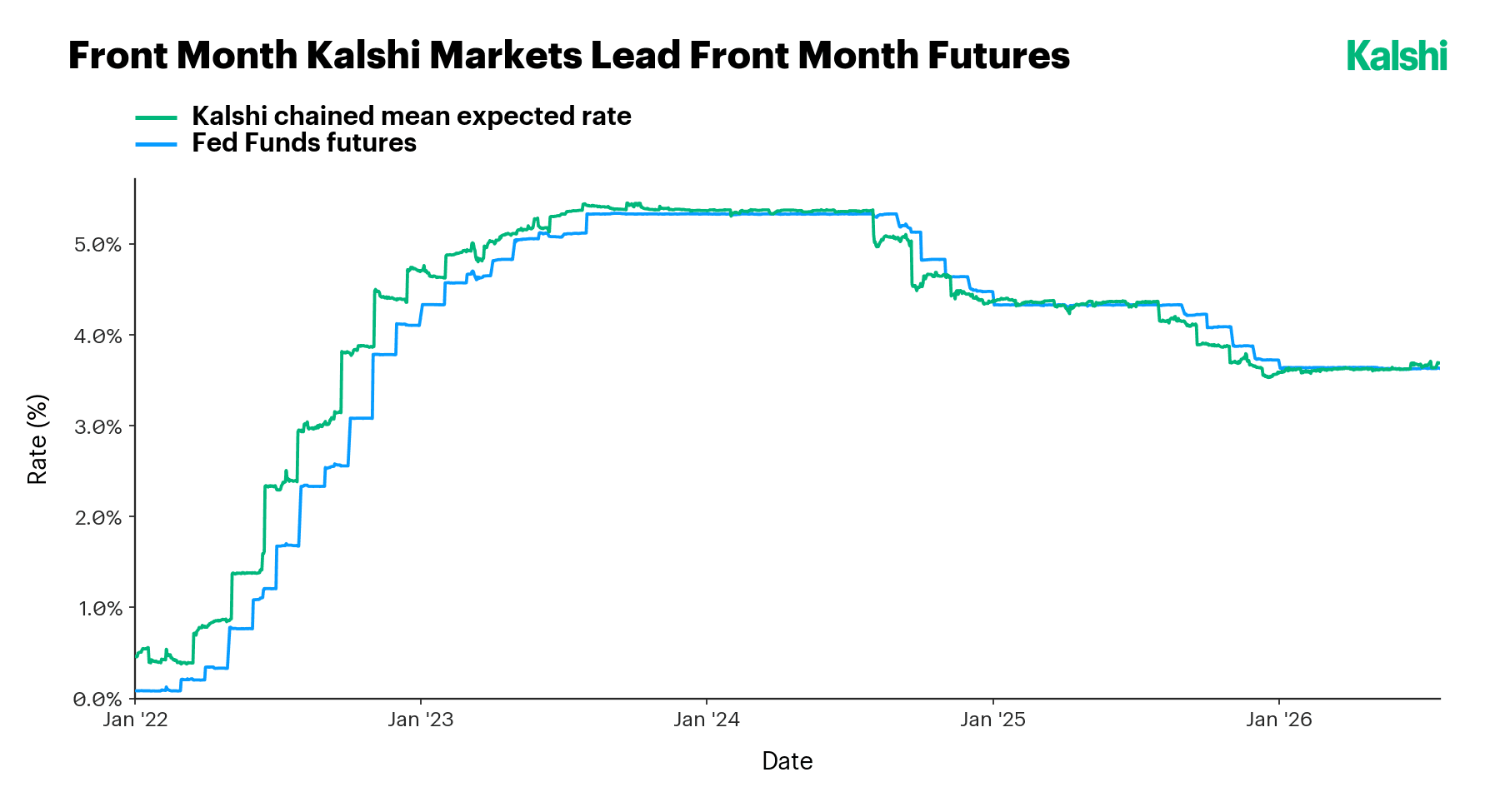
This pattern is consistent with a Federal Reserve staff paper (Diercks, Katz, and Wright, 2026), which found that Kalshi’s median and modal forecasts had a perfect track record predicting the FOMC’s decision the day before each meeting, outperforming futures.
The mid-month timing of futures contracts also makes it harder to extract a clean, meeting-specific implied probability from that market. This stands in contrast to Kalshi’s own markets, which are tied to specific meeting outcomes and thus represent a more direct ability to take a position on a particular FOMC decision.
What The Fed Is Watching
The Fed’s problem is one-sided. Inflation is the risk; growth and jobs are, for now, giving the Committee no reason to look away.
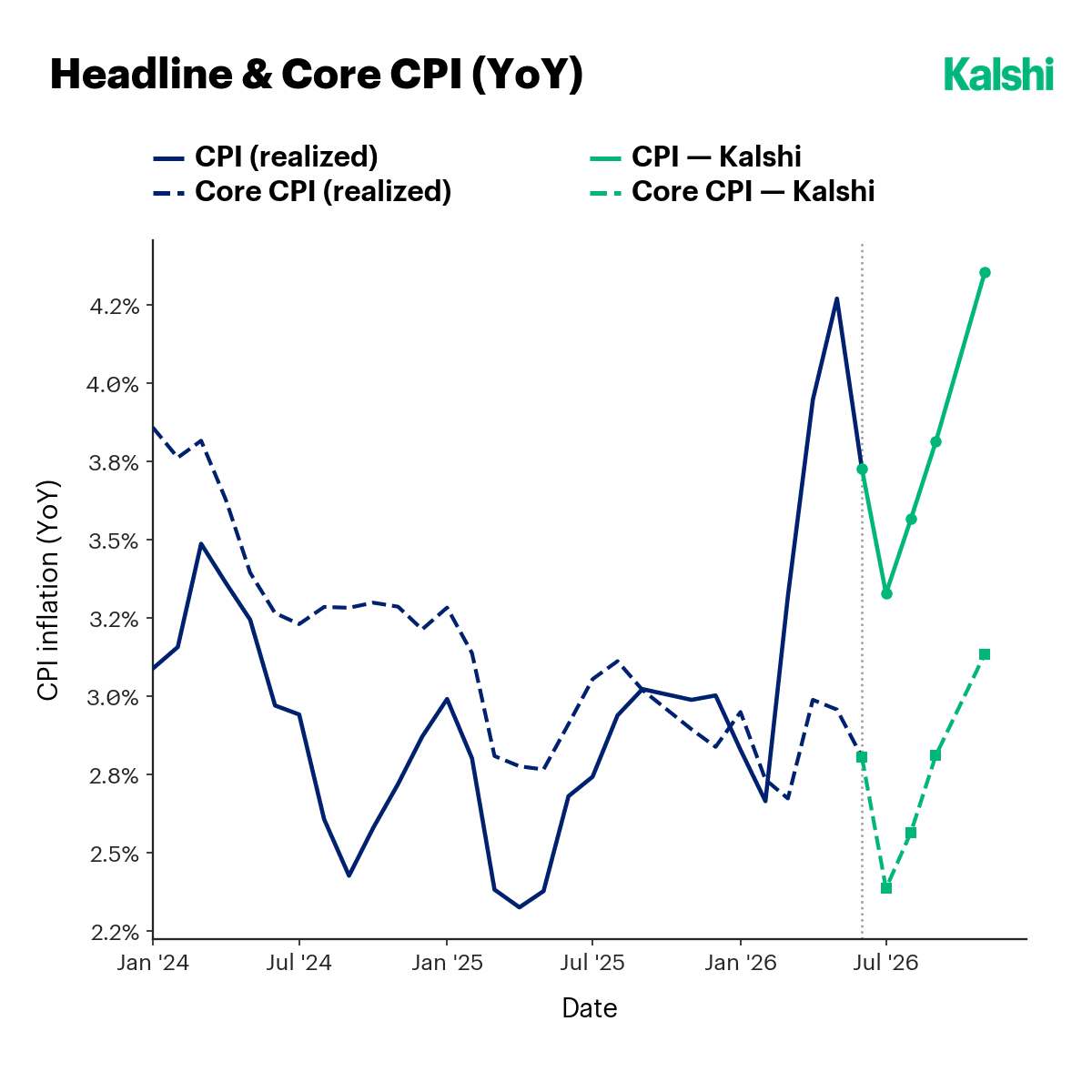
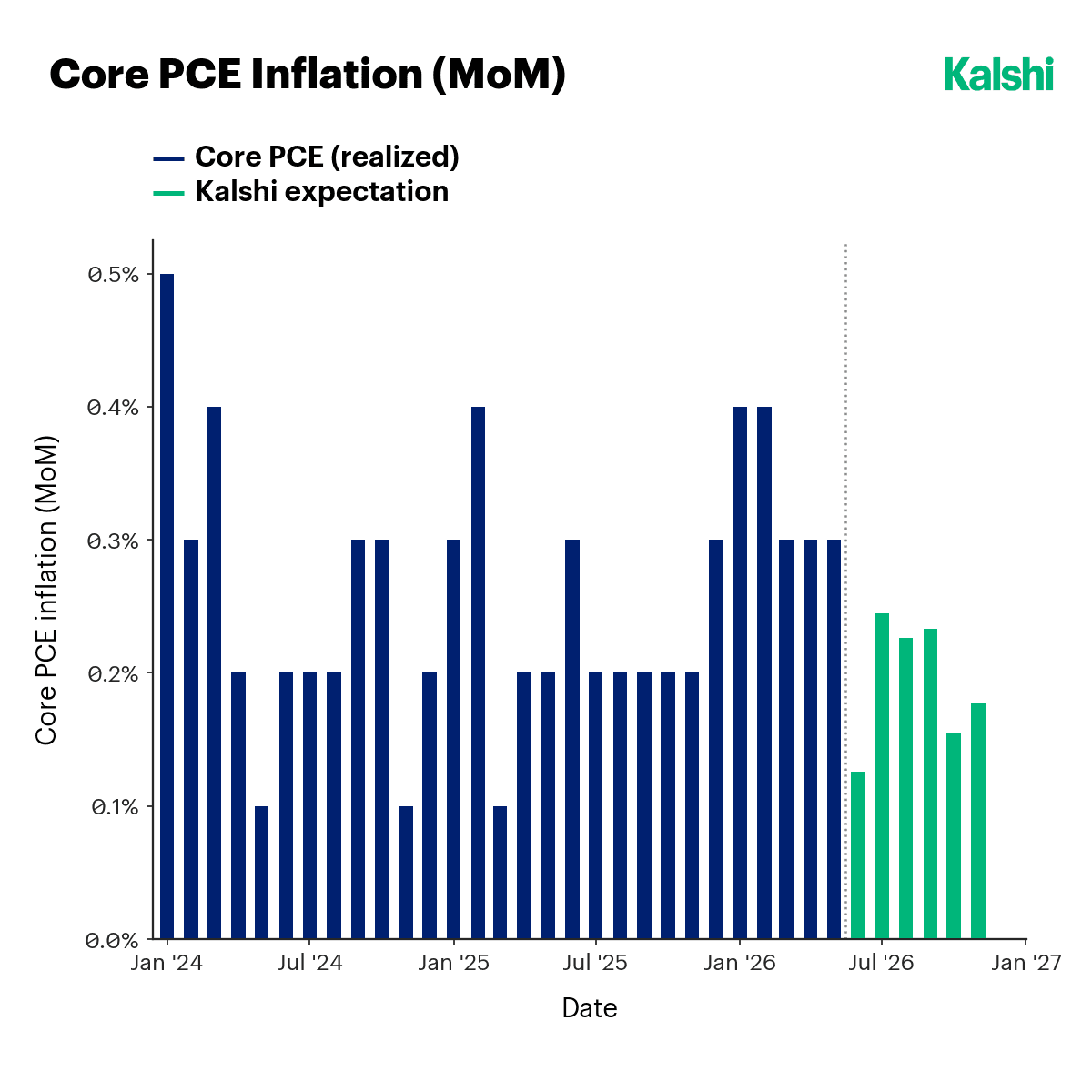
Headline PCE reached 4.1% in May and core, the Fed’s preferred measure of inflation, 3.4% – both multi-year highs. June CPI then fell back to 3.5% headline (from 4.2%) and 2.6% core, with the monthly headline down 0.4%, but that improvement was almost entirely energy-driven, on the back of easing Middle East tensions that appear to once again have erupted. With Brent back above $100 and WTI in the low $90s, the impulse the Fed refuses to look through is returning. Kalshi markets expect a brief retracement toward 3.3% before headline inflation grinds back above 4% into 2027 as energy and tariff pass-through reassert. Core PCE, though projected to decline MoM may be deprioritized in favor of a focus on this CPI reassertion if it persists. The Committee sees the same one-way risk: participants flagging upside inflation risk have risen to 17 of 18, attributing it to tariff pass-through on core goods, AI-buildout demand, and Middle East energy costs.
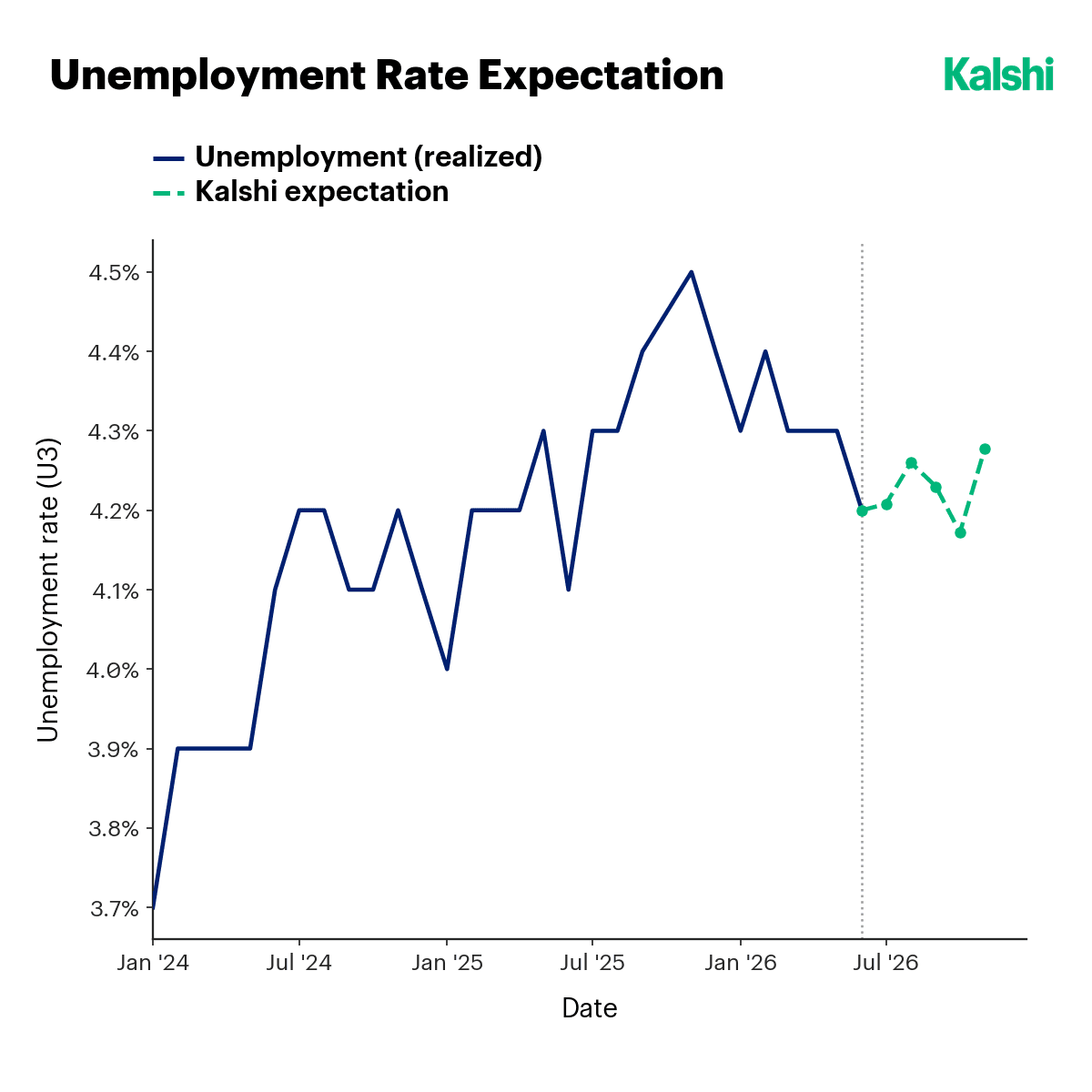
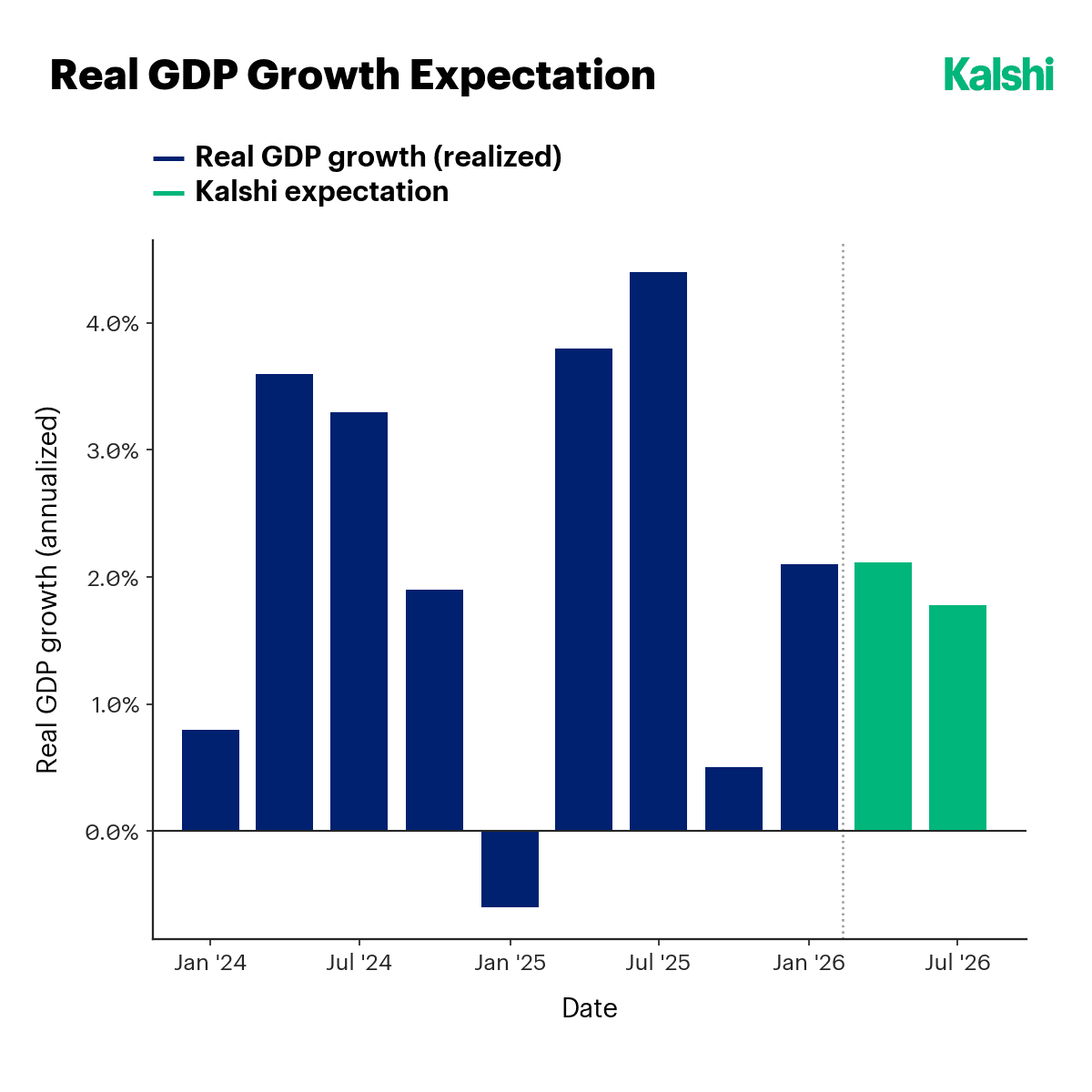
On the real economy, the data is steady rather than hot, and the Committee’s own fears have eased there even as they hardened on inflation. Kalshi expectations put real GDP near 2% in Q2 and 1.9% in Q3, solid but below the Atlanta Fed’s roughly 3% Q2 nowcast, a gap worth watching when the advance print lands July 30, the morning after the decision. Unemployment is expected to hold in a 4.2%–4.3% range into 2027. Tellingly, participants seeing downside growth risks fell from 14 to 5, and those seeing upside unemployment risks fell from 16 to 7. Receding growth fears against rising inflation fears is the analytical core of a Committee that has swapped an easing bias for a tightening one.
Enjoying this? Get our next piece of research as soon as it's out.
How To Survive A World Without Forward Guidance
Warsh’s leadership of the Federal Reserve represents a fundamental step-change from the Powell administration. He has committed to a leaner communication style – shorter statements, no explicit path signals, and a heavier reliance on incoming data – moving away from the pre-committed policy path that characterized the prior administration’s approach. With the statement stripped of signal and forward guidance effectively gone, three channels become disproportionately important for reading policy intent:
- Real-time market signal
- Commentary from the FOMC press conference
- Committee voting records
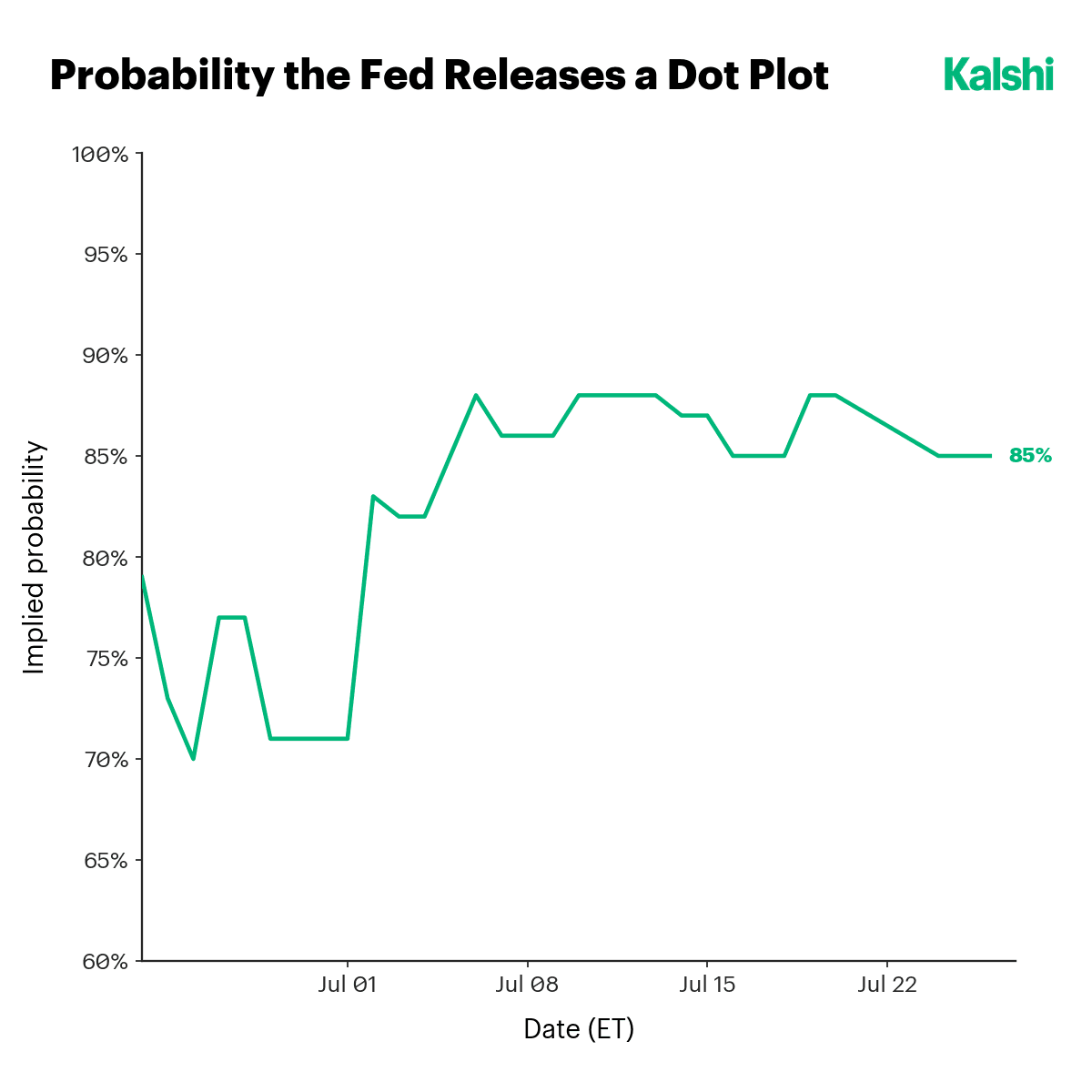
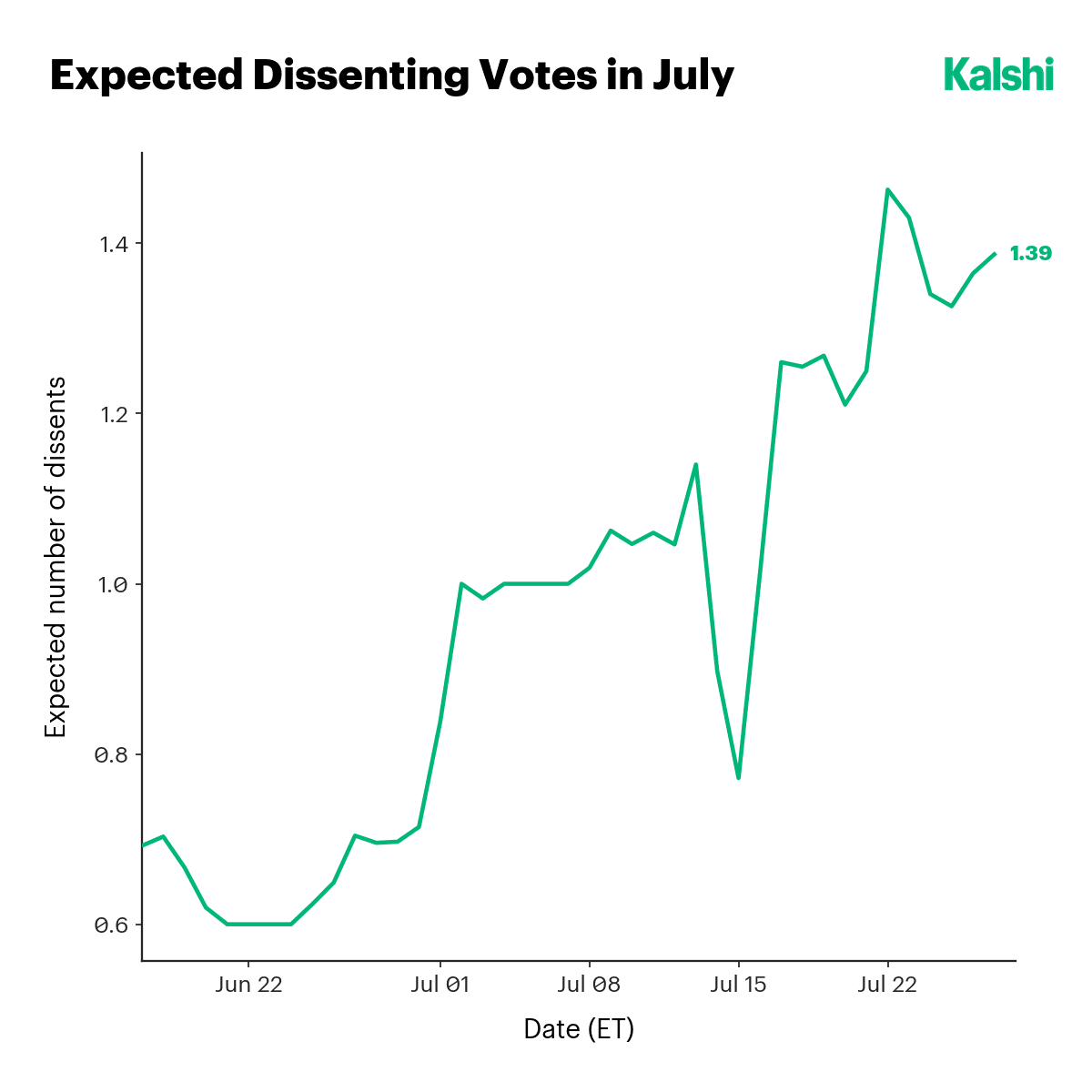
Markets currently price an 85% probability that the Fed releases a dot plot at this meeting, while the expected number of dissenting votes in July is running above 1, pointing to a possible break from the unanimous decision seen in June. In fact, this is likely derivative of both the differentiated opinions of Committee members, and the departure from pre-commitment, which provides greater latitude for individual members to express their positions with a lessened penalty.
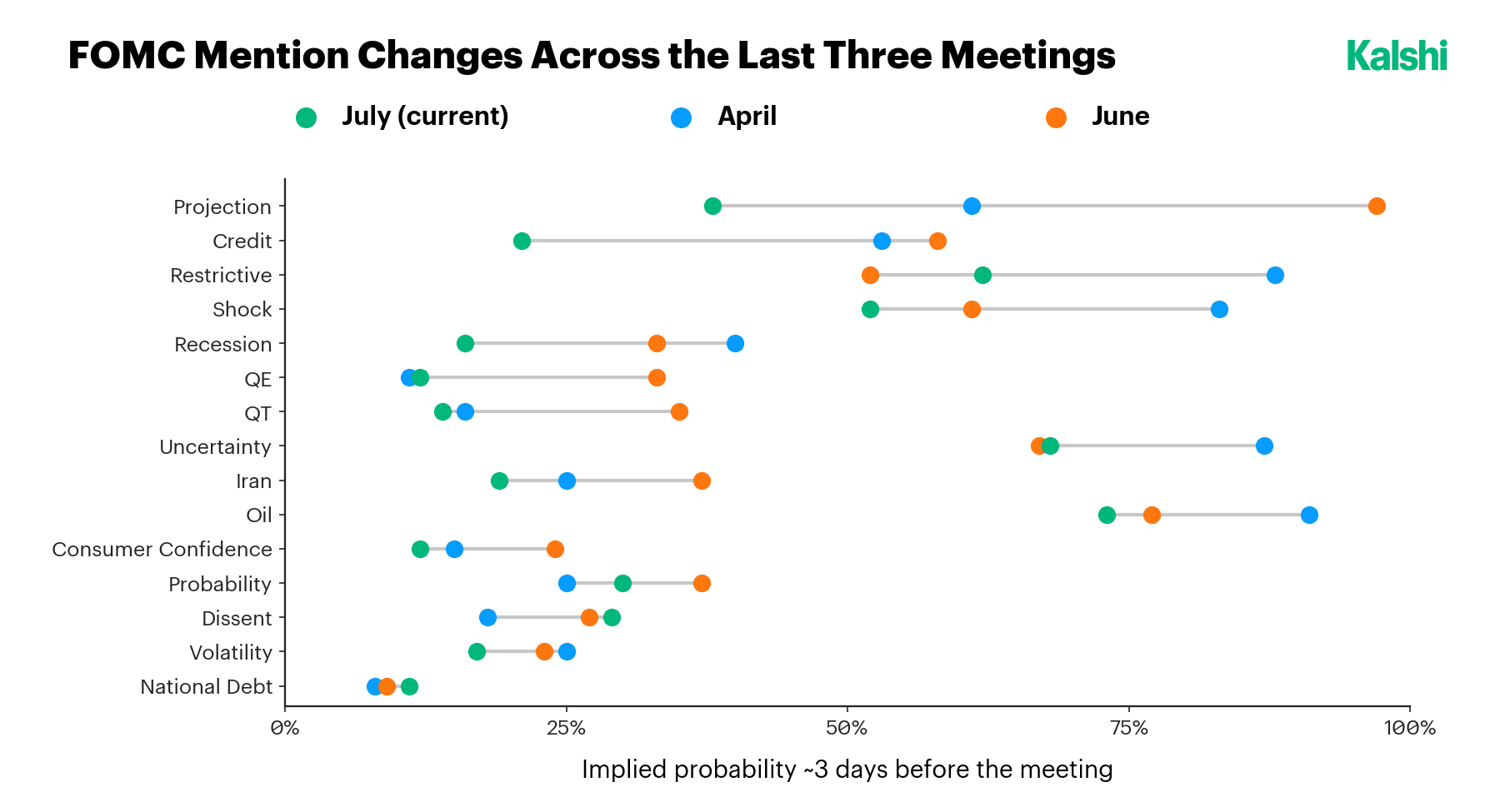
In addition the markets cited above, Kalshi also provides pricing on the words and expressions said during the FOMC press conference. Mention markets are particularly useful because they let you decompose “the Fed’s tone” into individual, tradeable components rather than treating the statement as one monolithic signal. Looking across themes, most crisis-adjacent language (e.g. shock, recession, credit, oil, Iran) has been steadily declining in implied probability across the last three meetings, suggesting the market expects a calmer, less defensive tone overall. The outlier – dissent – supports the narrative of fragmentation outlined above; in a world with reduced pre-commitment and increased uncertainty, dissenting individual positions are less costly.
Looking Ahead
All eyes will now move to the September FOMC meeting. That is the next meeting slated to have a Summary of Economic Projections, and will be the first real opportunity for the Committee to update its dot plot against two more months of inflation and labor data. This will be the first meaningful test of Warsh’s new approach to fundamentally limited forward guidance, and the financial market response will be valuable to watch.
Kalshi markets are currently pricing a single 25bps hike this year to a 3.75%–4.00% target range, followed by cuts resuming in 2027.
About Kalshi Research
Signal-rich analysis of prediction markets. Questions, data access (currently free for institutional clients), or collaboration: research@kalshi.com
Reference Material
- J.P. Morgan Asset Management. "FOMC Statement: June 2026." Accessed July 26, 2026. https://am.jpmorgan.com/us/en/asset-management/adv/insights/portfolio-insights/fixed-income/fixed-income-perspectives/fomc-statement-june-2026/
- Bank of Canada. "Policy Interest Rate." Accessed July 27, 2026. https://www.bankofcanada.ca/core-functions/monetary-policy/key-interest-rate/
- Bank of England. "Interest Rates and Bank Rate." Accessed July 27, 2026. https://www.bankofengland.co.uk/monetary-policy/the-interest-rate-bank-rate
- Bank of Japan. "Policy Rate / Basic Discount Rate." Accessed July 27, 2026. https://www.boj.or.jp/en/statistics/boj/other/discount/
- Board of Governors of the Federal Reserve System. "FOMC Meeting Calendars and Information, 2026–2027." Accessed July 27, 2026. https://www.federalreserve.gov/monetarypolicy/fomccalendars.htm
- Board of Governors of the Federal Reserve System. "Minutes of the Federal Open Market Committee, June 16–17, 2026." July 8, 2026. https://www.federalreserve.gov/monetarypolicy/fomcminutes20260617.htm
- Board of Governors of the Federal Reserve System. "Summary of Economic Projections, June 17, 2026." June 17, 2026. https://www.federalreserve.gov/monetarypolicy/fomcprojtabl20260617.htm
- Diercks, Anthony M., Jared Dean Katz, and Jonathan H. Wright. "Kalshi and the Rise of Macro Markets." Working Paper 34702, National Bureau of Economic Research, Cambridge, MA, 2026. https://www.nber.org/papers/w34702
- Federal Reserve Bank of St. Louis. "Federal Reserve Economic Data (FRED)." Accessed July 27, 2026. https://fred.stlouisfed.org/
- Reserve Bank of Australia. "Cash Rate Target." Accessed July 27, 2026. https://www.rba.gov.au/statistics/cash-rate/
- U.S. Bureau of Economic Analysis. "Table 1.1.1. Percent Change from Preceding Period in Real Gross Domestic Product." National Income and Product Accounts. Accessed July 27, 2026. https://www.bea.gov/
- Yahoo Finance. "Historical Price Data." Accessed July 27, 2026. https://finance.yahoo.com/
Disclaimer
This report is published by Kalshi Inc. (“Kalshi,” “we,” or “us”) for informational and educational purposes only. It is not investment, legal, tax, or trading advice, and it does not constitute a recommendation or solicitation to buy, sell, or hold any event contract, security, or other financial instrument. Nothing in this report creates a fiduciary, advisory, or professional-client relationship between Kalshi and the reader.
Kalshi operates a CFTC-regulated exchange. The event contracts and forward curves referenced herein are traded on or derived from Kalshi’s platform. The market prices, forward curves, and implied probabilities cited in this report reflect what market participants thought at a given moment; such data is subject to change without notice. These figures are not guarantees or predictions of actual outcomes. Past and current prices do not indicate future results. Data sourced from third parties is believed to be reliable but has not been independently verified. Third-party projections and estimates cited herein are subject to significant uncertainty and may not be realized.
Trading event contracts carries risk, including the risk that you may lose some or all of your invested capital. Event contract outcomes are binary and can result in the total loss of the amount paid for a contract. Every figure and probability here is current only as of the date of publication. Kalshi undertakes no obligation to update, revise, or correct this report after publication.
Kalshi, its affiliates, officers, directors, and employees may have financial interests in the contracts or markets discussed herein and may trade them at any time without notice to readers.
This report is not directed at any person in any jurisdiction where its distribution or the offering of event contracts would be contrary to local law or regulation. Before acting on anything in this report, consult your own independent legal, tax, financial, or other professional advisor.
This report is not insurance advice and does not constitute a recommendation regarding the purchase, renewal, or cancellation of any insurance policy or program. Comparisons between event contracts and insurance products are illustrative only and do not account for differences in regulatory protections, counterparty credit risk, claims processes, coverage scope, or policyholder rights that may apply to traditional insurance. Readers should consult a licensed insurance professional before making decisions about their insurance or risk-transfer arrangements.
Get new Kalshi Research publications and insights as they are released.