
KPOW: The Kalshi American Power Index – Explained
Published August 17, 2026
Download PDF- KPOW is an anchored sentiment indicator. It weighs forward-looking control expectations at 75% and present control at 25%, and because the present-control leg only steps at an election, effectively all of the variation is Kalshi traders repricing who holds Congress and the White House next.
- It’s highly responsive to geopolitical events. A 2025 government shutdown and a wave of favorable redistricting rulings each pulled the Index back toward Republicans before Democrats regained the ground. Both moves show how a single news event can reprice multiple chambers at once.
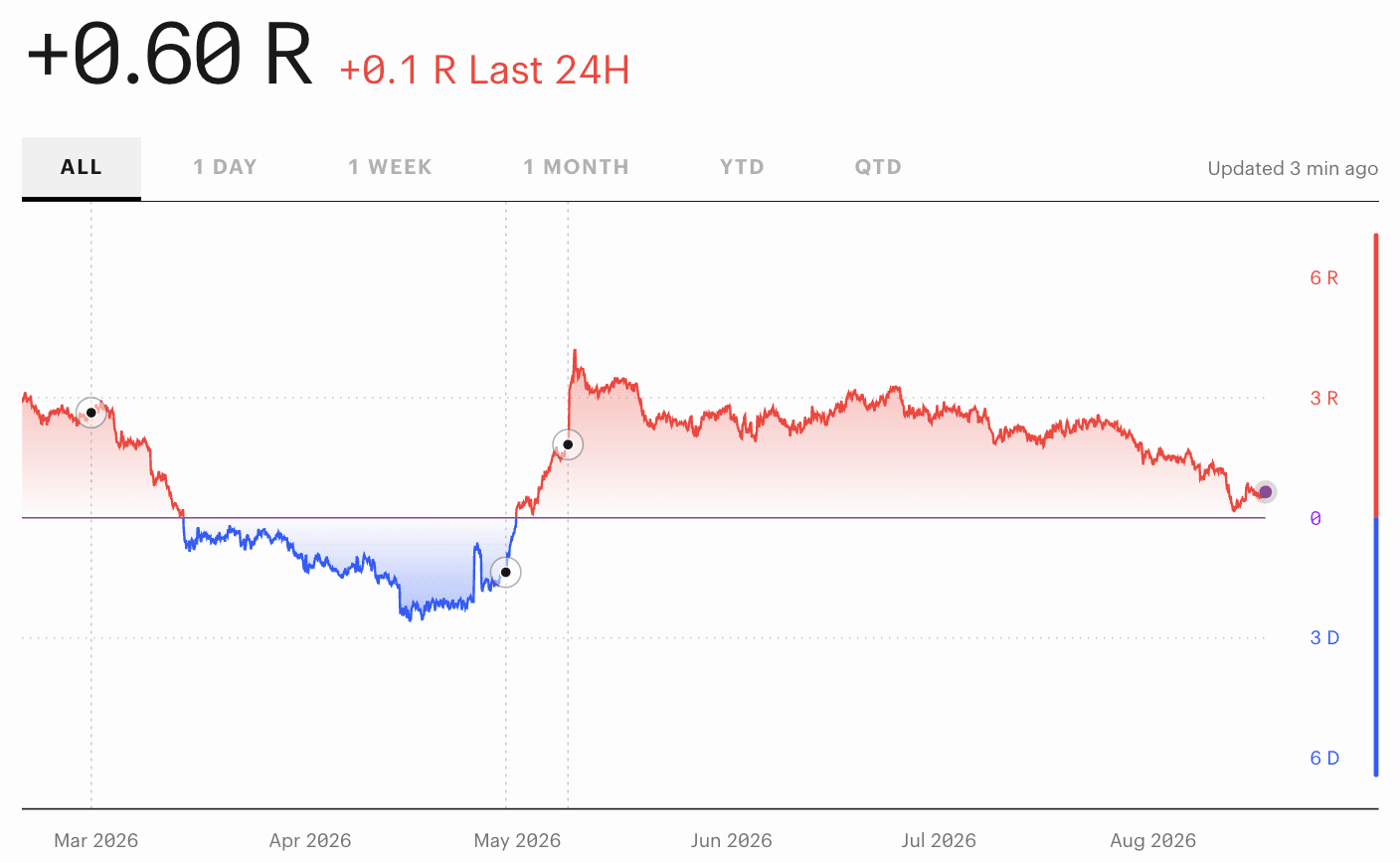
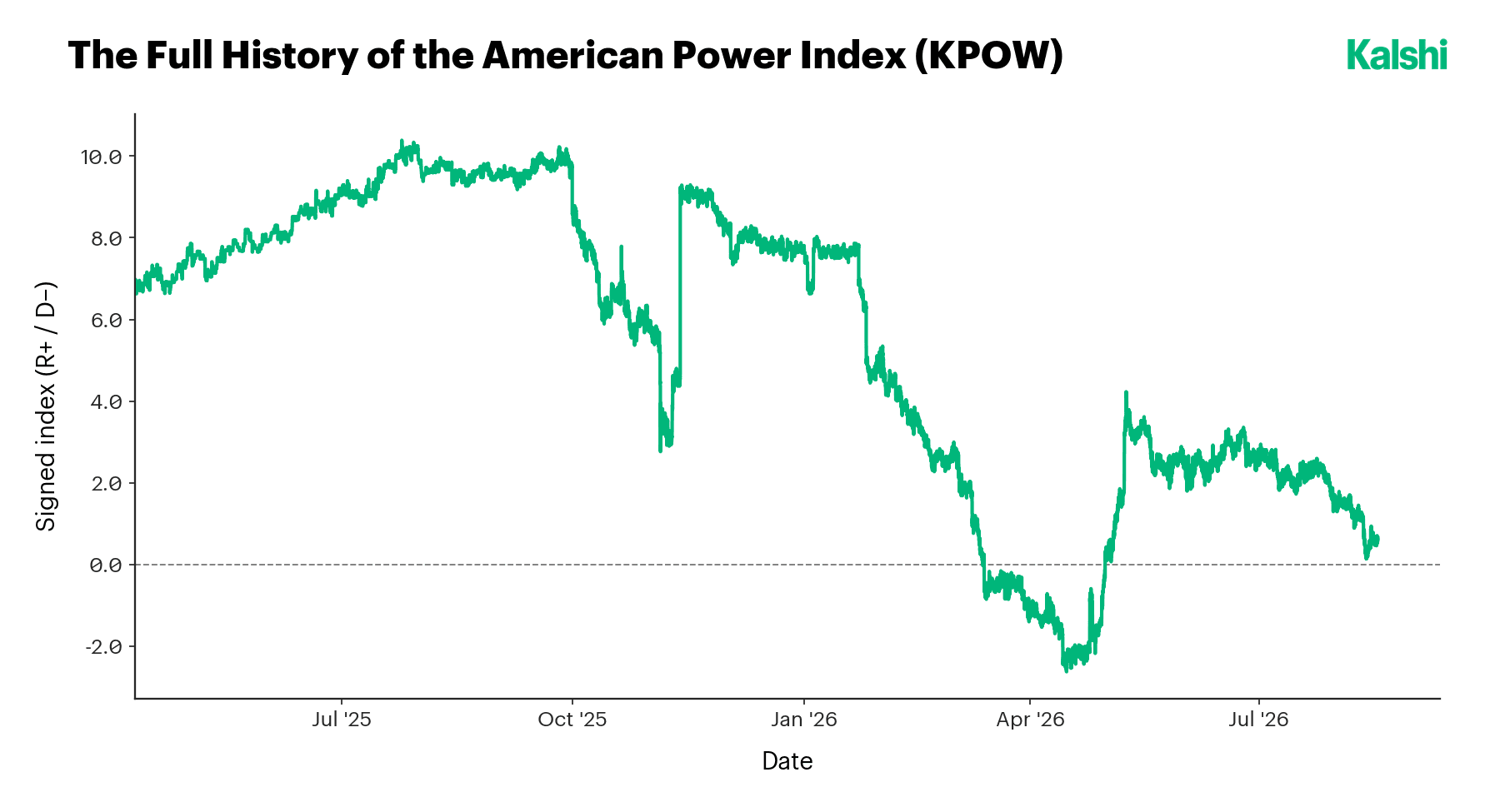
- KPOW has shifted towards even. The Index sits at roughly R +0.6 after sliding from R +10 in mid-2025, pricing a significant shift in control towards the Democrats heading into the 2026 Midterm elections.
The Power of A Single Number
Control of Congress and the White House sets the policy agenda for the next two years: who chairs committees, what gets a floor vote, which ideologies are brought to the fore. The Kalshi American Power Index (KPOW) prices expectations of the balance of power by pooling binary prediction markets into a single anchored sentiment indicator, reported on a signed scale (R +X.X, D +X.X) with a magnitude bound of 50. Over its first 15 months the Index has ranged from R +10.3 to D +2.7, a swing wide enough to capture the shift toward Democrats heading into November.
The Kalshi American Power Index is a proxy for who writes the rules on roughly $7.4 trillion in annual federal outlays, the level the Congressional Budget Office projects for fiscal 2026. A more direct slice of that figure changes hands by contract: the federal government committed about $793 billion to contracts in fiscal 2025 alone, spread across roughly 101,000 vendors in defense, healthcare, and IT, per GAO. Each shift in control redraws which agencies get funded and which vendors win the work.
Outside of the immediate impact on government contracting, the policies pursued by individual governments have significant implications for both domestic and global financial markets. Ranging from fiscal to foreign policy, markets hang on the words uttered by executives that are bound to reverberate through rates, equity markets, and foreign exchange.
New Kalshi Research, straight to your inbox.
The Components of KPOW
KPOW blends present control (25%) with forward-looking expectations (75%). This 75/25 blend keeps the Index tethered to who actually governs while letting expectations drive the variation. Because the present-control leg only steps at an election, it sets the level, not the direction, and works as a useful anchor to link back to reality. KPOW is driven both by the absolute side of control as much as it is by the degree of control (i.e. the margin by which seats are held).
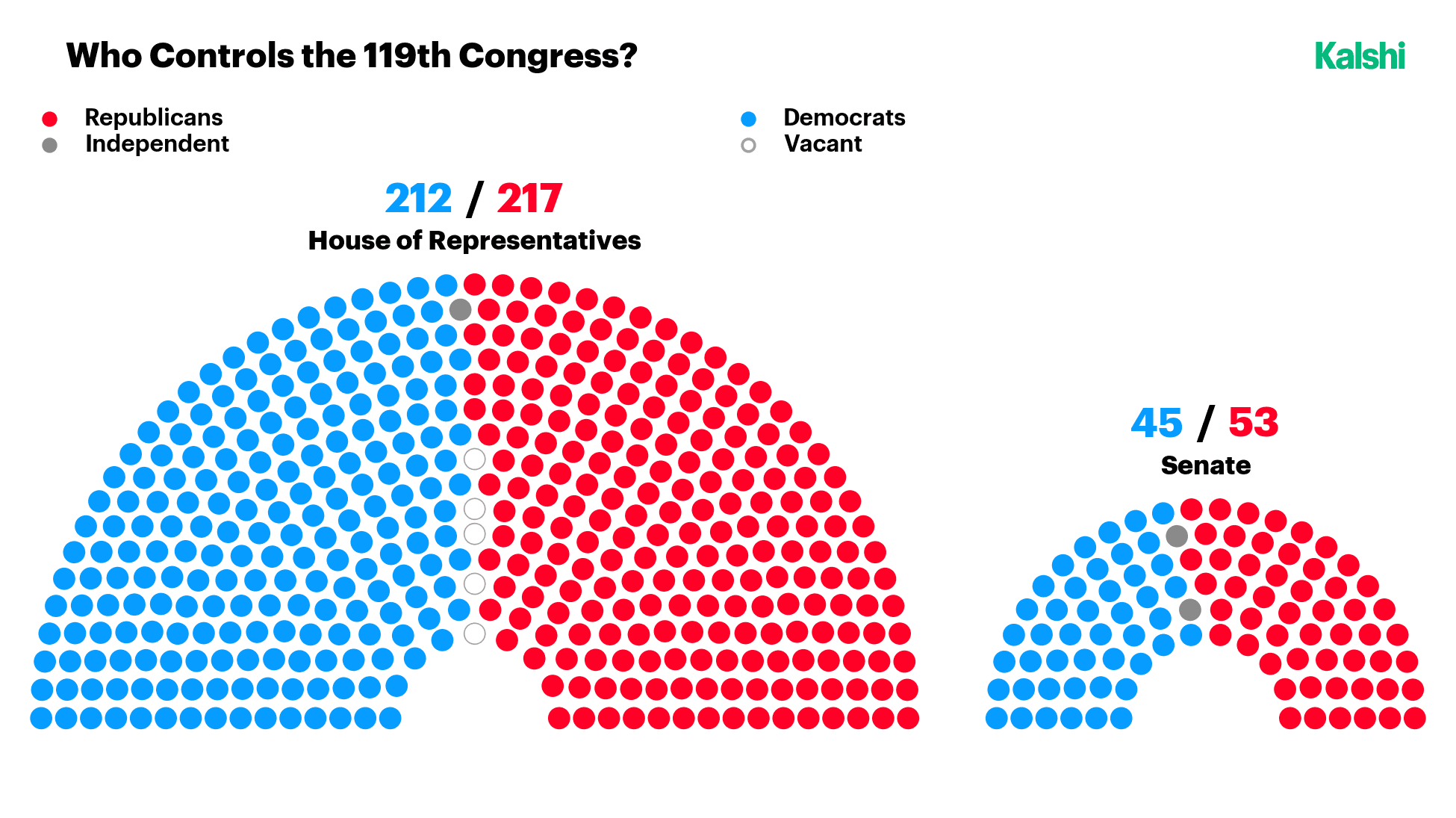
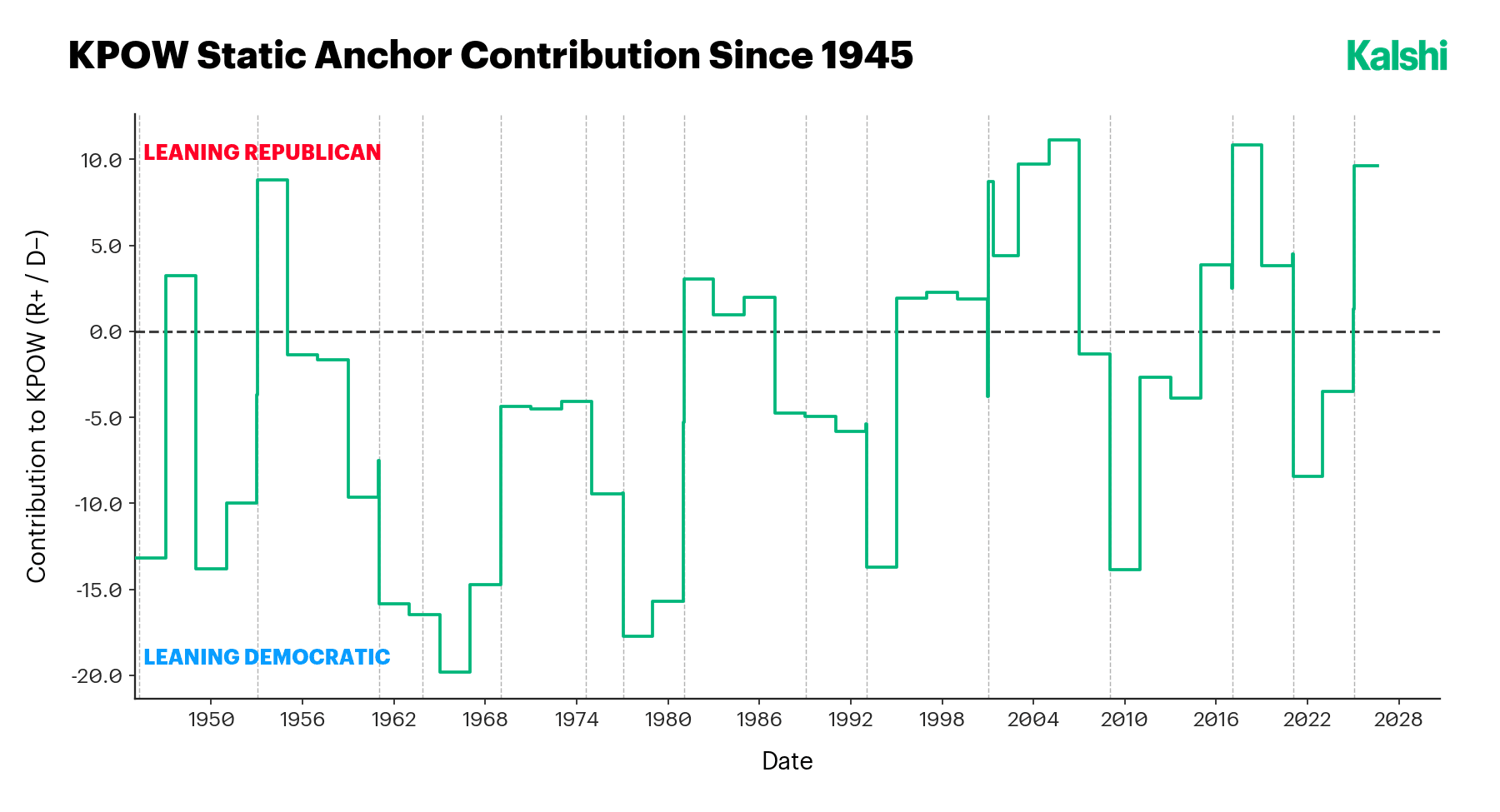
Post-2024, Republicans hold clear majorities in both chambers. In our formulation, that composition scores +37.5 Republican on the static leg, contributing +9 to the headline Index, a level of control rivaled only by 1952, 2002, and 2017.
Taking it Back in Time
Backing out the static anchor to 1945, the series shows a drift toward the GOP since the 1970s, though moderated by frequent oscillation.
The Expectations Engine
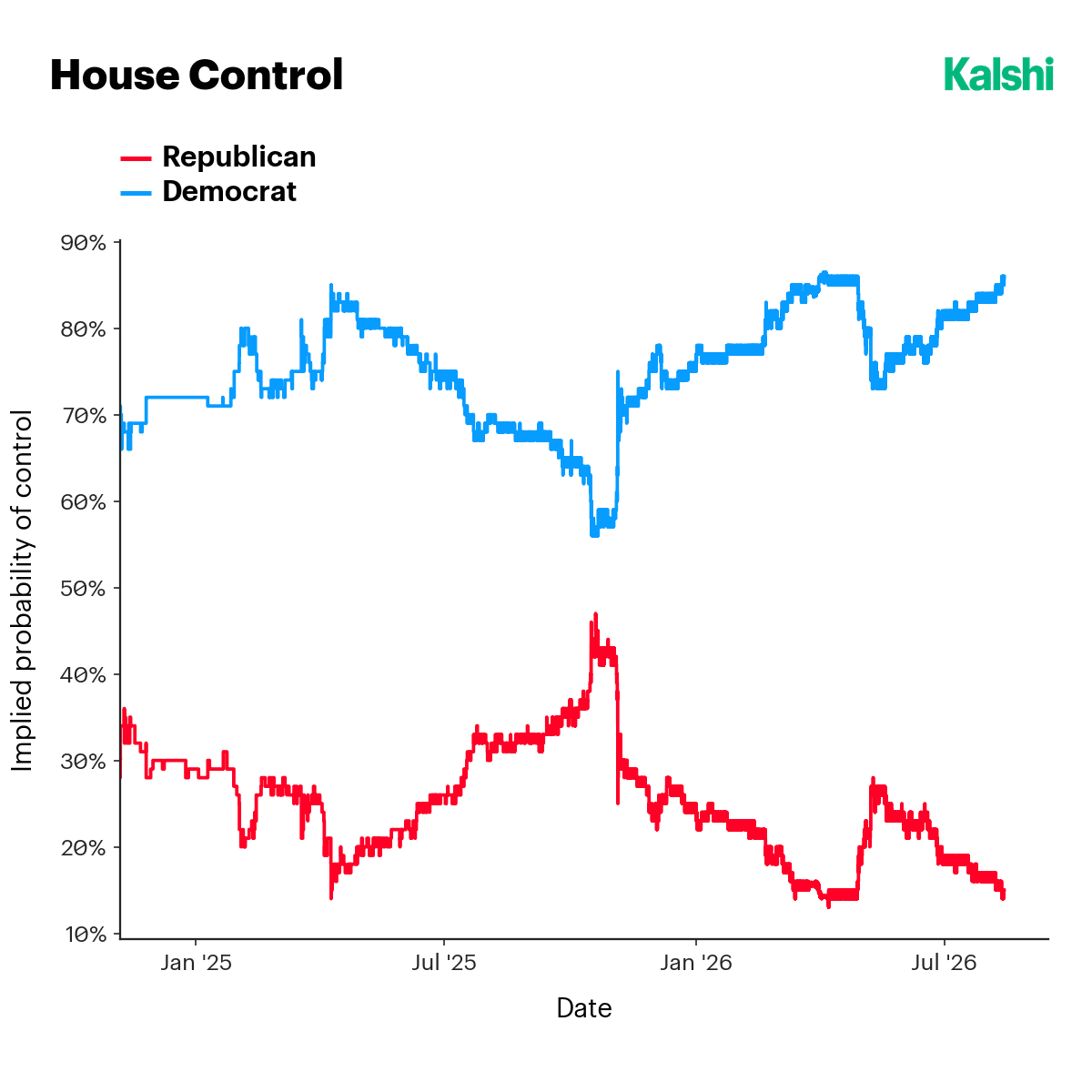
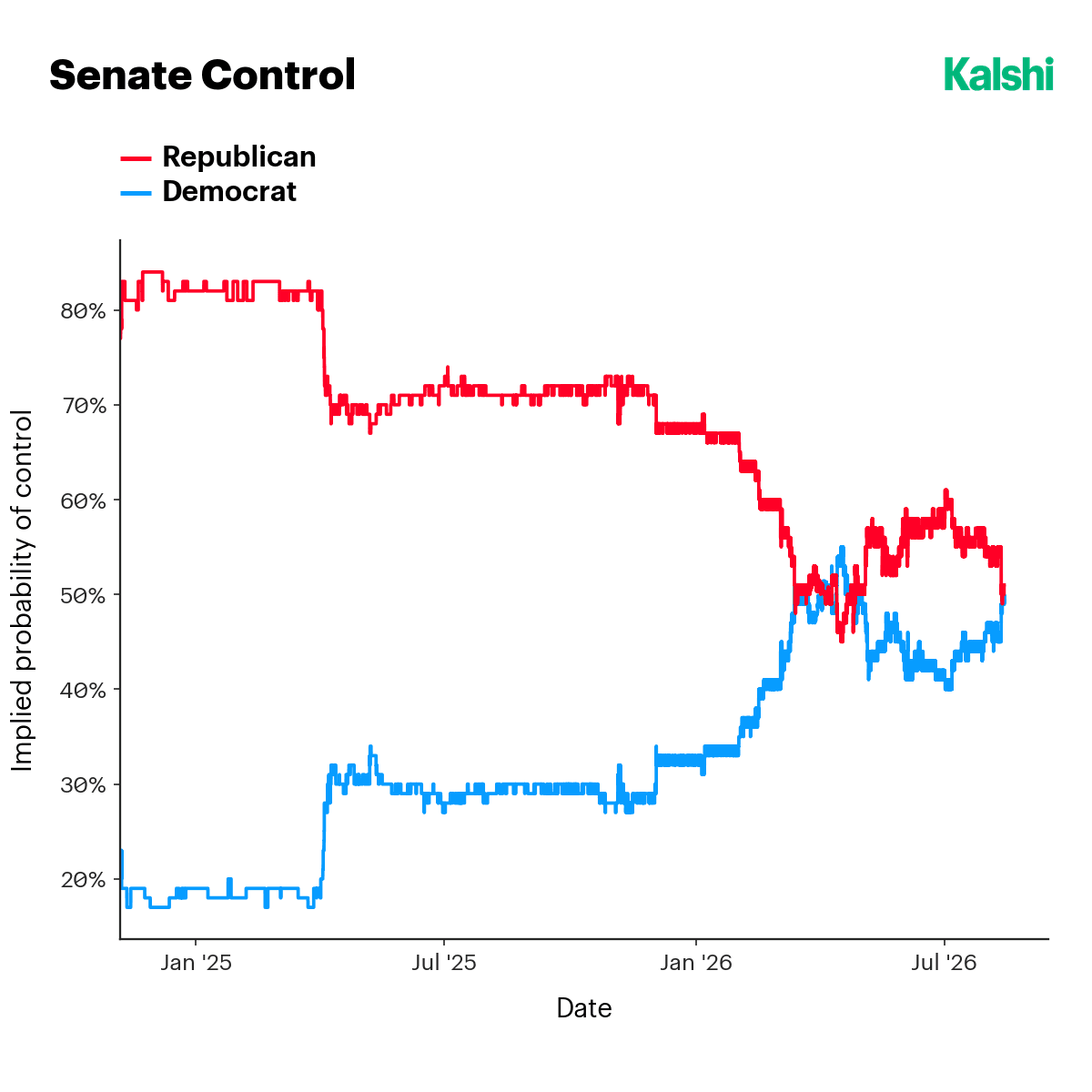
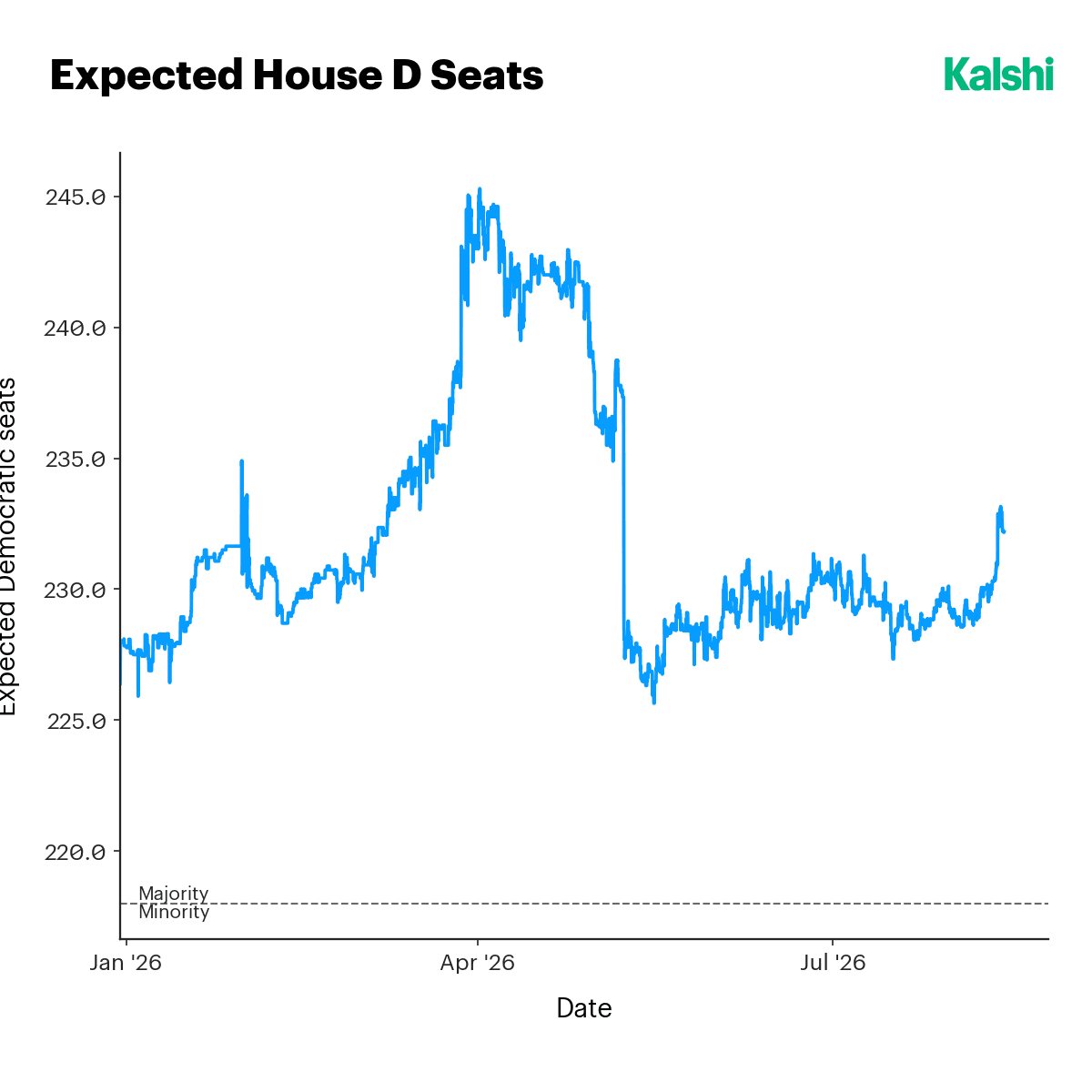
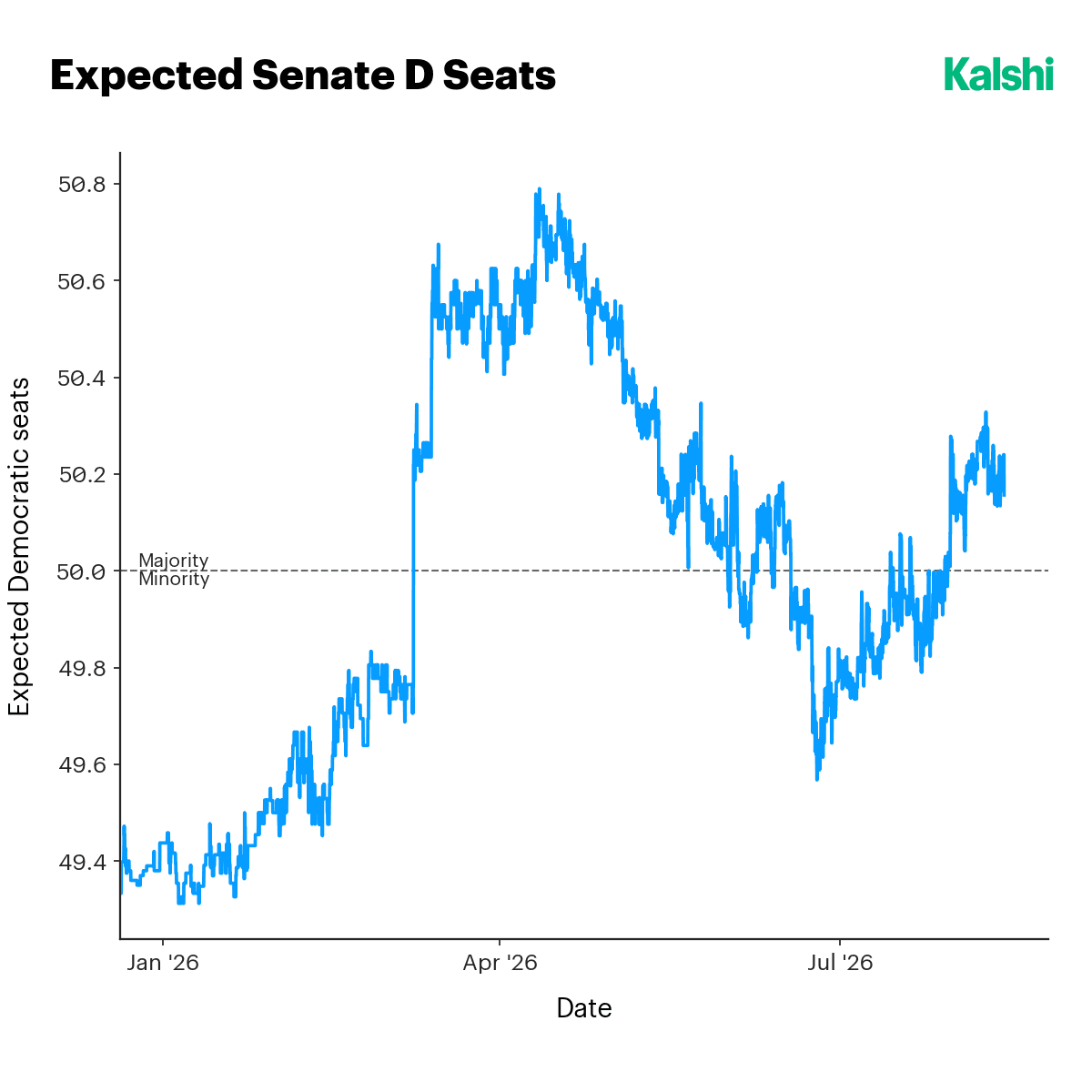
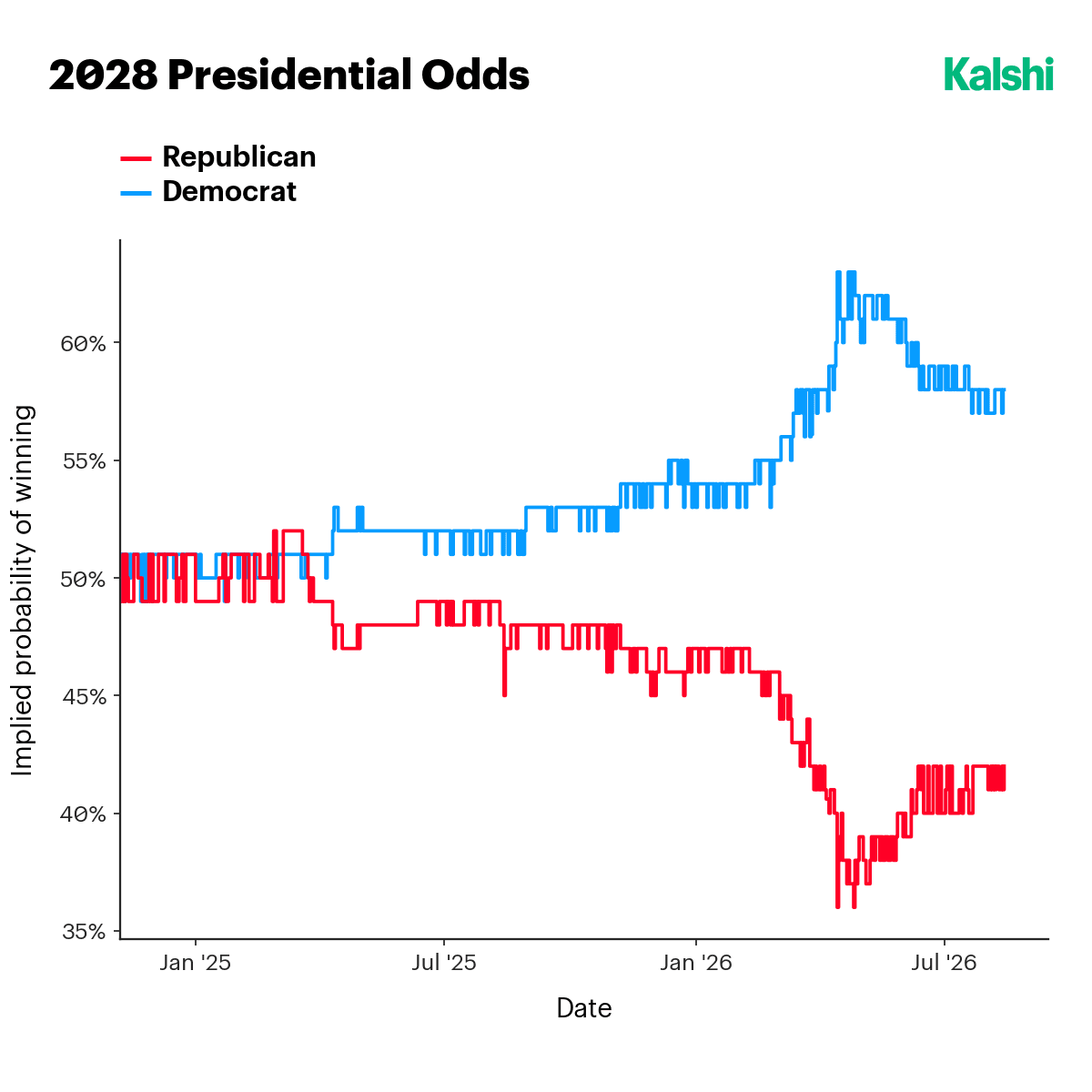
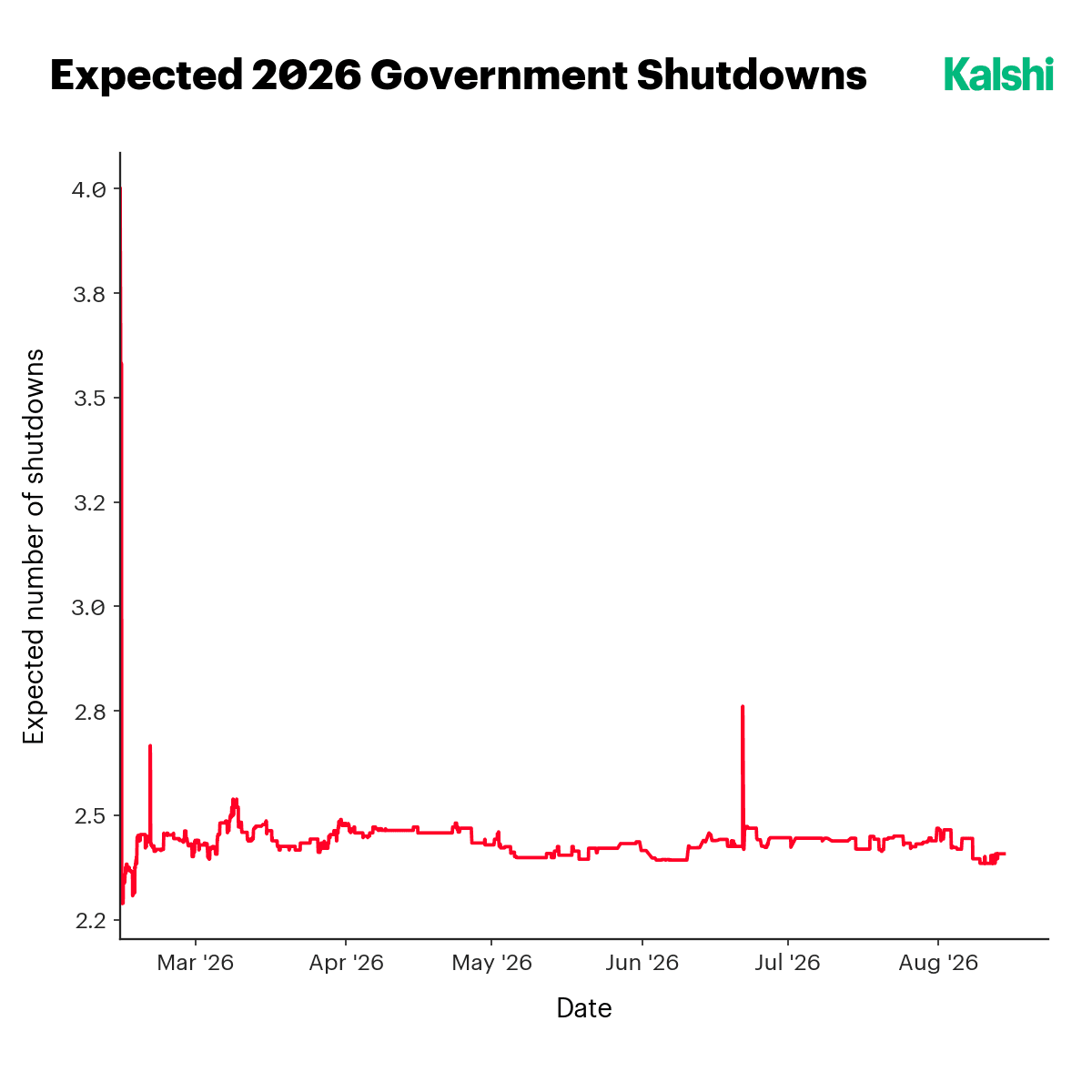
The forward-looking leg drives essentially all of KPOW’s variation and rolls up six market-derived components: the probability of Republican and Democratic control of the House and of the Senate after the 2026 Midterms; expected seat counts in each chamber; 2028 presidential odds, backed out of Kalshi’s 2028 election market; and a government shutdown component weighted by expected blame, length, and scope. Any one of the six can be the marginal driver at a given moment, which is what the last twelve months have shown.
The 6 Components
Enjoying this? Get our next piece of research as soon as it's out.
The Index in Motion: Case Studies
We run KPOW’s path from R +10 to Even through three episodes, each driven by a different one of the six components, and each illustrating how a single news event may move multiple chambers together rather than one race at a time.
1. Government Shutdown
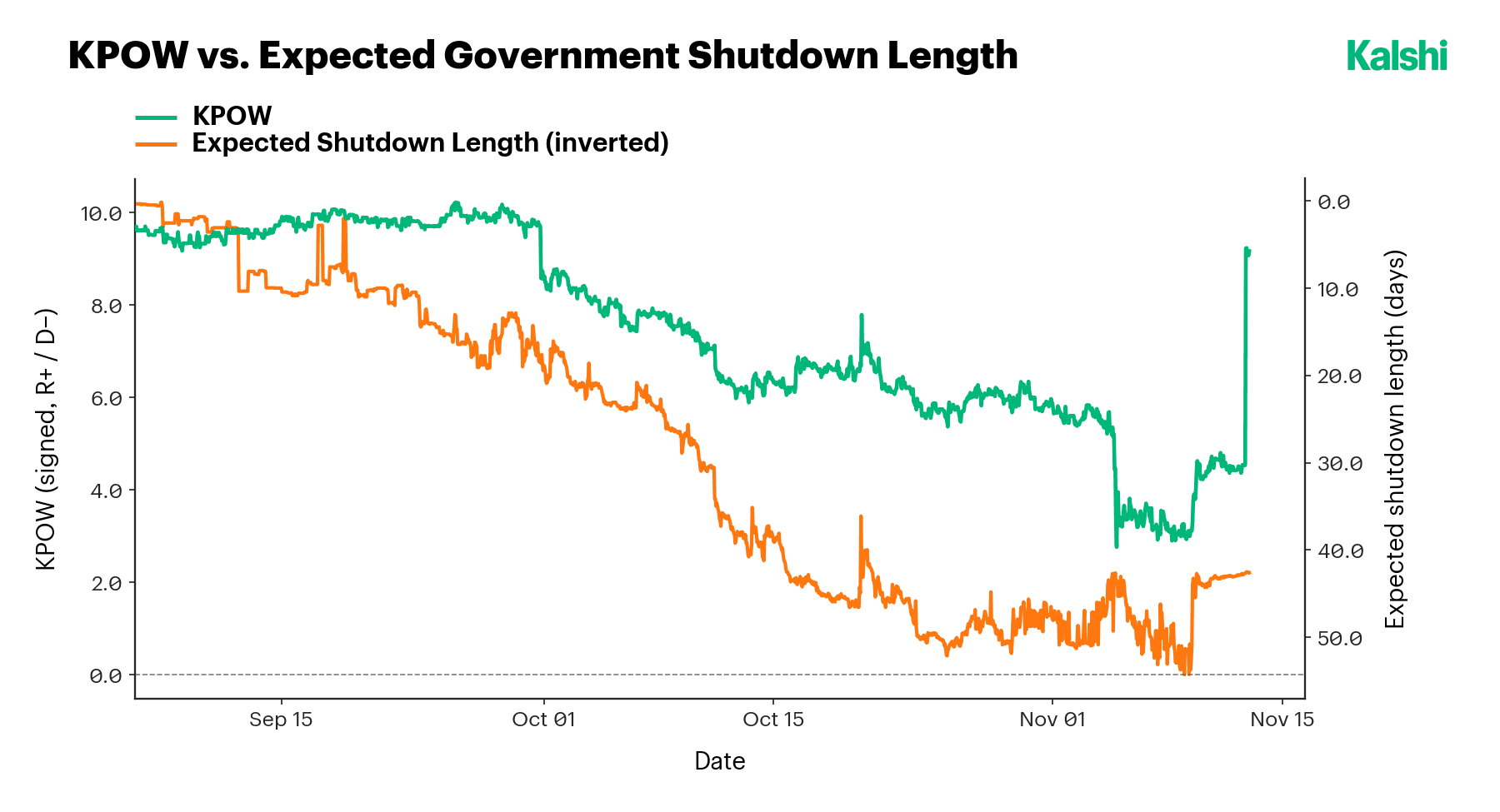
In October 2025 a prolonged shutdown occurred, affecting 2.2 million government employees. KPOW moved in lockstep with Kalshi’s market on the expected length of the shutdown – the most salient political news of the time – moving from +10 Republican to only +3. The longer the shutdown was expected to last, the more the Index shifted toward the Democrats. When the shutdown was lifted on November 12th, KPOW jumped back up towards the Republican party as the component lost its weight.
2. Supreme Court Decisions
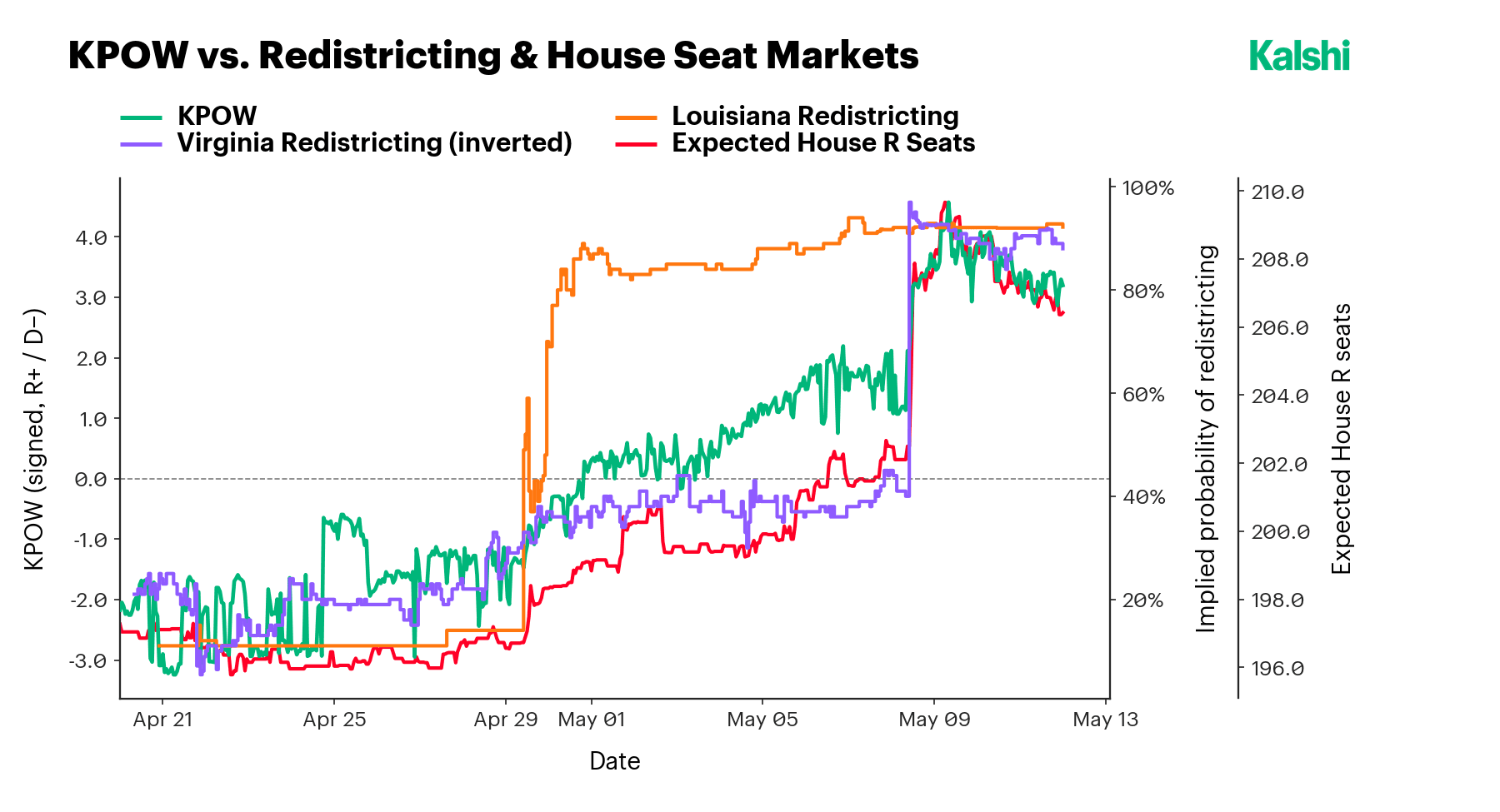
Re-districting decisions carry significant implications for future election outcomes, and their success contributes both to the electability of a party in a given chamber and the perception of judicial or legislative control. We saw this immediately reflected in KPOW, moving it from D –3 to R +3 as two Supreme Court rulings struck down Democratic redistricting maps in Louisiana and Virginia, adding an expected 10 House seats to the Republicans. Ceasefire talks with Iran contributed at the margin, but the redistricting rulings did the bulk of the work, and they moved House-seat expectations and the presidential-odds leg together rather than one market in isolation.
3. The Oil Story
The Iran story has captivated headlines all year and we have written on the subject in the past. Both at the beginning of the special operation and throughout the ensuing months, the relationship between oil prices – a key input into the current cost pressure being felt at the pump – and the perception of grip on electoral power has contributed to a slide to the left.
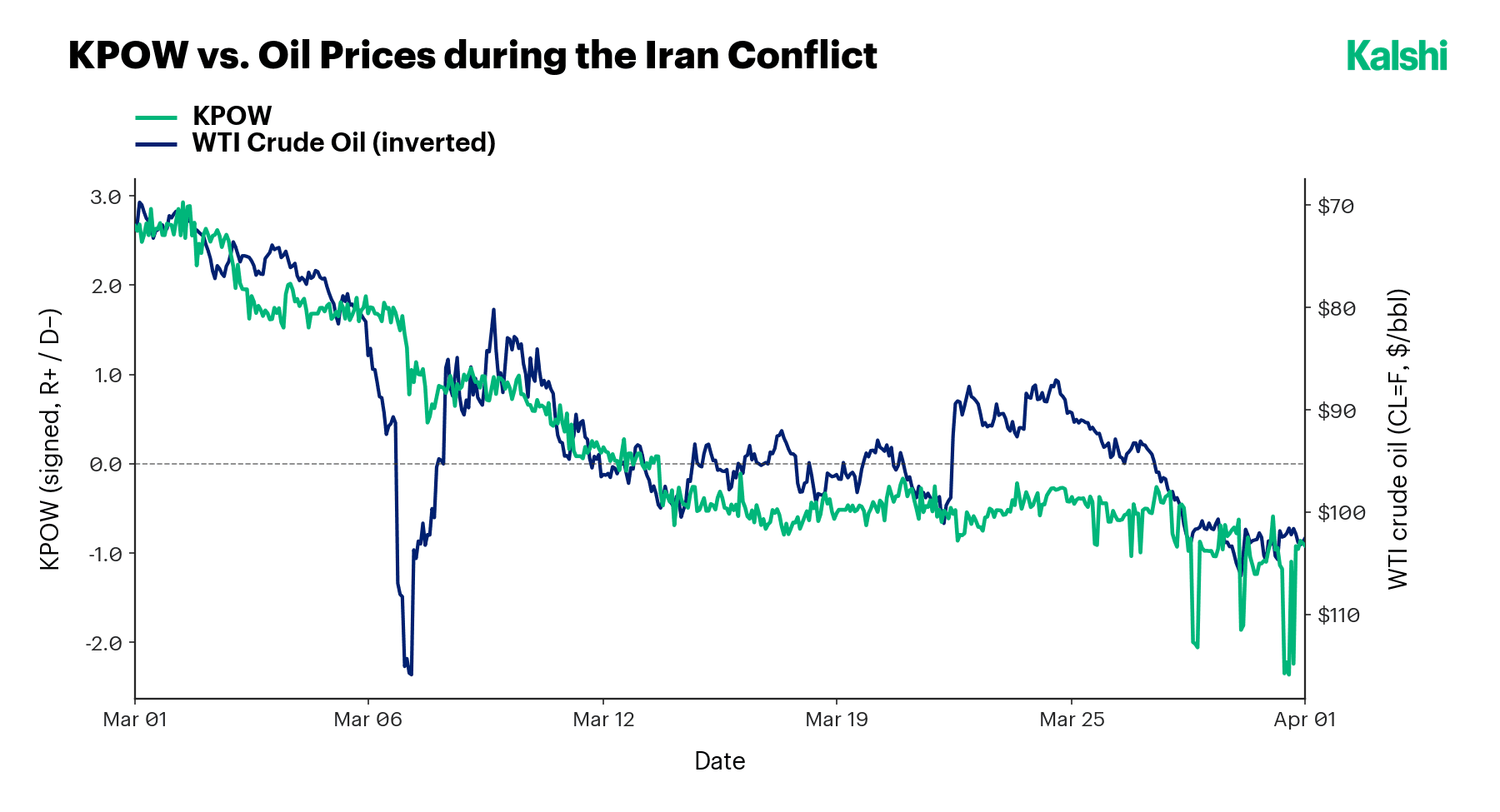
These three threads are simply illustrative of the key motivation for KPOW – that when politically and geopolitically impactful events occur, their effects are felt not just in an isolated way in one chamber of government, but rather through a number in concert. Together, all contribute to a broad picture of who has a grip on power, which markets previously were forced to price and weigh independently.
Conclusion
Heading into the 2026 Midterms, KPOW sits at Even, roughly R +0.6. That level is consistent with an 85% implied probability that Democrats take the House and a genuine coin-flip on the Senate. The near-term driver is a cluster of House and Senate tossups where Democrats have been gaining ground, tempered by markets pricing progressive primary winners with some skepticism. As we move into the midterm elections, we should expect substantial volatility – and to be able to timestamp exactly what drives it, using KPOW.
Find the index here: kalshi.com/KPOW
About Kalshi Research
Signal-rich analysis of prediction markets. Questions, data access (currently free for institutional clients), or collaboration: research@kalshi.com
Disclaimer
This report is published by Kalshi Inc. (“Kalshi,” “we,” or “us”) for informational and educational purposes only. It is not investment, legal, tax, or trading advice, and it does not constitute a recommendation or solicitation to buy, sell, or hold any event contract, security, or other financial instrument. Nothing in this report creates a fiduciary, advisory, or professional-client relationship between Kalshi and the reader.
Kalshi operates a CFTC-regulated exchange. The event contracts and forward curves referenced herein are traded on or derived from Kalshi’s platform. The market prices, forward curves, and implied probabilities cited in this report reflect what market participants thought at a given moment; such data is subject to change without notice. These figures are not guarantees or predictions of actual outcomes. Past and current prices do not indicate future results. Data sourced from third parties is believed to be reliable but has not been independently verified. Third-party projections and estimates cited herein are subject to significant uncertainty and may not be realized.
Trading event contracts carries risk, including the risk that you may lose some or all of your invested capital. Event contract outcomes are binary and can result in the total loss of the amount paid for a contract. Every figure and probability here is current only as of the date of publication. Kalshi undertakes no obligation to update, revise, or correct this report after publication.
Kalshi, its affiliates, officers, directors, and employees may have financial interests in the contracts or markets discussed herein and may trade them at any time without notice to readers.
This report is not directed at any person in any jurisdiction where its distribution or the offering of event contracts would be contrary to local law or regulation. Before acting on anything in this report, consult your own independent legal, tax, financial, or other professional advisor.
This report is not insurance advice and does not constitute a recommendation regarding the purchase, renewal, or cancellation of any insurance policy or program. Comparisons between event contracts and insurance products are illustrative only and do not account for differences in regulatory protections, counterparty credit risk, claims processes, coverage scope, or policyholder rights that may apply to traditional insurance. Readers should consult a licensed insurance professional before making decisions about their insurance or risk-transfer arrangements.
Get new Kalshi Research publications and insights as they are released.