
SpaceX Earnings: Pricing Elon’s Trillion-Dollar AI Space Story
Published August 3, 2026
Download PDFNew Kalshi Research, straight to your inbox.
- For now it’s a compute story, not a rocket story. Markets are pricing much of the earnings call to be dominated by discussions of AI compute deals.
- Orbital data centers are not expected in the next half-decade. Kalshi markets assign just 23% probability to a 1-megawatt facility reaching orbit by 2030, rising to only 39% by 2034, making SpaceX largely a terrestrial (Colossus) bet for now.
- Competition is real and moving quickly. Kalshi markets price a 63.4% chance Blue Origin beats SpaceX to the moon, and a ~40% probability that China does.
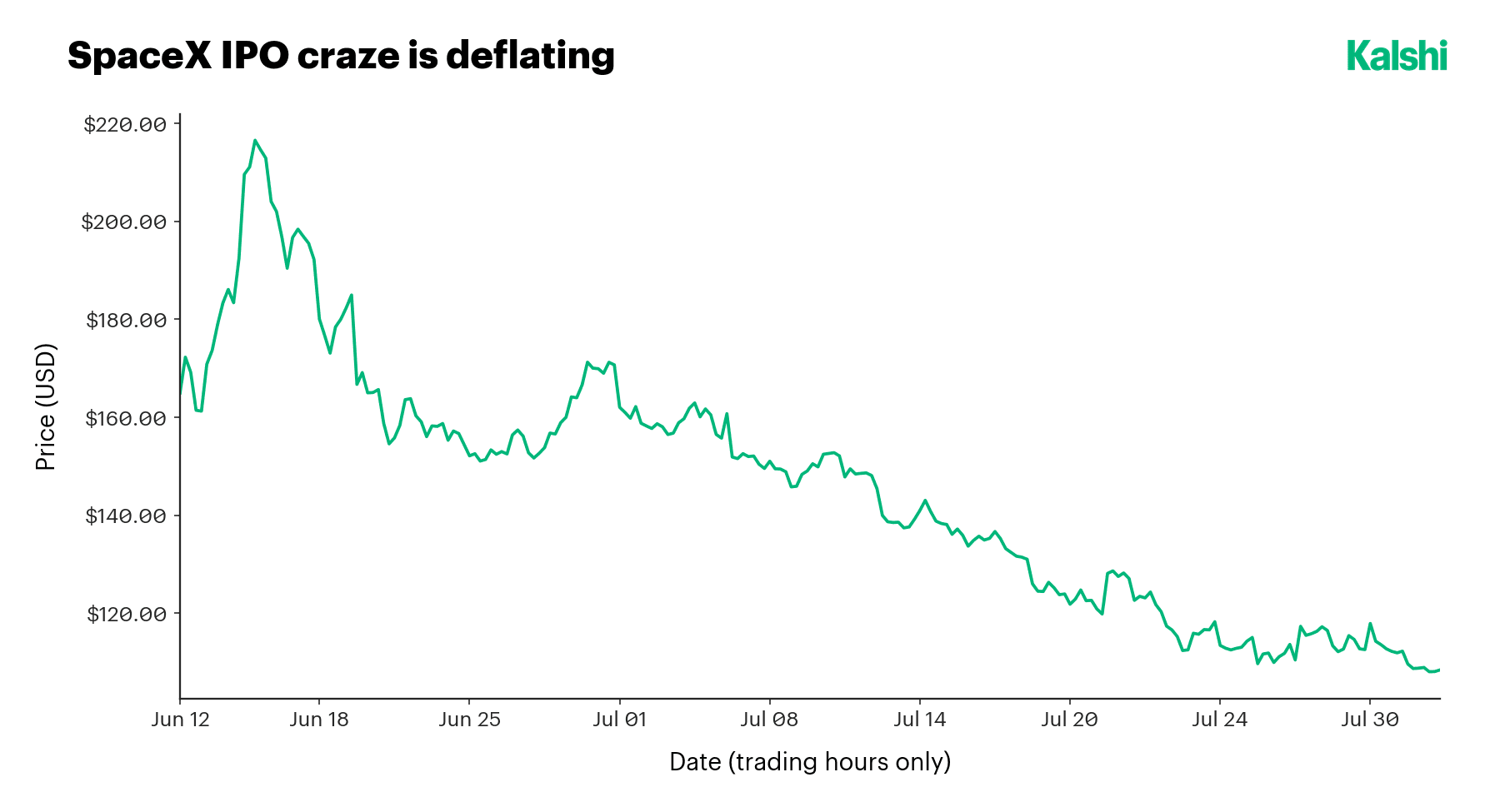
SpaceX reports its first earnings after market close on Tuesday, marking its first public financial statement since its June IPO – the largest in history, which raised $75bn and briefly valued the company above $2tn. Much of the enthusiasm around that debut stems from investors treating SpaceX as a hard to price “ideas” company, one whose valuation rests as much on multi-year narratives, including Starship, AI compute, and extraterrestrial settlement, as it does on current disclosed cash flow. That dynamic, combined with the fact that SpaceX is effectively several distinct businesses bundled into one stock, has made shares highly volatile, with the price down 52% from its June all-time high. Together, these factors have largely decoupled SPCX’s stock price from its underlying fundamentals.
Adding to the uncertainty, a large tranche of insider and employee shares, over 900 million in total and representing up to $100bn in potential selling pressure, comes out of lock-up just two trading sessions after Tuesday’s report. In this report we dive into how Kalshi traders are pricing key performance indicators, taking precise positions in an otherwise noisy public market.
Tuesday's Headlines
Kalshi markets point to three key narratives likely to come out on the earnings call this week:
1. AI compute
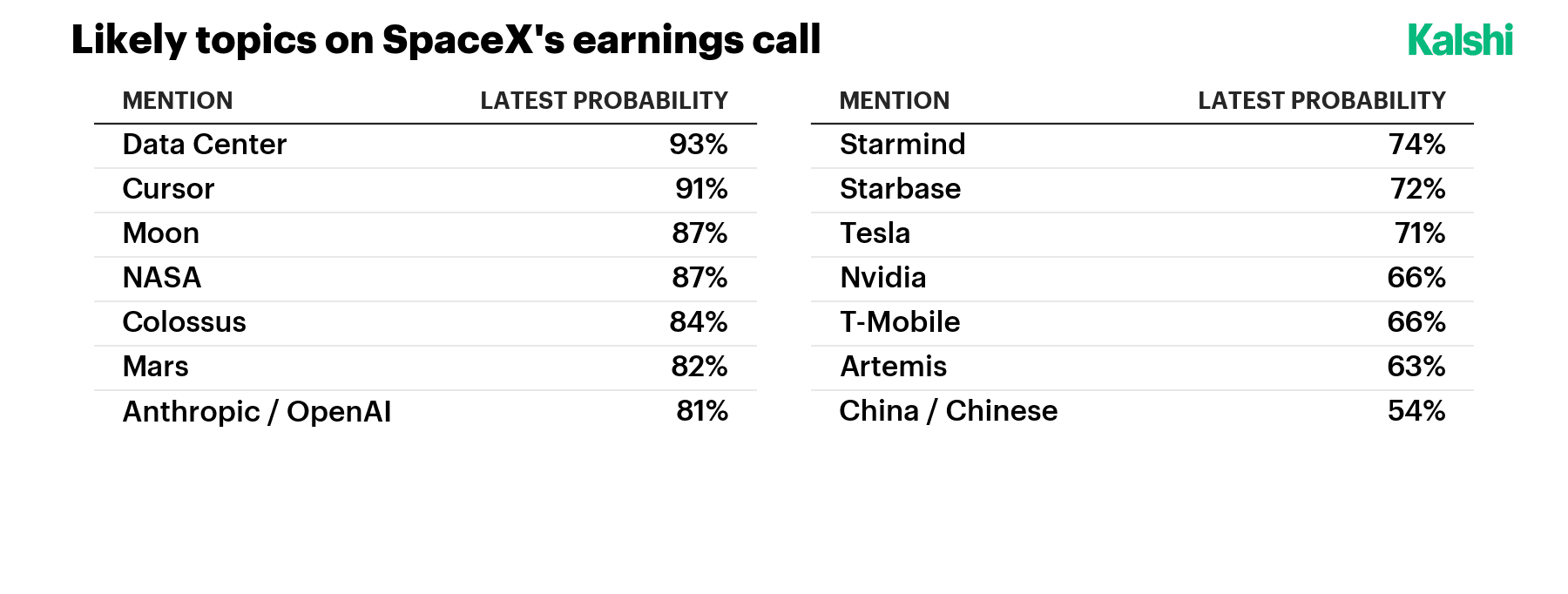
Unsurprisingly, the key story driving the call is likely to be AI compute. “Data center” tops the list at 93%, with Colossus (84%), Anthropic (81%), and Nvidia (66%) close behind. In May, SpaceX agreed to give Anthropic access to roughly 325,000 Nvidia GPUs across Colossus for $1.25 billion per month, and weeks later struck a similar deal with Google for about 110,000 GPUs at $920 million per month; together, those two contracts alone could generate roughly $26 billion a year, more than SpaceX’s entire revenue the year before. That’s before counting a separate $150 million a month deal with Reflection AI worth up to $6.3 billion if it runs through 2029. It’s important to note that Nvidia is not just a “chip-supplier” to SpaceX, but an investor. Nvidia invested up to $2 billion in xAI’s $20 billion funding round in January 2026, structured through a special purpose vehicle that used the money to buy Nvidia GPUs, which xAI then leased back for its own data centers. When SpaceX acquired xAI the following month in an all-stock merger valuing the combined company at $1.25 trillion, that Nvidia stake converted into SpaceX equity, making Nvidia an actual shareholder in the company whose data centers it supplies.
Zooming in to finer details, Cursor’s 91% mention probability ties to SpaceX’s reported option to acquire the startup for $60 billion later this year, or pay a $10 billion breakup fee if it doesn’t.
2. Exploration and government work
SpaceX has historically held about $22 billion in cumulative federal contracts across NASA (87%), the Space Force, the NRO, and the Space Development Agency, with the Artemis Human Landing System contract worth about $4.04 billion (over $2.6 billion already disbursed), a classified NRO Starshield contract worth roughly $1.8 billion, and an ISS deorbit vehicle contract at $843 million. That base has grown sharply in just the past few months. SpaceX has already secured at least $7 billion in Pentagon contracts in 2026 alone, including a $4.6 billion award for an airborne moving target indicator satellite system and $2.29 billion for a related data relay network, plus a $1.6 billion contract awarded last week for 18 Falcon 9 launches carrying Space Based Sensing and Targeting satellites through 2027. Much of this ties to Golden Dome, the roughly $185 billion missile defense initiative where SpaceX is currently the only functioning launch provider, since rivals ULA and Blue Origin remain grounded. The potential upside is large too: the Space Force just tripled the ceiling on its NSSL Phase 3 Lane 1 launch contract from $5.6 billion to $17 billion, shared across seven providers through fiscal 2029, and under the separate Lane 2 track, SpaceX is already set to receive about $5.9 billion, or 43% of $13.7 billion in total launch spending, for missions running 2027 through 2032.
The flagship claim – settlement on Mars – has also not disappeared, reporting a 82% probability of being mentioned on Tuesday.
3. Corporate structure
The Tesla story (71%) isn’t just governance and control, it’s increasingly a capital expenditure story. SpaceX allocated more than 75% of its $10.1 billion in first quarter capex to AI, while Tesla has guided to total 2026 capex exceeding $25 billion, up from roughly $8.5 billion the year before. Both companies are pouring money into Terafab, a joint chip manufacturing plant with xAI that was originally pegged at $25 billion but which SpaceX has since disclosed could cost $55 billion for its first phase alone, with full buildout potentially reaching $119 billion. UBS estimates SpaceX could spend about $135 billion on wafer fabrication equipment for Terafab over five years, and RBC sees the project generating over $1 trillion in chip cost savings by 2050 if Tesla and SpaceX combine their procurement.
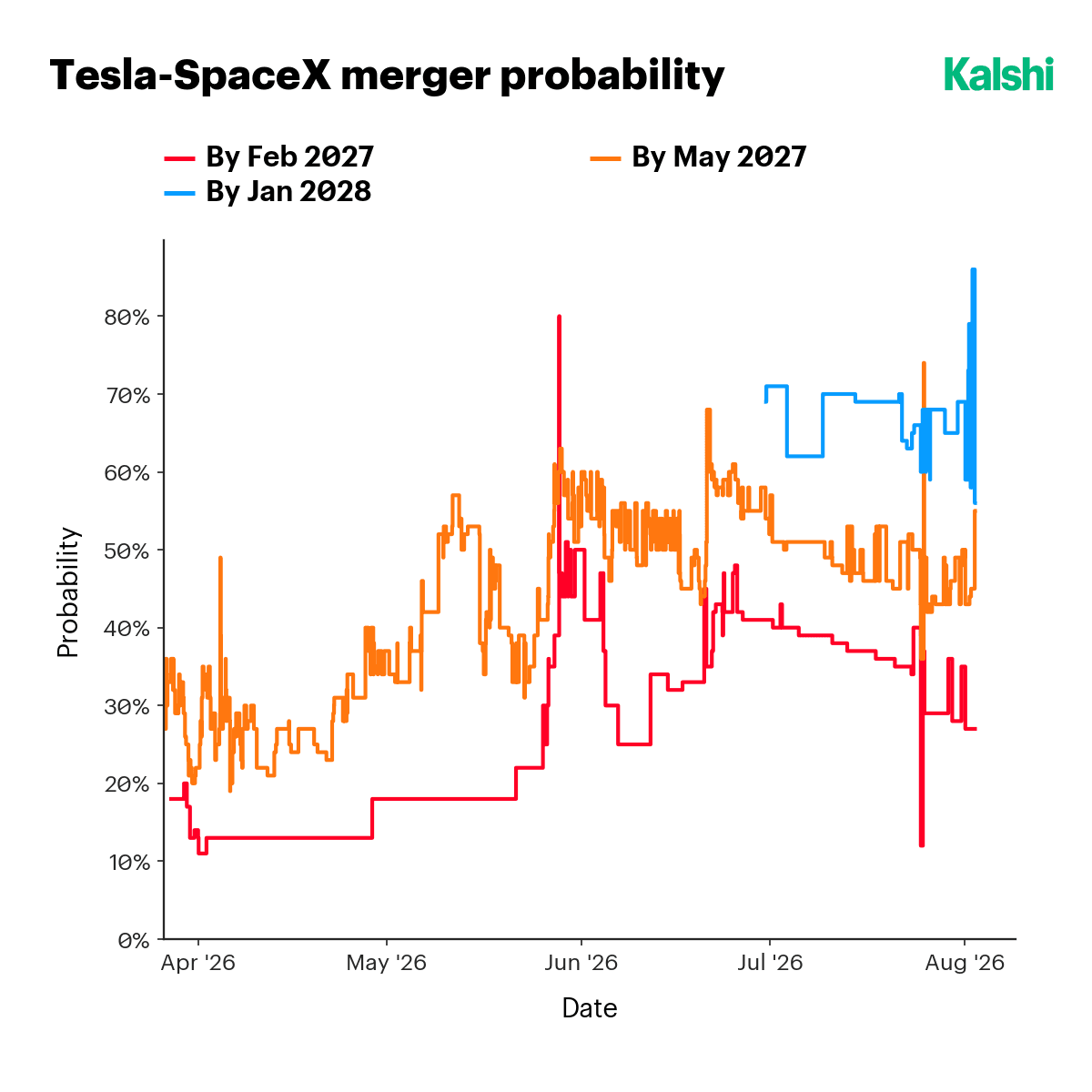
The financial case for merging, in other words, is partly about pooling two enormous and overlapping capex programs under one balance sheet, so neither company has to fund its AI buildout alone. The counter argument is just as sharp: Goldman Sachs estimates SpaceX alone needs about $270 billion in debt between 2026 and 2030 and doesn’t expect positive free cash flow until late 2030, and stacking Tesla’s capex on top of that would mean combining two cash burning businesses rather than one funding the other. On governance, Musk holds more than 80% of the voting shares at SpaceX versus only about 20% at the publicly listed Tesla, so a merger would extend his control considerably. Musk himself raised the overlap on Tesla’s own July earnings call, saying there was “more and more overlap” between the companies, while declining to confirm a transaction. Markets are pricing such a move as more likely than not by May 2027.
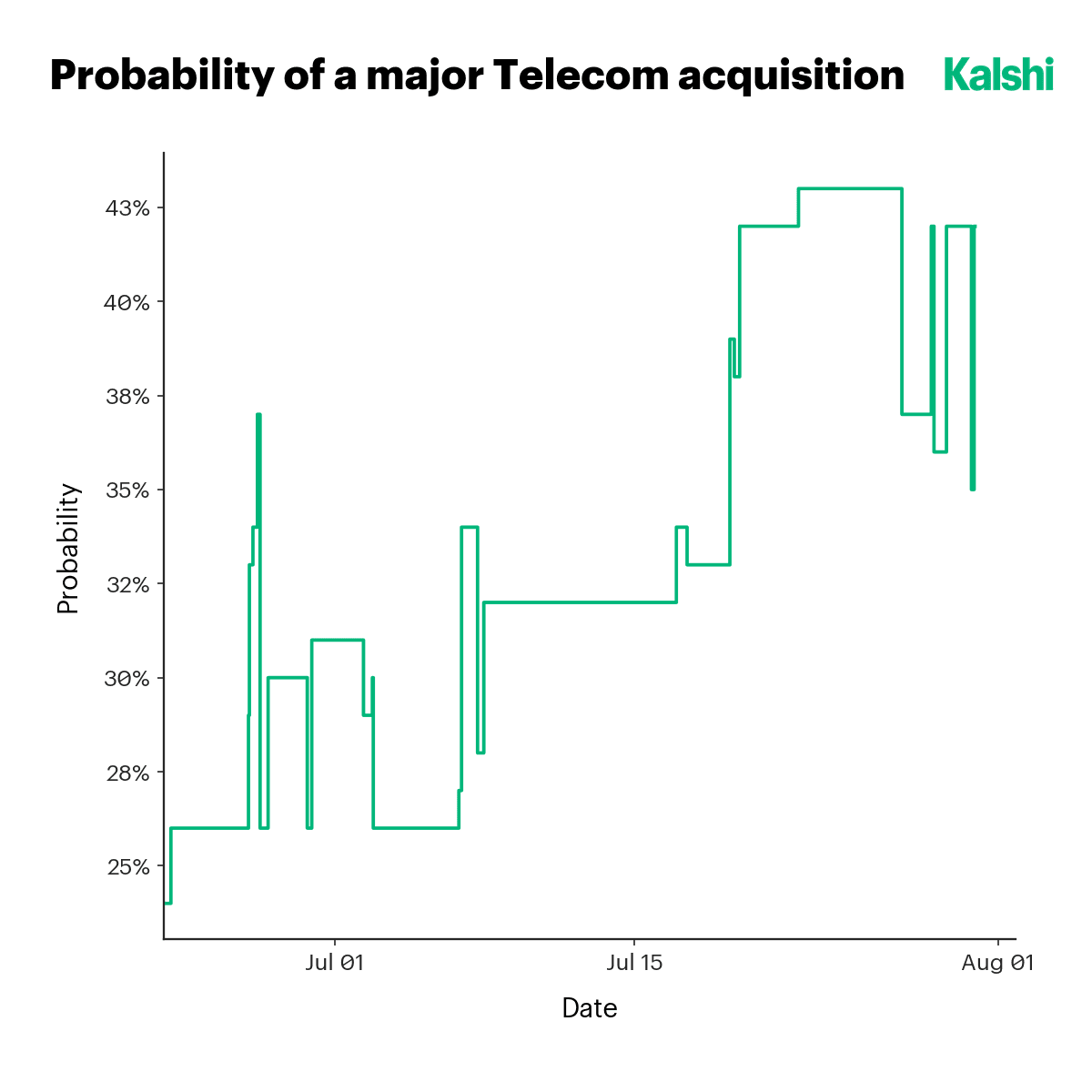
The T-Mobile mention (66%) isn’t about Direct to Cell, which is already live across 650+ satellites and 22 countries. It’s about acquisition speculation: analysts see T-Mobile as SpaceX’s likely target if it can’t land a wholesale network deal and wants to launch retail Starlink Mobile. That sits on top of SpaceX’s $17 billion EchoStar spectrum buy, the infrastructure any such deal would build on.
Zooming Into the Compute Story
American data centers are power-constrained. Grid interconnection queues may run past five years in some regions; individual AI sites now request 100–750 megawatts each. The thesis is simple: put the compute where the power and cooling are cheaper (read: free), and a large share of the rapidly growing $2.4tn AI-infrastructure industry may be yours. SpaceX isn’t alone in the idea, but does appear to be paving the way with greatest ambition.
Google unveiled its own version, Project Suncatcher, in November 2025: constellations of satellites carrying Google’s own TPU chips, linked by optical lasers, flying in a dawn-dusk orbit chosen for near-continuous sunlight, where solar panels generate roughly eight times what they would on the ground. Google plans to launch two prototype satellites with Planet Labs by early 2027 to test the concept, modest next to Starmind’s stated ambitions, but a signal the idea is being taken seriously well beyond SpaceX. (Musk’s own reaction to the announcement, posted on X: “Great idea lol.”)
That said, the idea is not without significant engineering challenge (and perhaps economic, given the sheer magnitude of cost associated with creating orbital data centers – widely understood to be a minimum of three times more expensive than terrestrial alternatives).
Starcloud flew the first Nvidia H100 in orbit last November and is targeting a larger “Hypercluster” design by October 2026. Axiom Space and Sophia Space both tested dedicated thermal hardware in January, working the same radiator problem from different angles. Starmind, SpaceX’s own answer, filed with the FCC in January for a constellation of up to one million AI satellites and unveiled its first “AI1” design in June, targeting a first launch in 2027, though each satellite is specified at just 120 kilowatts of average compute, a fraction of even the market’s 1-megawatt bar. Musk has floated a larger version still: a lunar factory building AI satellites on-site and launching them by electromagnetic catapult rather than rocket, eventually harnessing “a significant portion” of the sun’s total output.
Markets put the probability of a 1-megawatt data center, less than one-hundredth the size of SpaceX’s Earth-bound Colossus, reaching orbit by 2030 at just 23%, rising to a modest 39% by 2034. That skepticism reflects real doubt among traders about the near-term feasibility of placing so large and complex a facility in space.
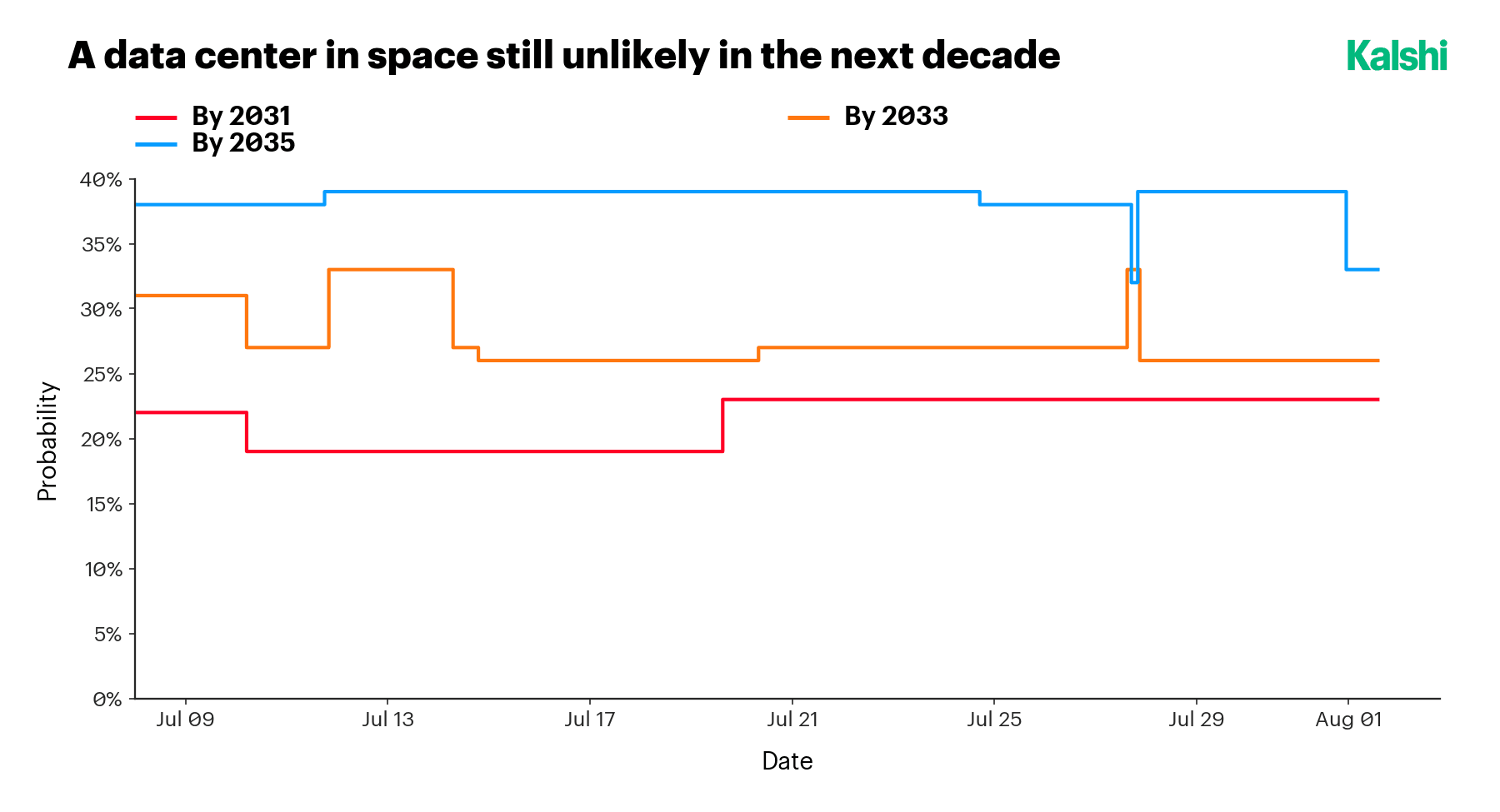
Still, the nearer-term, better-collateralized version of this story is entirely terrestrial. As previewed in the discussion of earnings mentions above: Colossus’s leases to Anthropic ($1.25 billion a month through 2029) and Google (~$920 million a month) are worth a combined $26 billion a year, by SpaceX’s own account. Everything more speculative than that, orbital data centers included, ultimately comes down to a single bet: whether SpaceX can get Starship working at the cost and cadence it has promised.
Enjoying this? Get our next piece of research as soon as it's out.
The Possibility of Dominating Space
Most of SpaceX’s targets hinge on its new Starship rocket. Its massive payload capacity and range push the industry beyond Low Earth Orbit while cutting cost per kilogram 99%, from $18,500 to mere hundreds of dollars, efficiencies meant to unlock orbital data centers, asteroid mining, and lunar and Martian colonization. The question is how close it is: across 13 launches, 8 were mission successes, the latest achieving the first controlled Starlink deployment and first successful upper-stage reentry, yet the stock buckled as experts called current heat-shield tech a “dead end” for rapid reuse, pointing to the real issue of ramp-up velocity, how fast Starships can be built, reliably launched, and reused.
On capabilities, Kalshi traders put only 7.7% odds on a human-graded lander version being tested this year, and 64% on a successful in-space refueling by 2028, key for NASA’s moon landing the next year. Markets expect the next attempt in early September, capping the year at 4 test launches, down from an estimated five last month. Moreover, markets are also significantly discounting total launch numbers from the beginning of the year, having reduced expectations by ~25% from January numbers due to expected delays and the complexity of the move toward Starship.
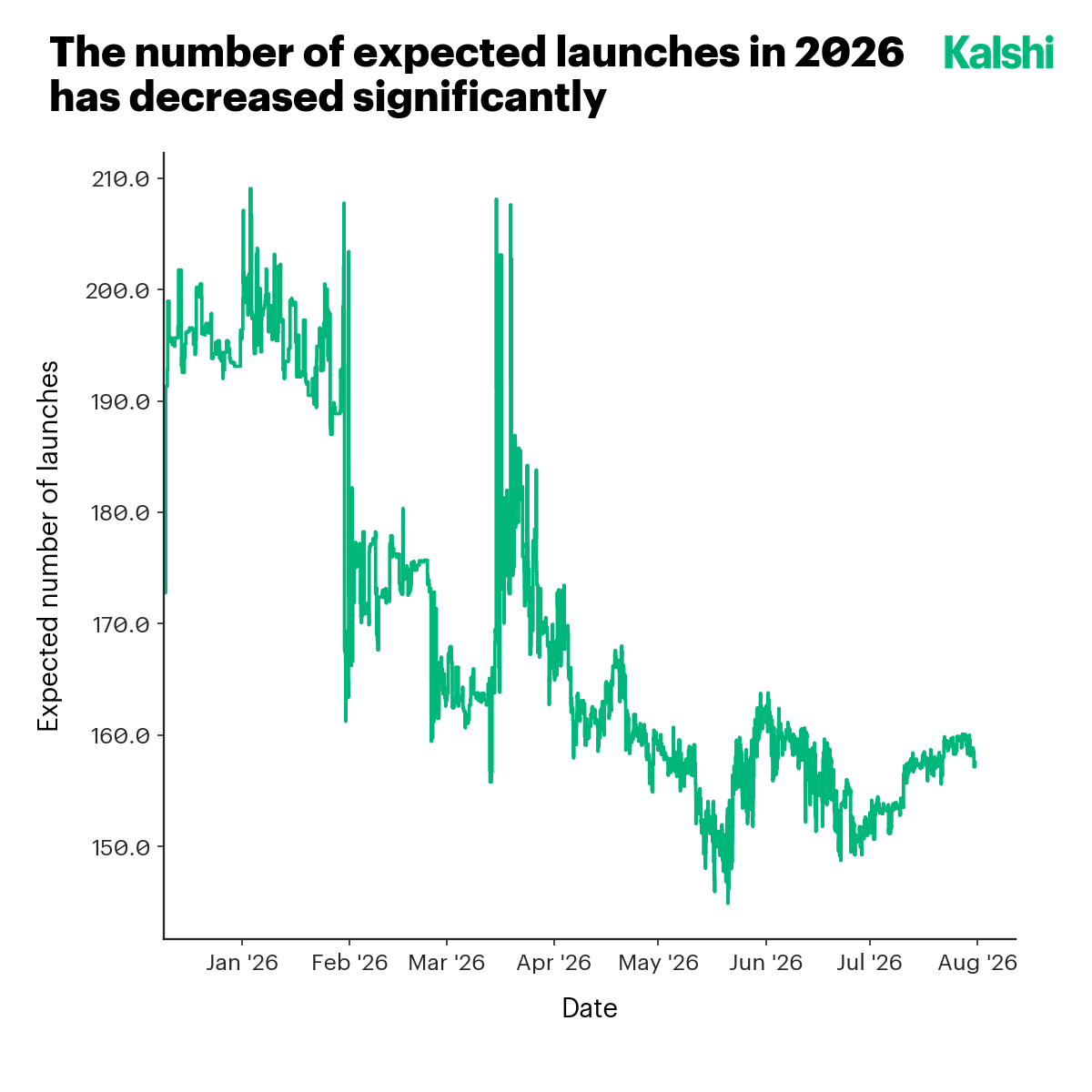
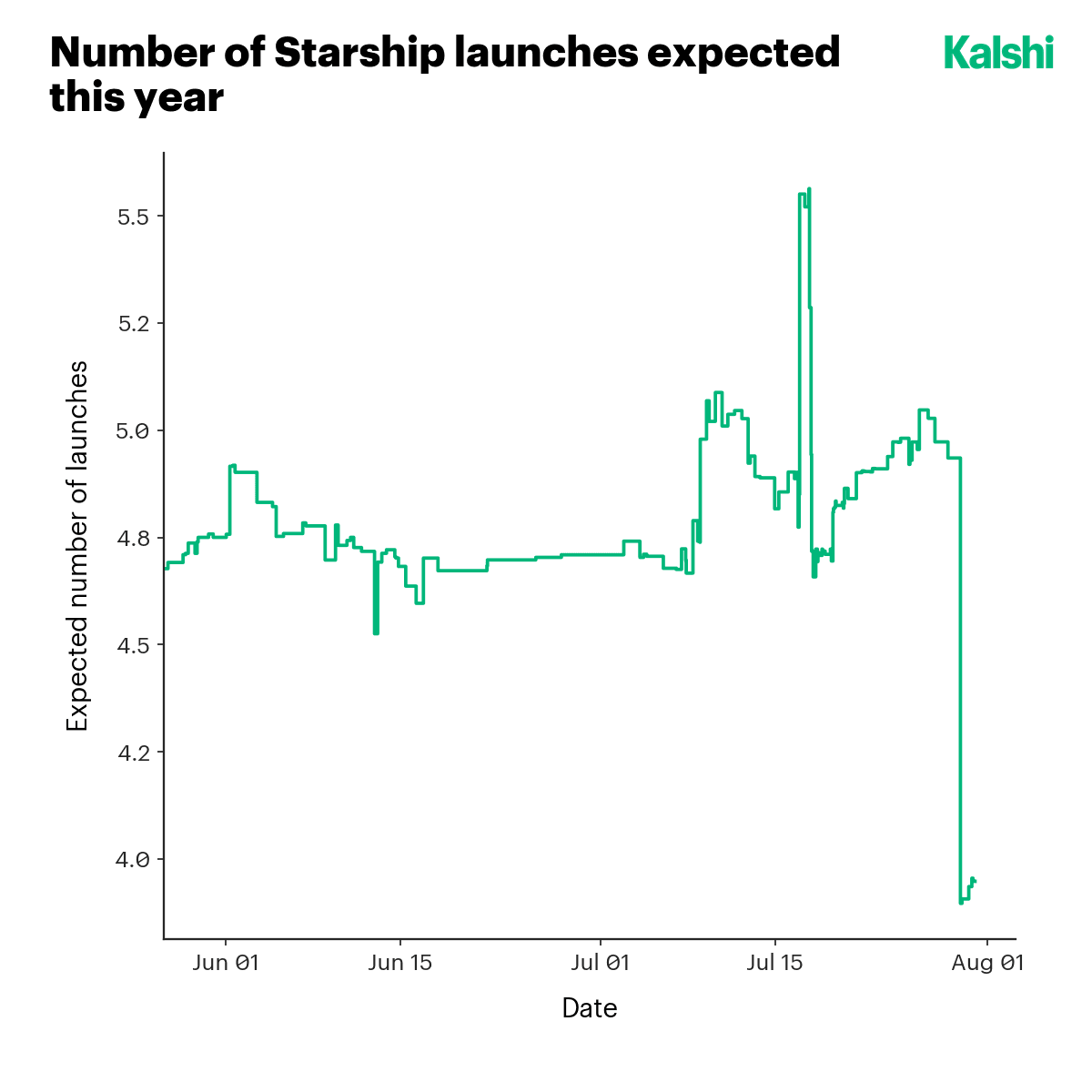
Such estimates signal significant uncertainty on the pace of development. It took SpaceX’s Falcon 9 family of rockets 10 years to scale reliably from 6 launches in 2014 to above a 100 in 2024. While SpaceX has much higher access to capital today its mission objectives are also much more complex. On aggregate, these milestones are likely to be achieved, yet Kalshi points towards this being later than what the stock market would hope for.
Outside Threats to SPCX Loom Large
That gap between the market’s optimism and Kalshi’s more sober timeline matters because SpaceX isn’t just racing against its own schedule. Two outside competitors are shaping how much slack it actually has: one fighting for the same near-term prize, the other running a longer, separate race that could matter more in the end.
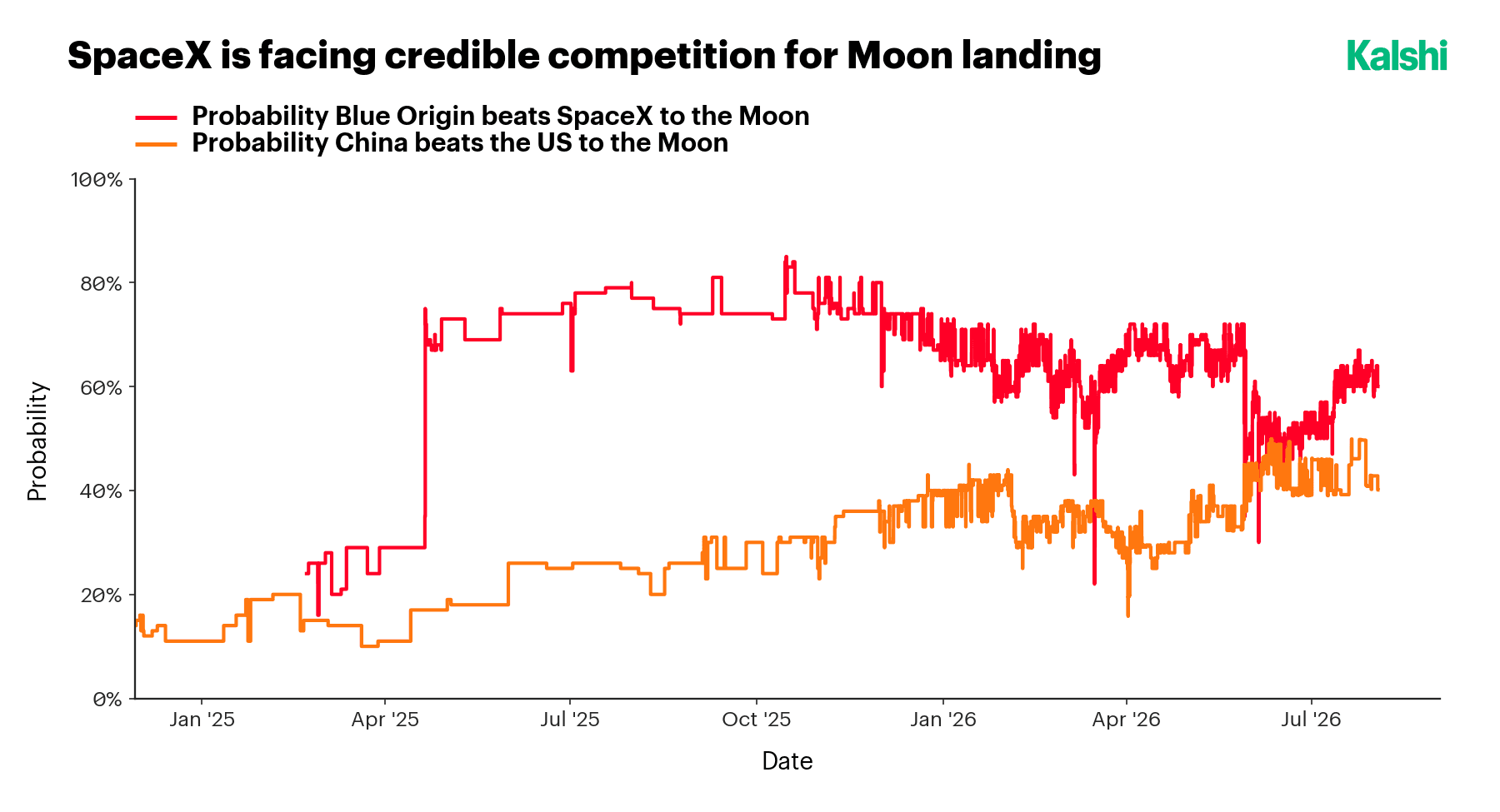
The more immediate risk, timing aside, is Jeff Bezos. Blue Origin’s simpler lunar lander design, initially passed over by NASA, has drawn renewed attention as SpaceX’s Starship program slips. Blue Origin’s rockets can’t match Starship on raw capability, but Bezos has positioned his company to win the nearer prize: NASA’s return to the moon, targeted for 2028. Kalshi currently favors Blue Origin at 63.4% to land there before SpaceX, in effect a bet that NASA picks the simpler, more schedule-certain lander over SpaceX’s more ambitious one. Losing that race wouldn’t be fatal, but it would cast a shadow over SpaceX’s footing for future NASA contracts. The delays behind it, though, are really a byproduct of ambition rather than incompetence: Starship is built for Mars, not just the moon, and the walls of SpaceX’s headquarters make that priority obvious, lined with pictures of Mars rather than the lunar surface.
The more durable threat sits on a longer horizon. China’s own crewed lunar program is built around a next-generation Mengzhou crew capsule meant to carry astronauts to the moon in 2030, alongside its Long March 10 rocket and Lanyue lander, and it’s advancing on a track entirely independent of whichever U.S. company wins the Blue Origin versus SpaceX contest. This month, China even successfully tested a re-usable rocket for the first time. China and the United States are now effectively racing toward the moon, with NASA targeting a crewed landing in 2028, two years ahead of Beijing’s stated goal. That’s a tight enough gap that a further Starship slip could hand China a symbolically significant first: it would be the first time humans have walked on the moon in more than 50 years, and China, not the U.S., would get there first. For SpaceX, that’s a different category of risk than Blue Origin. It isn’t a lost contract, it’s a lost race, one that could reshape how much political will and federal funding Washington is willing to keep pouring into the far more expensive, far more Mars-oriented roadmap that Starship represents.
About Kalshi Research
Signal-rich analysis of prediction markets. Questions, data access (currently free for institutional clients), or collaboration: research@kalshi.com
Reference Material
- Investing.com. "SpaceX (SPCX) Stock Forecast & Price Target." Accessed July 31, 2026. https://www.investing.com/equities/spacex-consensus-estimates
- "SpaceX Raises $75 Billion in Record-Setting IPO ahead of Nasdaq Debut." CNBC, June 11, 2026. https://www.cnbc.com/2026/06/11/spacex-raises-75-billion-in-record-setting-ipo-ahead-of-nasdaq-debut.html
- SpaceXNow. "SpaceX Launch Statistics: Falcon 9, Falcon Heavy and Starship." Accessed July 31, 2026. https://spacexnow.com/stats
- Space Exploration Technologies Corp. Roadshow Presentation. June 2026. https://s21.q4cdn.com/184289198/files/doc_events/SpaceX_IPO_Roadshow_Final.pdf
- Space Stats. "Launches by Year and Country." Last modified June 29, 2026. https://spacestatsonline.com/launches/country/
- Davenport, Christian. Rocket Dreams. New York: Dutton, 2025.
- Berger, Eric. "Despite Recent Successes, Rapid Reuse of Starship Remains a Tough Nut to Crack." Ars Technica, July 2026. https://arstechnica.com/space/2026/07/despite-recent-successes-rapid-reuse-of-starship-remains-a-tough-nut-to-crack/
Disclaimer
This report is published by Kalshi Inc. (“Kalshi,” “we,” or “us”) for informational and educational purposes only. It is not investment, legal, tax, or trading advice, and it does not constitute a recommendation or solicitation to buy, sell, or hold any event contract, security, or other financial instrument. Nothing in this report creates a fiduciary, advisory, or professional-client relationship between Kalshi and the reader.
Kalshi operates a CFTC-regulated exchange. The event contracts and forward curves referenced herein are traded on or derived from Kalshi’s platform. The market prices, forward curves, and implied probabilities cited in this report reflect what market participants thought at a given moment; such data is subject to change without notice. These figures are not guarantees or predictions of actual outcomes. Past and current prices do not indicate future results. Data sourced from third parties is believed to be reliable but has not been independently verified. Third-party projections and estimates cited herein are subject to significant uncertainty and may not be realized.
Trading event contracts carries risk, including the risk that you may lose some or all of your invested capital. Event contract outcomes are binary and can result in the total loss of the amount paid for a contract. Every figure and probability here is current only as of the date of publication. Kalshi undertakes no obligation to update, revise, or correct this report after publication.
Kalshi, its affiliates, officers, directors, and employees may have financial interests in the contracts or markets discussed herein and may trade them at any time without notice to readers.
This report is not directed at any person in any jurisdiction where its distribution or the offering of event contracts would be contrary to local law or regulation. Before acting on anything in this report, consult your own independent legal, tax, financial, or other professional advisor.
This report is not insurance advice and does not constitute a recommendation regarding the purchase, renewal, or cancellation of any insurance policy or program. Comparisons between event contracts and insurance products are illustrative only and do not account for differences in regulatory protections, counterparty credit risk, claims processes, coverage scope, or policyholder rights that may apply to traditional insurance. Readers should consult a licensed insurance professional before making decisions about their insurance or risk-transfer arrangements.
Get new Kalshi Research publications and insights as they are released.