
The Economics of Compute
Published July 22, 2026
Download PDFCompute prices have been supported by supply constraints and demand pressures that our markets are expecting to ease over the coming months. Risks persist, however, in potential grid interconnection delays, prolonged geopolitical conflict, and a shifting legislative landscape around data center construction.
New Kalshi Research, straight to your inbox.
Compute is, in the words of Nvidia’s CEO Jensen Huang, a “new natural resource.” Once merely a verb, the word has settled into common use as a noun – a shift that mirrors its own transformation from a back-office IT line item into the central strategic bottleneck dictating AI development, corporate capex and national industrial policy.
Given the surging equity valuations of companies tied to the industry – Nvidia, Amazon, SK Hynix – the question of most interest is not whether compute is currently scarce – it is – but whether that scarcity is structural or a supply-demand mismatch that is moving toward resolution. Kalshi’s markets, which decompose the compute supply chain into individual, tradable risk factors, give a cleaner read on this than equities or futures, where these dynamics are hard to disentangle.
The Supply Story
Conflict
The ongoing conflict in Iran has disrupted the market for helium - a minor but critical input to the fabrication process that is used for chip-cooling. Roughly a third of global helium supply transits the Strait of Hormuz, originating primarily from Qatar’s large natural gas processing hub at Ras Laffan (which initially suspended production on March 2, 2026 as a result of regional instability). The direct helium effect is minor; the larger cost has been a 50–100% rise in East Asian energy prices, since most upstream chip production sits in the region.
Kalshi markets put only 45% probability on Hormuz traffic normalizing by year-end, with a mean expected reopening in February 2027. Thus far, chipmakers, relying on a complex network of suppliers, have skirted major output dislocation, though a continued blockade (or a regional conflict commenced through hawkish positioning) would bring along with it a different order of shock magnitude.
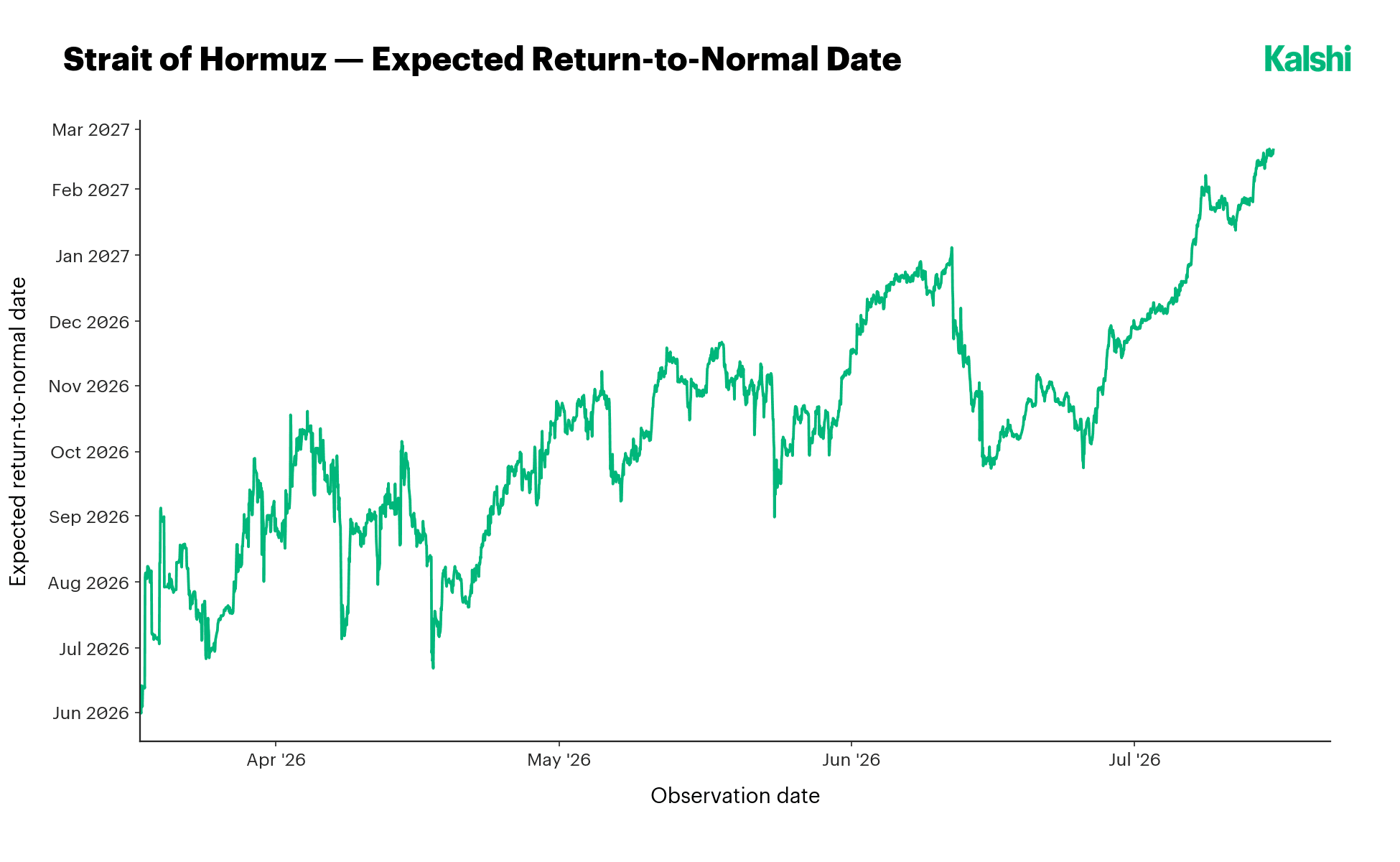
The conflict has also become a direct infrastructure story rather than a purely upstream one. Iranian drone strikes hit three AWS data centers during the war, prompting AWS to advise clients to consider moving workloads out of the Middle East. Iran subsequently circulated a target list naming AWS, Microsoft, Google, Nvidia, Oracle, and Palantir facilities across Bahrain, the UAE, and Qatar as legitimate military infrastructure - introducing new price risk for compute.
Critical Minerals
More durably upstream, the supply chain’s dependence on scarce, tightly held minerals represents a more persistent risk. China dominates the $2 trillion mining and refining market. It holds roughly 98% of the world’s gallium and about two-thirds of its germanium. Both are essential for producing advanced chips. Export controls and tariffs have become a policy lever amid rising US-China tensions. Washington’s posture this cycle has followed a familiar sequence: tariff pressure paired with negotiated carve-outs.
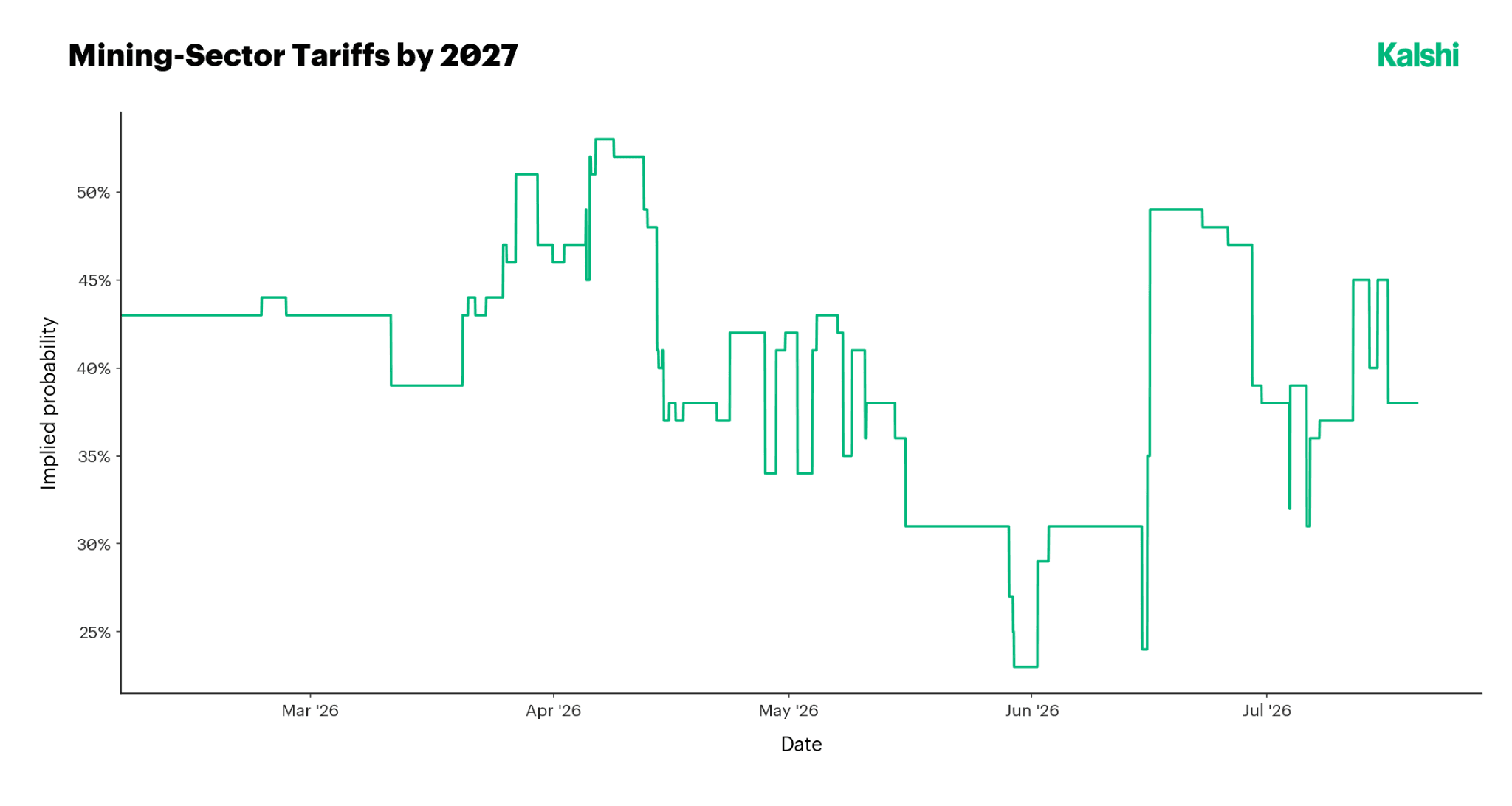
Markets currently assign 37% odds that the administration imposes tariffs on critical minerals this year, down from a peak near 50%, against 20% odds that Congress mandates a domestic stockpile instead. Either path reshapes the same trade: tariffs would strain the $57 billion U.S. chip export market even as they accelerate a North American mining and refining buildout projected to reach $30 billion and $14 billion, respectively, by 2030.
Reshoring
Downstream, the U.S. has been trying to buy its way out of dependence on Taiwan. Trump has said the U.S. will control half of global chip manufacturing by the time he leaves office, and the current administration has extracted hundreds of billions in committed plant investment from TSMC, Samsung, and SK Hynix, alongside a direct equity stake in Intel.
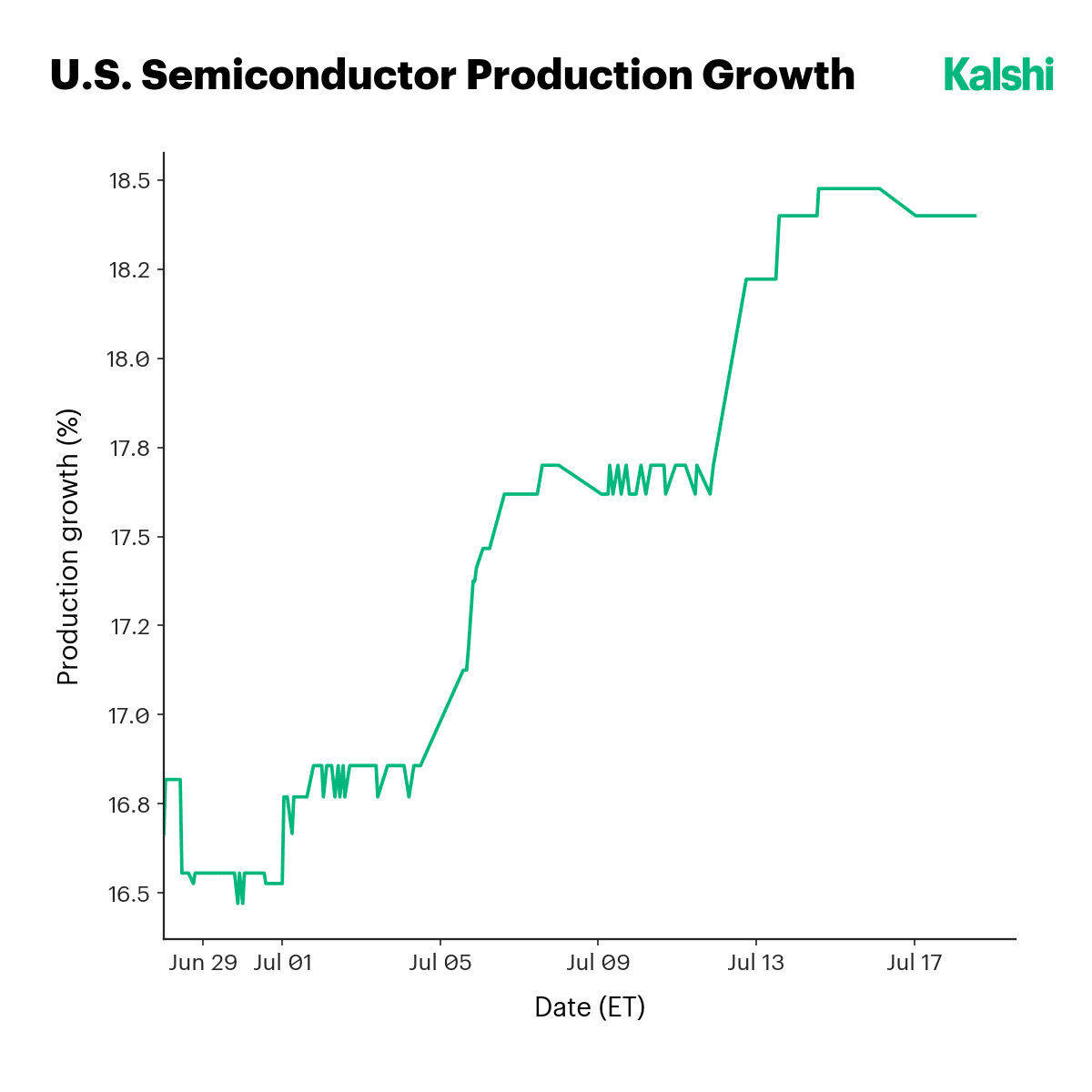
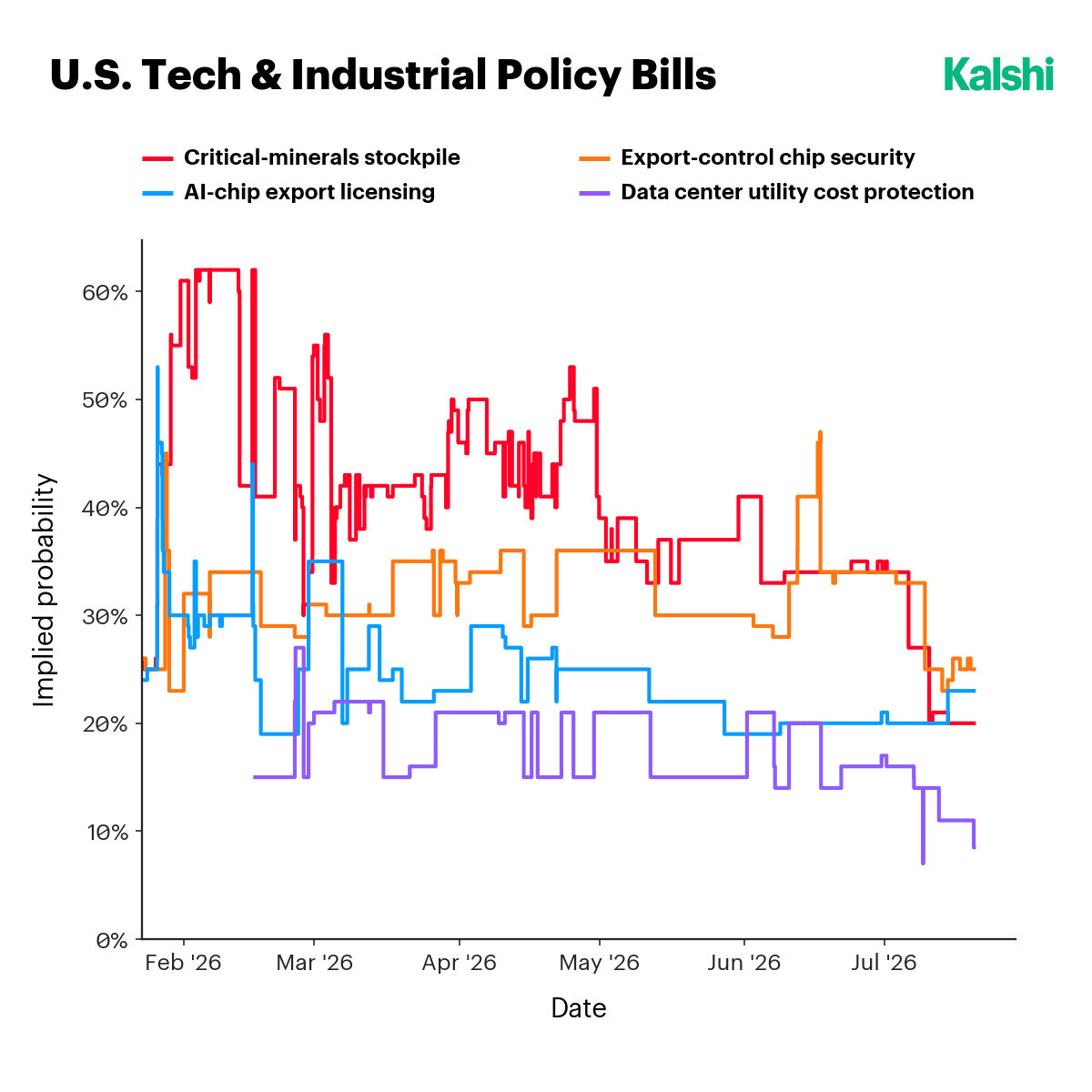
The results are starting to show up in the data: Kalshi markets put 2026 U.S. semiconductor manufacturing growth at 18.4%, up from 14.2% in 2025 and 6.7% in 2024 – genuine acceleration, if still short of a near-term fix for the $141 billion U.S. semiconductor market. The offsetting risk sits in Congress, where two export-restriction bills – one requiring congressional review of AI-chip exports (23% odds), another mandating location verification on those exports (25% odds) – could tighten supply further if either passes.
Risk to watch
If export controls succeed in their aims, they risk spurring on China’s own domestic chip industry, which may begin to produce genuinely competitive chips (e.g. Huawei’s Ascend line) that could eventually challenge the established American behemoths.
The Demand Story
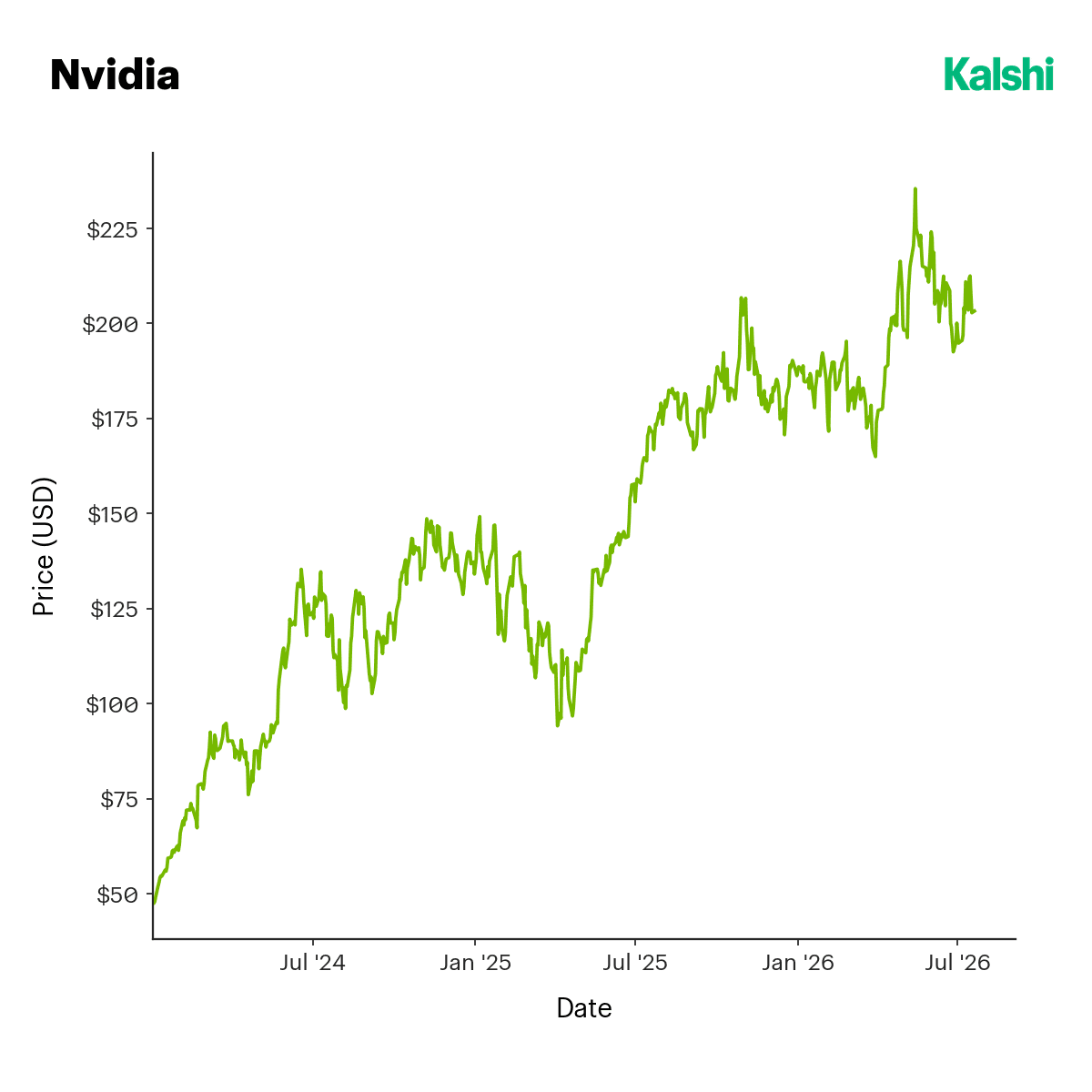
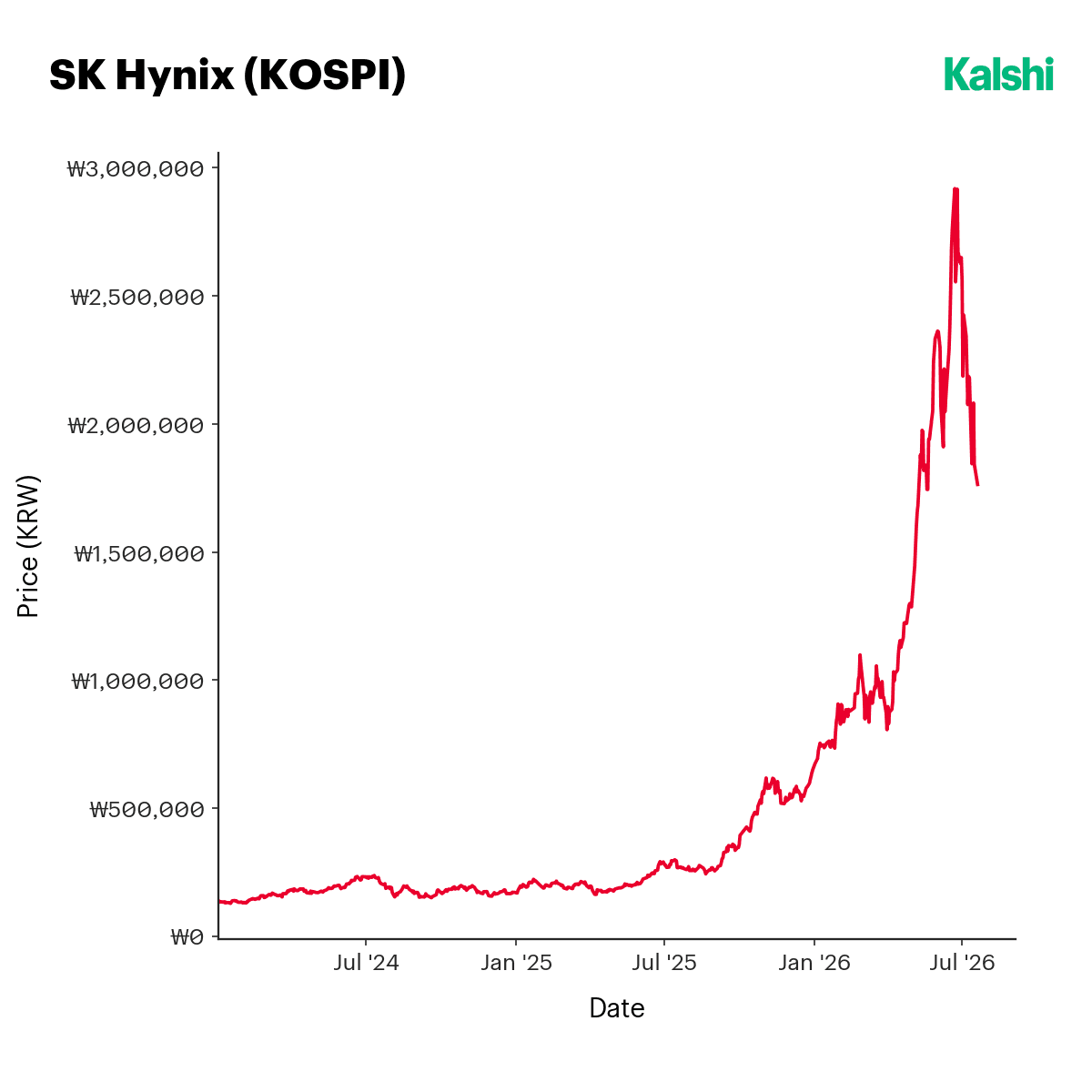
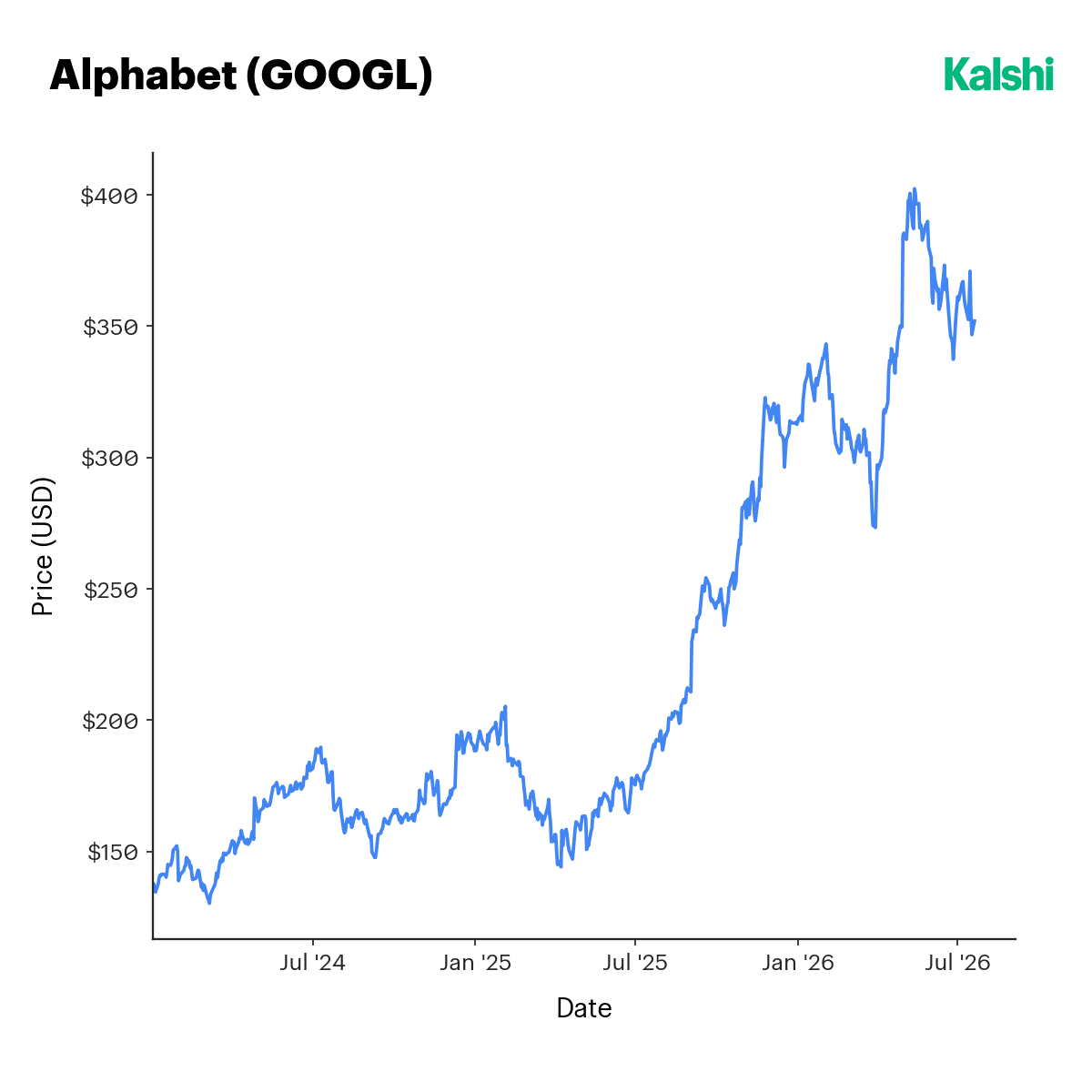
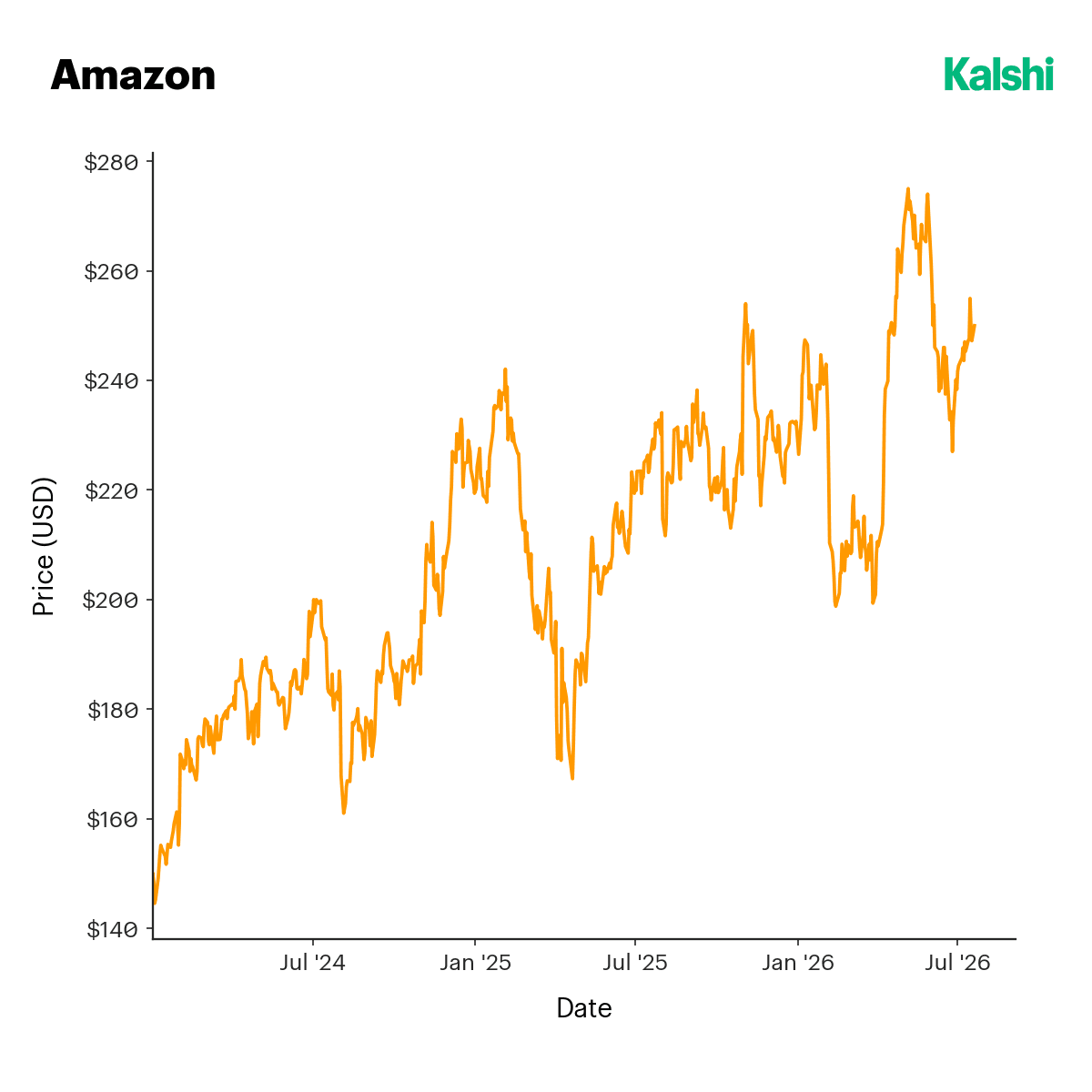
Compute is a hot commodity and markets are fully cognizant of that fact. Nvidia has gained 9-10% year-to-date despite already trading at a premium, while SK Hynix has surged roughly 580%+ over the trailing year, briefly overtaking Samsung as Korea’s most valuable company on the strength of its HBM dominance. Alphabet and Amazon are both up about 10% year-to-date, rewarded for capex discipline and cloud growth. The demand for compute is real and growth is priced in.
The Spending Story
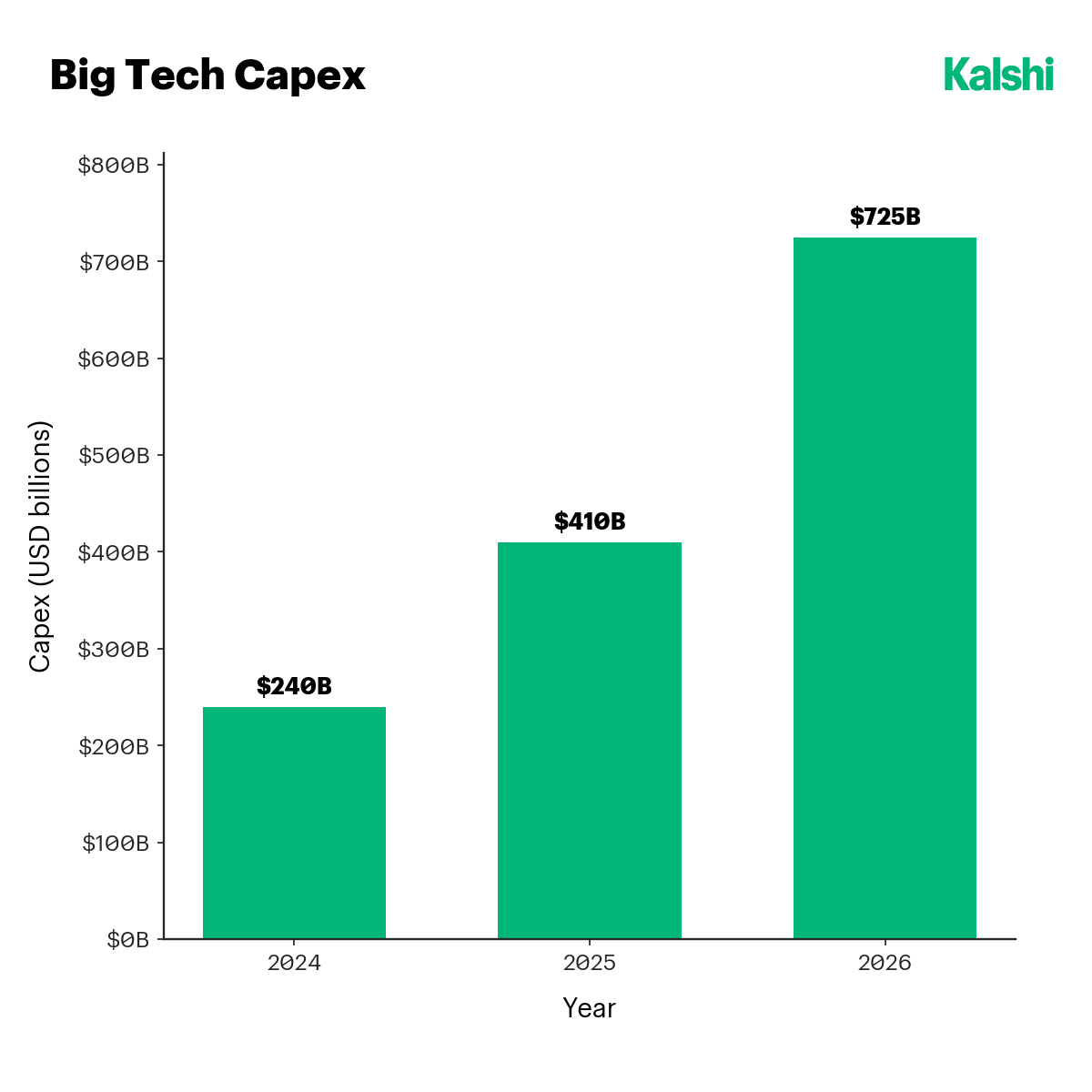
Capital expenditure is also climbing steeply. The core is still coming from the four large U.S. hyperscalers: Amazon, Google, Meta, and Microsoft, which are on pace to spend roughly $725 billion combined on AI infrastructure in 2026 alone, a 77% jump from ~$410 billion in 2025. This demand pressure is expected to continue and support compute pricing.
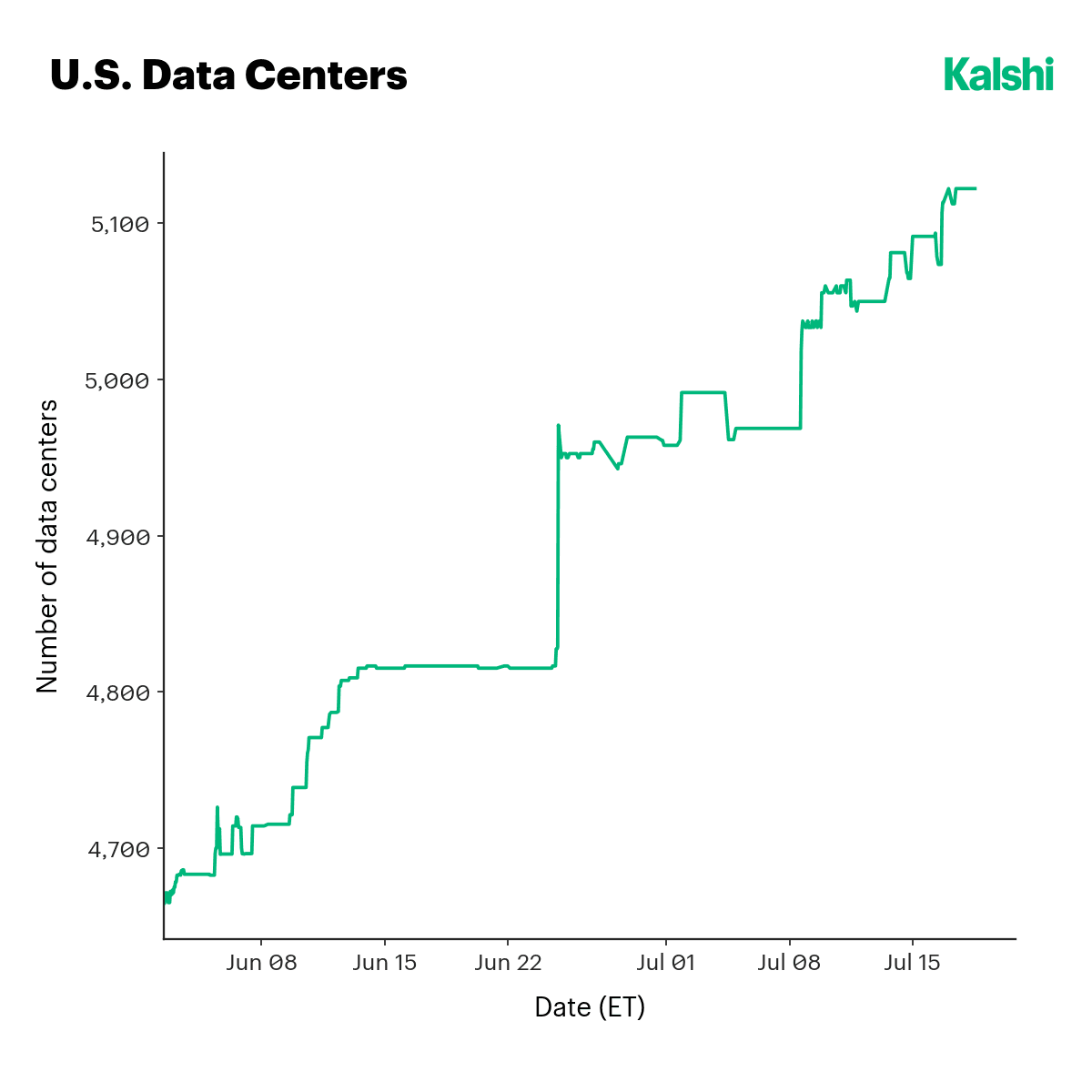
Kalshi markets show the expected number of active U.S. data centers rising to 5,120 by year end, up from a forecast of 4,700 in early June. This sharp upward revision is a live signal of how much compute demand is truly outrunning the base case.
Enjoying this? Get our next piece of research as soon as it's out.
Lessons From the Forward Curve
Kalshi’s new forward curves display the trajectories of hourly rental price of several key Nvidia GPUs. This lets market participants hedge future price risk (block trading available) and gives interested parties a real-time price signal for a market that’s always been negotiated privately. Because GPUs are mostly rented out due to the variability of demand, rental prices are an indicative metric.
The curves for Nvidia’s three legacy chips suggest stable prices ahead. The curves for the A100, H100, and H200 stay flat into 2027. The B200 is different. Nvidia’s latest and most powerful chip is in backwardation. Traders expect it to get cheaper as Blackwell supply comes online. This is somewhat expected, as the B200 recently spiked to all-time highs while the legacy chips held steady. Taken together, the curves point one way: today’s shortage remains real, but the market has already begun pricing its end. Compute will stay costly, but the age of runaway prices looks to be closing. The B200 curve is the tell. Even the newest, scarcest chip is expected to cheapen to $5.5 from the current ~$7.2 per hour.
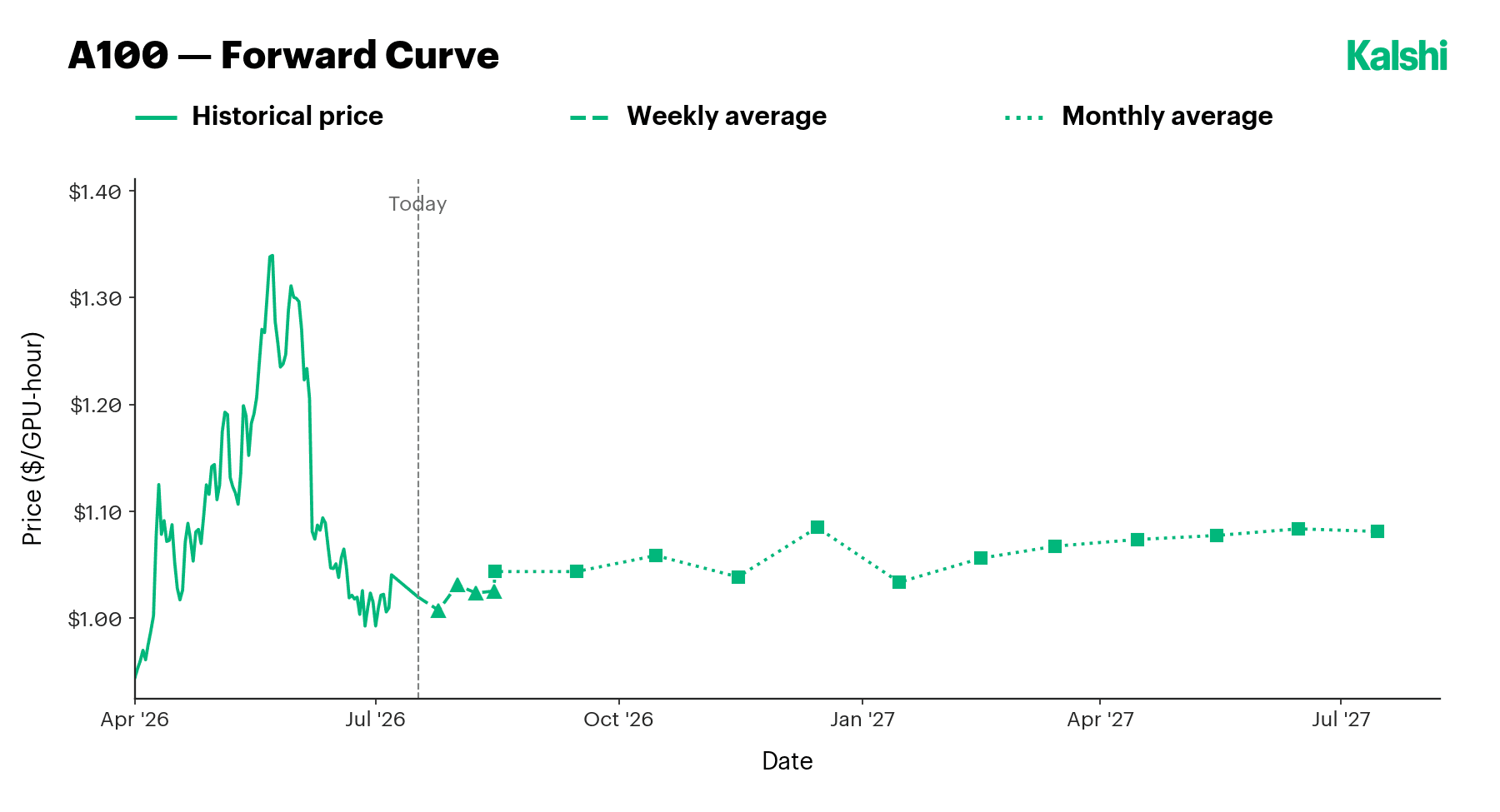
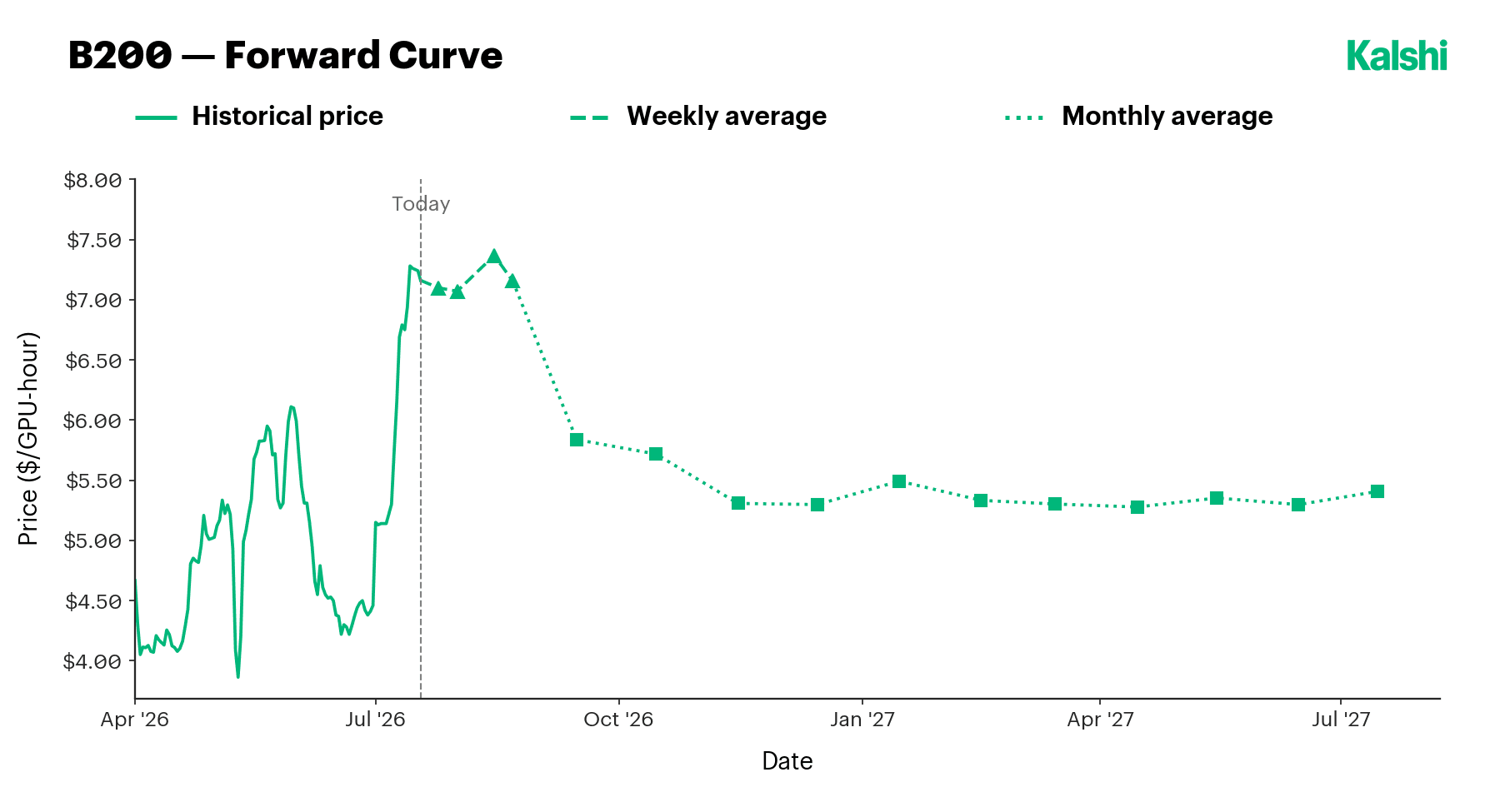
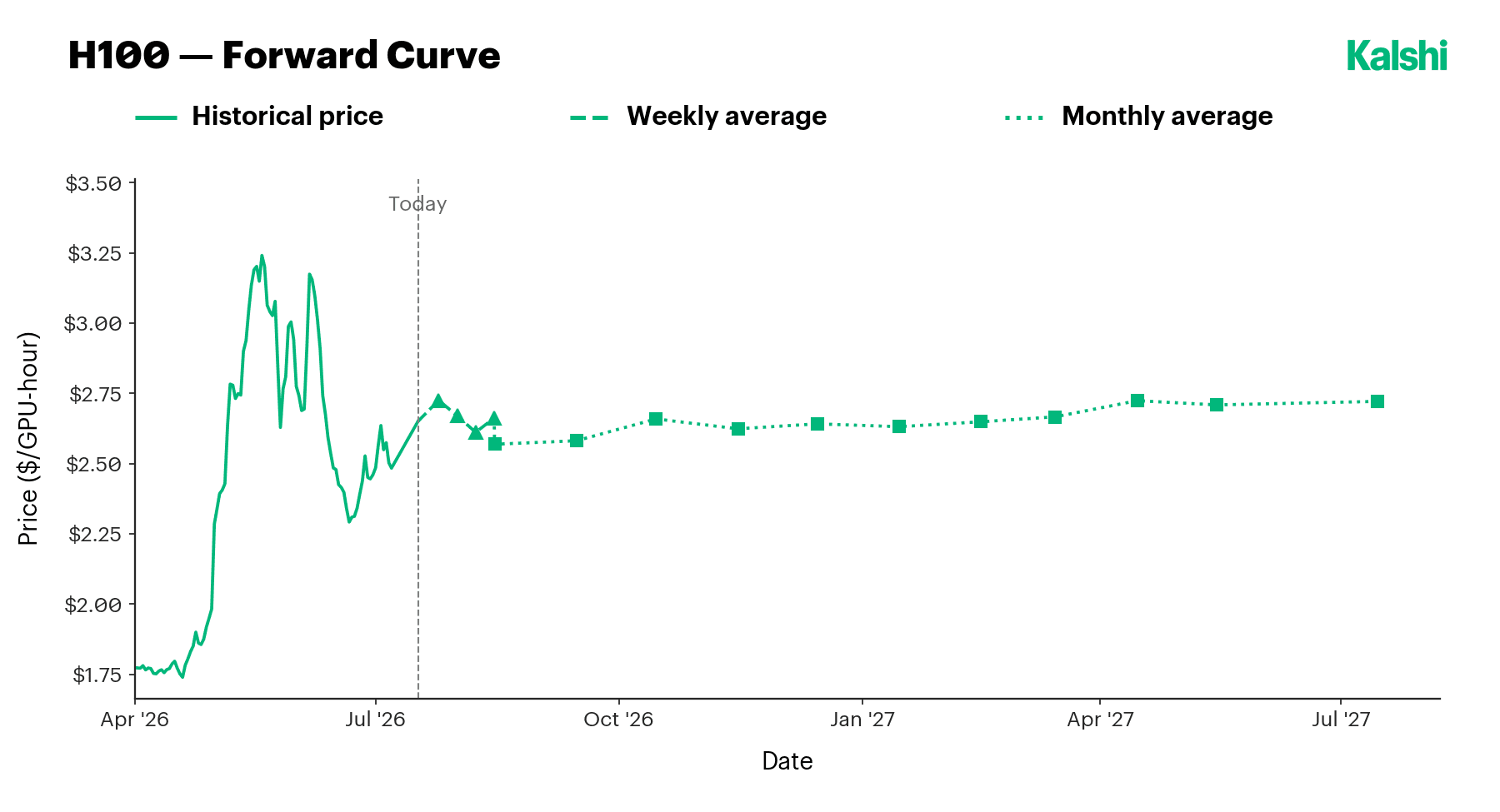
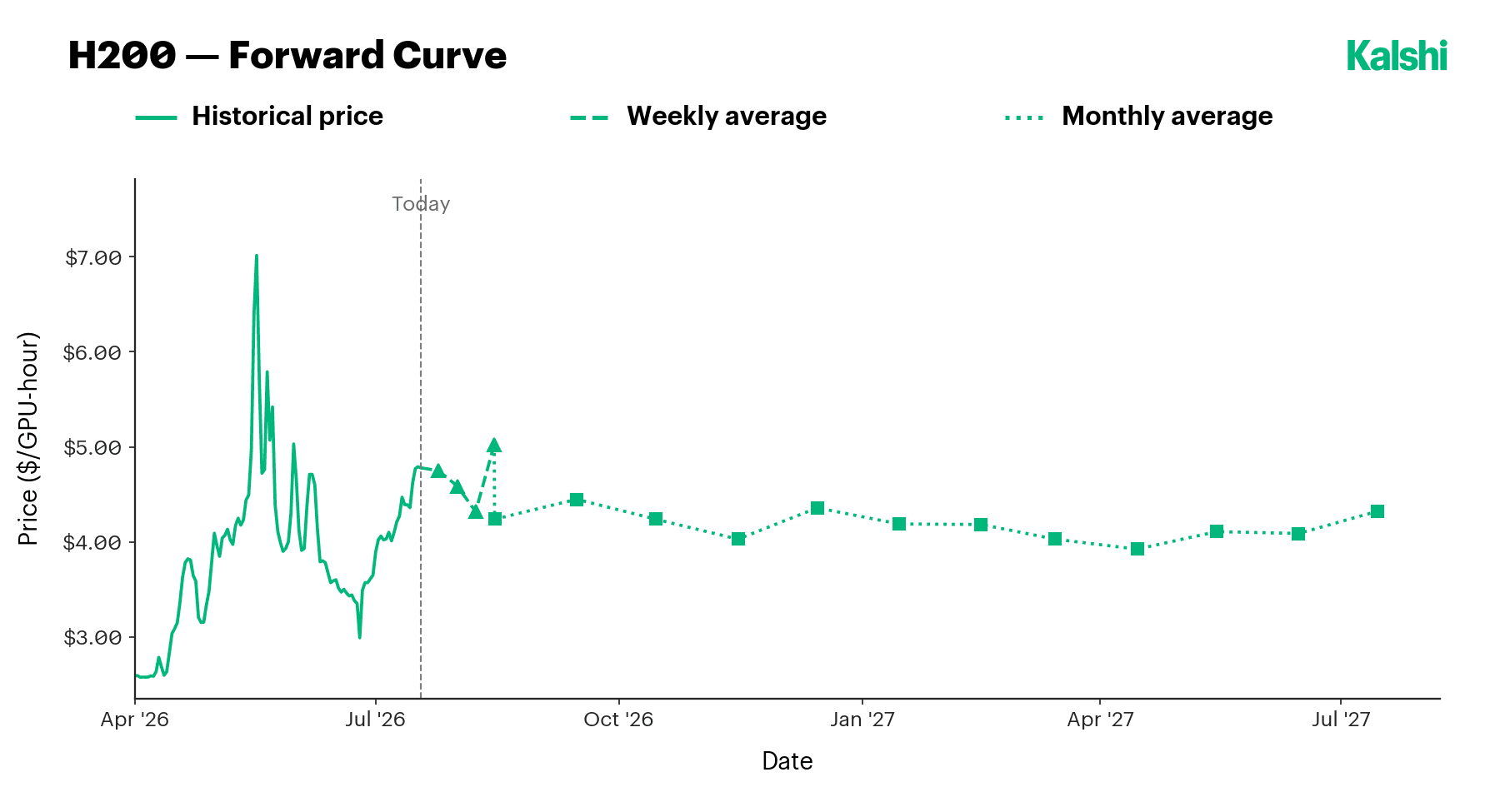
Moreover, the Blackwell-to-Vera-Rubin transition is a swing factor worth watching. Nvidia has said its next-generation Vera Rubin GPUs are already in full production, with shipments beginning in Q3 2026 and a fuller volume ramp in Q4, and has framed the transition as a step change lower in cost per unit of compute. If that timeline holds, demand migrating to the new generation should relieve pressure on current Hopper- and Blackwell-class supply. This should reinforce, rather than contradict the backwardation the B200 curve appears to already be pricing.
The Go-Forward
Earnings season over the next six weeks should sharpen this picture. Alphabet reports July 22, with our own markets assigning 60% odds Nvidia gets a direct mention; relevant given Google’s push to erode Nvidia’s position with its own TPUs. Intel reports July 23, where its Foundry unit (99% odds of coming up) is the cleanest read on whether U.S. reshoring is translating into shipped capacity rather than announced investment. Meta reports July 29, and its 5-gigawatt Hyperion data center should offer the most direct read on hyperscaler demand intentions. Nvidia’s own earnings in late August will likely close the loop.
Additionally, if the B200 forward curve keeps pointing lower as Blackwell supply scales, expect capex guidance across hyperscalers to hold or increase, consistent with a supply-catch-up story. If backwardation proves shallower than currently priced, or reverses, that would signal scarcity is more structural than the market now assumes, and we’d expect capex guidance to turn more cautious in response. We’d also watch how hyperscalers talk about power specifically: a growing emphasis on on-site generation, dedicated PPAs, or nuclear/SMR commitments would tell us operators increasingly view grid access, not chip supply, as the multi-year bottleneck.
Beyond the chip-level data, two softer signals now matter more than they used to: any commentary on Gulf project timelines or war-risk insurance costs from G42, Humain, or their hyperscaler partners, and any tightening in disclosed terms on vendor-financing arrangements, equity stakes tied to purchase commitments, for instance, that would suggest the market is starting to price the circularity question rather than take reported capex at face value.
Finally, grid connections still take 2-3 years to approve, and a growing wave of state and local moratoriums (e.g. New York, which just became the first state to halt new data-center permits in line with ~115 municipalities nationwide), adds a policy constraint on top of the physical one. Watch hyperscaler siting and on-site generation commentary for confirmation.
About Kalshi Research
Signal-rich analysis of prediction markets. Questions, data access (currently free for institutional clients), or collaboration: research@kalshi.com
Reference Material
- Baab, Catherine. "Big Tech's AI Spending Spree: $650 Billion in 1 Year." Quartz, February 6, 2026. https://finance.yahoo.com/news/big-techs-ai-spending-spree-142111465.html
- Baskaran, Gracelin, and Meredith Schwartz. "From Mine to Microchip: Addressing Critical Mineral Supply Chain Risks in Semiconductor Production." Center for Strategic and International Studies, October 7, 2024. https://www.csis.org/analysis/mine-microchip
- The Business Research Company. Mining Market Report 2026. The Business Research Company, January 2026. Distributed by Research and Markets. https://www.researchandmarkets.com/report/mining
- Federal Reserve Bank of St. Louis. "Industrial Production: Manufacturing: Durable Goods: Semiconductor and Other Electronic Component." FRED. Accessed July 21, 2026. https://fred.stlouisfed.org/series/IPG3344A
- Frenette, Joey. "Jensen Huang Says Compute Power Is the 'New Natural Resource' of the Modern Era." 24/7 Wall St., February 16, 2026. https://finance.yahoo.com/news/jensen-huang-says-compute-power-141830246.html
- "Helium and the Strait of Hormuz." Science (blog). Accessed July 21, 2026. https://www.science.org/content/blog-post/helium-and-strait-hormuz
- Jain, Rounak. "Trump Says US Will Have 50% of Chip Industry by the Time He Leaves Office, Threatens Tariffs of Over 200% Otherwise." Stocktwits, June 16, 2026. https://finance.yahoo.com/technology/ai/articles/trump-says-us-50-chip-100639839.html
- J.P. Morgan Global Research. "Critical Minerals Outlook: Surging Demand, Expanding Supply Chains." J.P. Morgan, February 23, 2026. https://www.jpmorgan.com/insights/global-research/commodities/critical-minerals
- Mordor Intelligence. United States Semiconductor Market Size, Share & 2030 Growth Trends Report. Mordor Intelligence, August 28, 2025. https://www.mordorintelligence.com/industry-reports/united-states-semiconductor-market
- Nakano, Jane. "The Hormuz Energy Crisis Generates a Tailwind for Nuclear Energy in Northeast Asia." Center for Strategic and International Studies, July 14, 2026. https://www.csis.org/analysis/hormuz-energy-crisis-generates-tailwind-nuclear-energy-northeast-asia
- Semiconductor Industry Association. 2025 State of the Industry Report. Semiconductor Industry Association, July 2025. https://www.semiconductors.org/wp-content/uploads/2025/07/SIA-State-of-the-Industry-Report-2025.pdf
- Sozzi, Brian. "Meta, Microsoft, Amazon, and Alphabet Are About to Spend a Shocking Amount of Money to Dominate the AI Era." Yahoo Finance, June 3, 2026. https://finance.yahoo.com/sectors/technology/article/meta-microsoft-amazon-and-alphabet-are-about-to-spend-a-shocking-amount-of-money-to-dominate-the-ai-era-115359575.html
- "Why the Middle East Helium Supply Shock Didn't Hit Chip Makers." The Wall Street Journal. Accessed July 21, 2026. https://www.wsj.com/finance/why-the-middle-east-helium-supply-shock-didnt-hit-chip-makers-471585a0
Disclaimer
This report is published by Kalshi Inc. (“Kalshi,” “we,” or “us”) for informational and educational purposes only. It is not investment, legal, tax, or trading advice, and it does not constitute a recommendation or solicitation to buy, sell, or hold any event contract, security, or other financial instrument. Nothing in this report creates a fiduciary, advisory, or professional-client relationship between Kalshi and the reader.
Kalshi operates a CFTC-regulated exchange. The event contracts and forward curves referenced herein are traded on or derived from Kalshi’s platform. The market prices, forward curves, and implied probabilities cited in this report reflect what market participants thought at a given moment; such data is subject to change without notice. These figures are not guarantees or predictions of actual outcomes. Past and current prices do not indicate future results. Data sourced from third parties is believed to be reliable but has not been independently verified. Third-party projections and estimates cited herein are subject to significant uncertainty and may not be realized.
Trading event contracts carries risk, including the risk that you may lose some or all of your invested capital. Event contract outcomes are binary and can result in the total loss of the amount paid for a contract. Every figure and probability here is current only as of the date of publication. Kalshi undertakes no obligation to update, revise, or correct this report after publication.
Kalshi, its affiliates, officers, directors, and employees may have financial interests in the contracts or markets discussed herein and may trade them at any time without notice to readers.
This report is not directed at any person in any jurisdiction where its distribution or the offering of event contracts would be contrary to local law or regulation. Before acting on anything in this report, consult your own independent legal, tax, financial, or other professional advisor.
This report is not insurance advice and does not constitute a recommendation regarding the purchase, renewal, or cancellation of any insurance policy or program. Comparisons between event contracts and insurance products are illustrative only and do not account for differences in regulatory protections, counterparty credit risk, claims processes, coverage scope, or policyholder rights that may apply to traditional insurance. Readers should consult a licensed insurance professional before making decisions about their insurance or risk-transfer arrangements.
Get new Kalshi Research publications and insights as they are released.