
Chips, Capital, and Concrete: AI after the Midterms
Published November 16, 2026
Download PDF- Three large forces are currently shaping the AI conversation. Jensen Huang’s sudden departure from NVIDIA, the upcoming Anthropic IPO, and the midterm results, which raised concern about the viability of data center construction.
- Voters are deciding where the chips can go. Voters backed limits on data centers in 40 of 41 local ballot measures on November 3, yet traders have not cut their forecast for how many data centers the US will have. They expect the industry to build around the restrictions.
Investors Aren’t Convinced About a NVIDIA without Huang
Ahead of earnings, NVIDIA stock has taken a tumble, pricing in the departure of co-founder and CEO Jensen Huang (and later, the uncertainty around his return). NVIDIA's shares, tracked by Kalshi's perpetual contract, fell 9.1% over the afternoon of November 11, when news first floated the idea of an executive exit, from $175.57 at 15:00 to $159.53. The 5.6% that followed the collapse in his odds is a closer gauge of what traders think his departure costs NVIDIA. Fundamentally, the market appears to view Jensen as inextricably linked to NVIDIA, rather than a perfunctory executive manager. While unsurprising, it is somewhat shocking that in the lead-up to earnings season (typically a time of extreme excitement and market exuberance given past performance), such tumult is being seen.
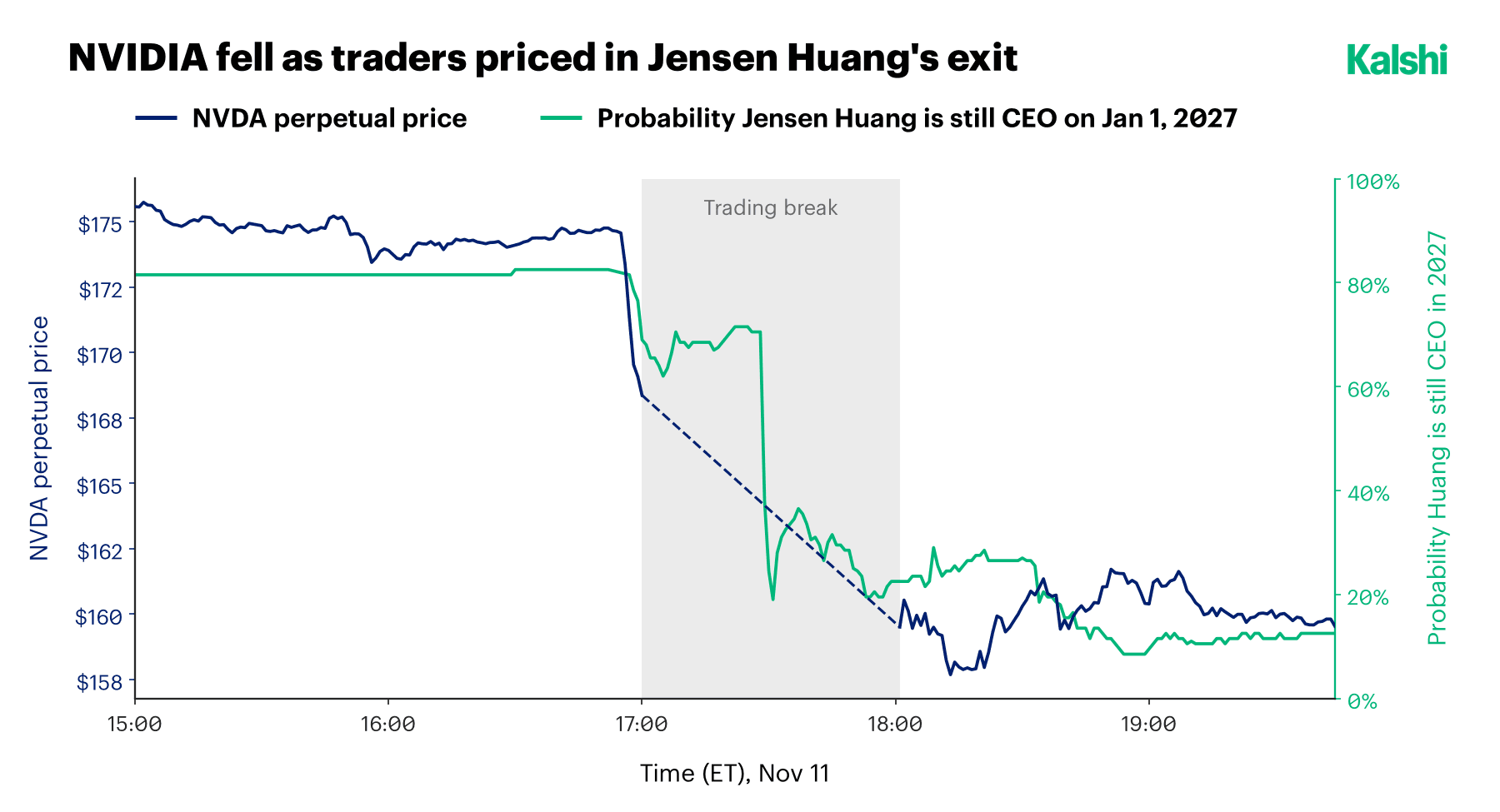
Front and center is the question of succession. Traders are leaning toward someone who would keep NVIDIA on its current course. Rene Haas leads the next-CEO market at about 23% as of the time of writing, with a return by Huang himself briefly priced as the second-most-probable outcome.
The Industry At A Glance
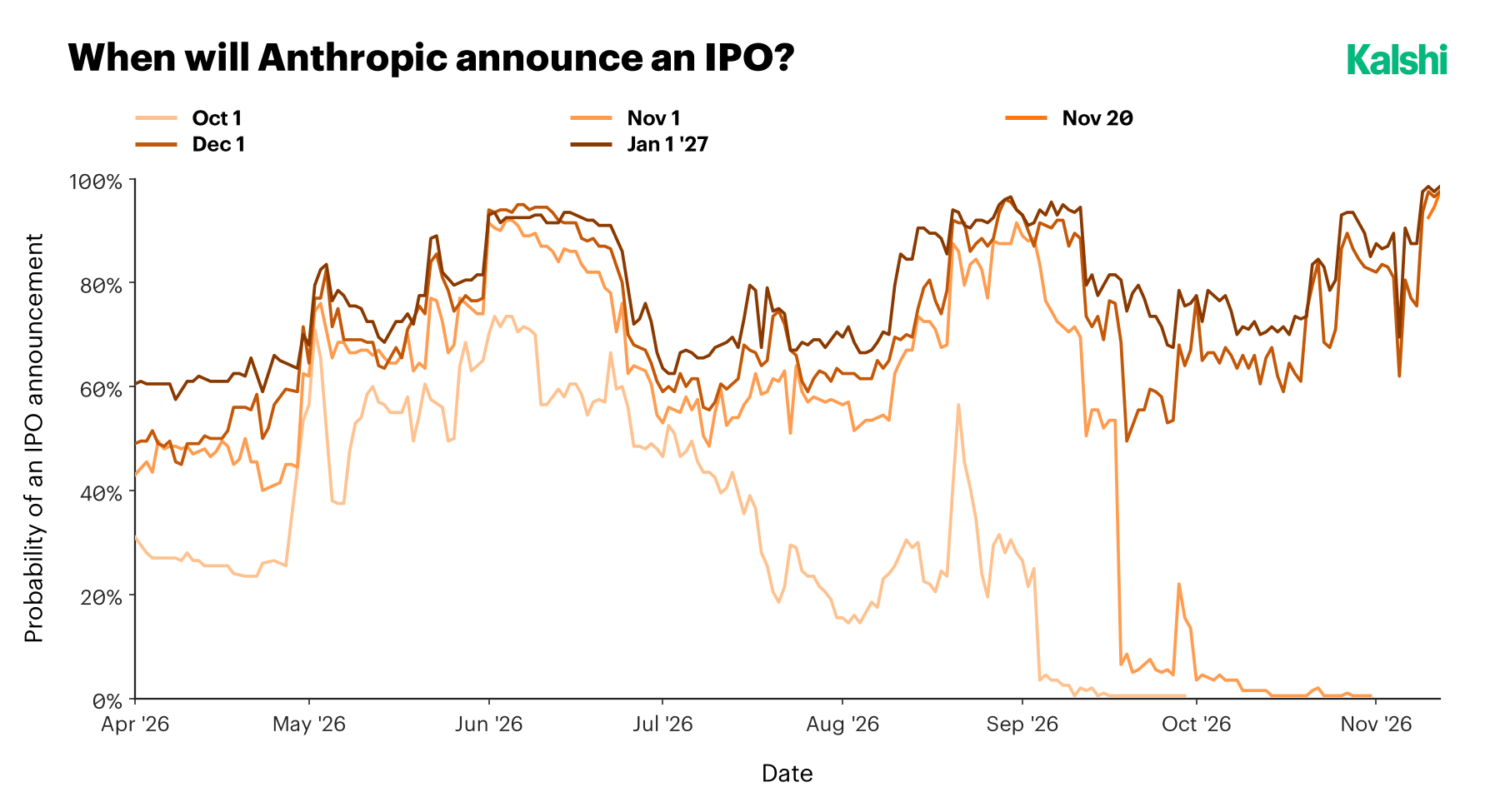
NVIDIA provides much of the underlying compute infrastructure used by model providers. Its chips, formerly relegated to the niche world of gaming, have been moved into the spotlight due to their high-performance capabilities in the world of inference. And in this world of model building, all eyes have turned to Anthropic ahead of its blockbuster IPO slated for later this month. Anthropic is widely expected to debut for trading on November 19, 2026.
Though having held the lead for much of the year, Claude is no longer the favorite to finish the year as the top AI model. From October onward, Google’s Gemini has continued to climb higher.

Ballot Measures Have Constrained Data Center Construction, But Traders See More In Future
Data centers turn chips into computing power, and that capacity is the core of the US lead in AI. Epoch AI estimates that the US holds about 75% of global GPU cluster performance and China about 15%. Customs data tell the same story: the US captured 72% of the AI chips shipped since 2022, against about 10% for China, and 78% of new compute hardware in the first half of 2026. That lead lasts only as long as the US keeps building, and the midterm vote showed how unpopular building new data centers has become.
Rising electricity bills made data centers a campaign issue. Ohio's residential power bills have risen more than 20% in two years, according to the Energy Information Administration, and a Dallas Fed working paper estimates that data centers have raised wholesale electricity prices by 6.9%. CNN's exit poll found voters opposed building data centers in their own communities by about three to one. Though unlikely to have been singularly decisive, candidates who made data centers central to their campaigns won hard races, among them Sherrod Brown, elected to the Senate in Ohio, and James Talarico in Texas, who ran on a plan to hold data centers accountable.

Kalshi's traders saw the backlash coming long before election day. They now expect just under five states to adopt a binding data center moratorium in 2026, nearly three times the 1.69 they expected on July 21. Almost all of that rise came during the campaign trail: the vote itself lifted the forecast only from 4.62 on November 2 to 4.86 on November 4, and it has since eased back. Yet traders have not cut their forecast for the build-out. The expected number of US data centers at the end of 2026 rose from 5,109 to 5,360, about 5%, and barely moved on November 3. The one wobble came earlier: the forecast reached about 5,450 in August and September and fell to about 5,050 in mid-October before recovering. Traders expect the industry to build around the restrictions rather than stop.
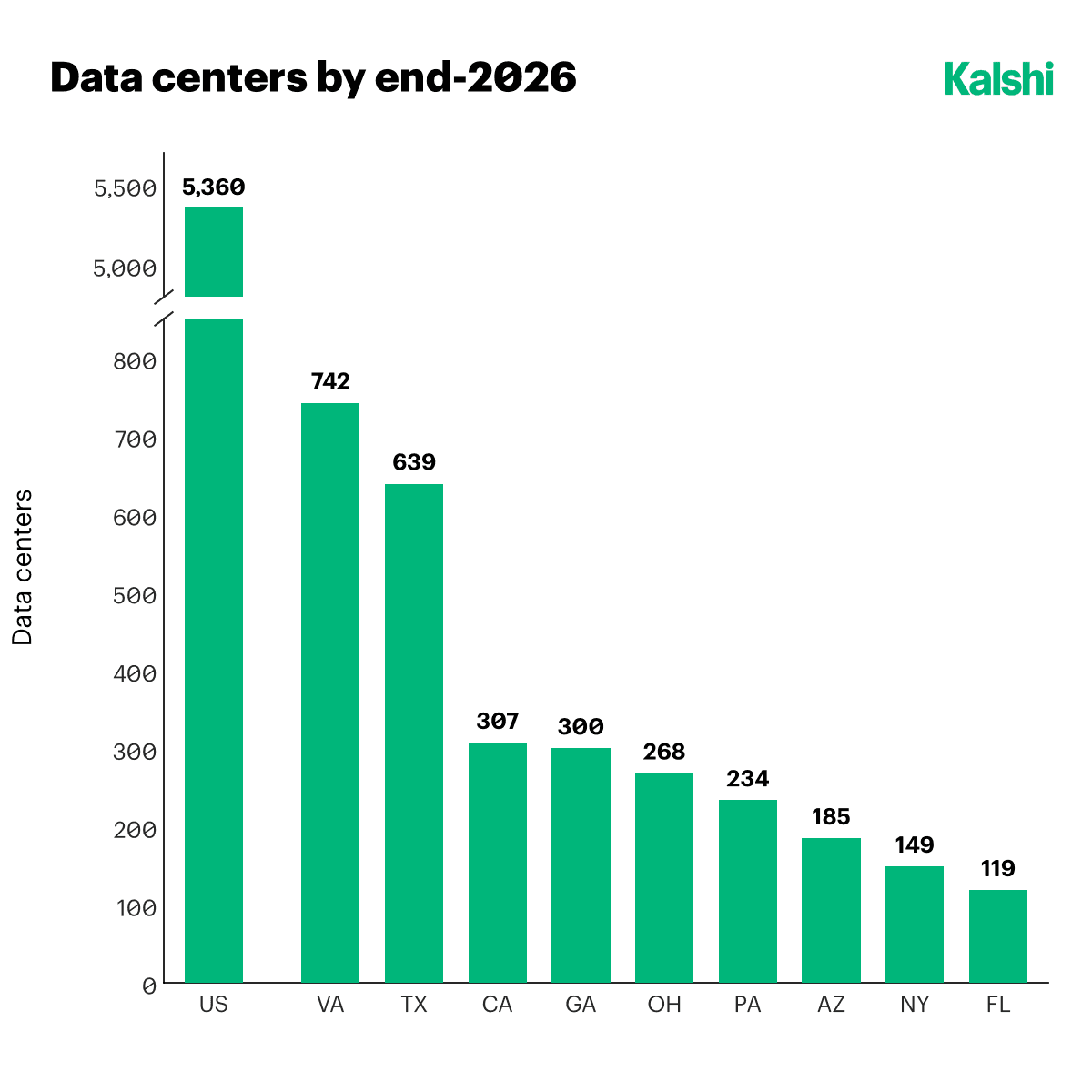
That depends on where the restrictions land, and the build-out is concentrated in a few states. Virginia is forecast to end the year with 742 data centers and Texas with 639, together about a quarter of the US total. California (307), Georgia (300), Ohio (268), Pennsylvania (234), Arizona (185), New York (149) and Florida (119) follow. These state markets trade thinly, so their forecasts are less reliable than the national one.
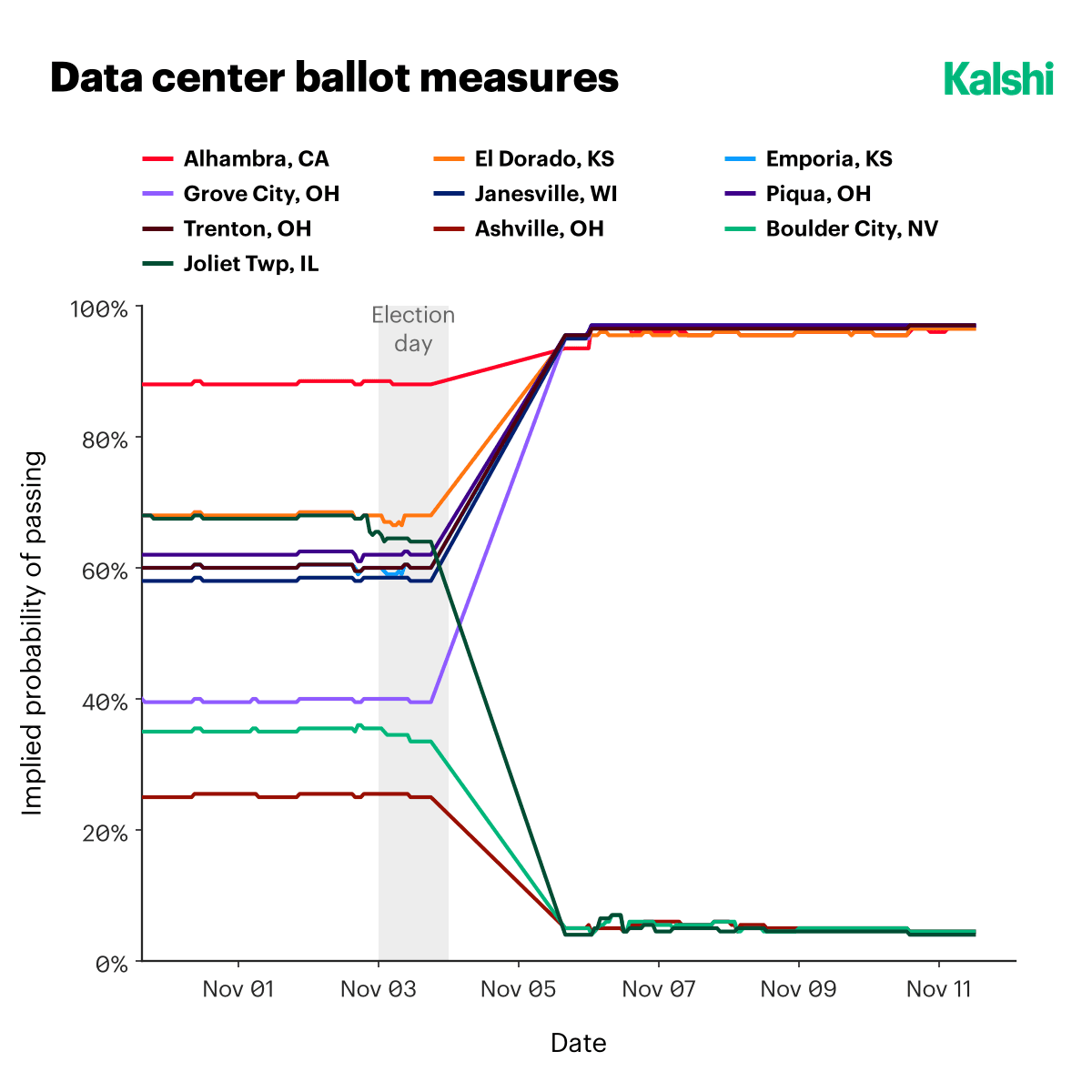
The local measures on the midterm ballot went one way. Seven passed, and every one restricts data centers. Alhambra, California, banned them outright with about 82% of the vote, and Piqua, Ohio, banned their construction with 67%. Trenton, Ohio, barred large-scale facilities with 80%. In Kansas, El Dorado approved a 10-year ban on high-impact data centers with 71%, and Emporia a prohibition with about 60%. Grove City, Ohio (about 55%), and Janesville, Wisconsin, for the former GM/JATCO site (63%), now require a public vote on large projects. The only measure that would have opened land to data centers, Question 1 in Boulder City, Nevada, failed with 29%. Measures in Ashville, Ohio, and Joliet Township, Illinois, also failed, with unclear legal effect. These results are preliminary.
On these local votes, unlike the statewide count, traders underpriced the backlash. Before the vote they gave most of the measures between 25% and 68%, and only Alhambra was a near-certainty at 88%. Where the outcome looked uncertain, the restrictive side won almost every time; Joliet Township, the highest-priced of that group, was the exception. Press tallies show the same pattern nationally, with the restrictive side winning the large majority of about 41 local measures.
What to Watch
Much of the price action for broad-based indices this year has been driven by the promise of AI. As a result, we’ve seen significant volatility be derived from a leadership change at the company widely considered the cornerstone of the industry. At the same time, new entrants are expected to debut in the marketplace. In any case, the week of November 16 is set to be significant between earnings and a potential IPO.
About Kalshi Research
Signal-rich analysis of prediction markets. Questions, data access (currently free for institutional clients), or collaboration: research@kalshi.com
Disclaimer
This report is published by Kalshi Inc. (“Kalshi,” “we,” or “us”) for informational and educational purposes only. It is not investment, legal, tax, or trading advice, and it does not constitute a recommendation or solicitation to buy, sell, or hold any event contract, security, or other financial instrument. Nothing in this report creates a fiduciary, advisory, or professional-client relationship between Kalshi and the reader.
Kalshi operates a CFTC-regulated exchange. The event contracts and forward curves referenced herein are traded on or derived from Kalshi’s platform. The market prices, forward curves, and implied probabilities cited in this report reflect what market participants thought at a given moment; such data is subject to change without notice. These figures are not guarantees or predictions of actual outcomes. Past and current prices do not indicate future results. Data sourced from third parties is believed to be reliable but has not been independently verified. Third-party projections and estimates cited herein are subject to significant uncertainty and may not be realized.
Trading event contracts carries risk, including the risk that you may lose some or all of your invested capital. Event contract outcomes are binary and can result in the total loss of the amount paid for a contract. Every figure and probability here is current only as of the date of publication. Kalshi undertakes no obligation to update, revise, or correct this report after publication.
Kalshi, its affiliates, officers, directors, and employees may have financial interests in the contracts or markets discussed herein and may trade them at any time without notice to readers.
This report is not directed at any person in any jurisdiction where its distribution or the offering of event contracts would be contrary to local law or regulation. Before acting on anything in this report, consult your own independent legal, tax, financial, or other professional advisor.
This report is not insurance advice and does not constitute a recommendation regarding the purchase, renewal, or cancellation of any insurance policy or program. Comparisons between event contracts and insurance products are illustrative only and do not account for differences in regulatory protections, counterparty credit risk, claims processes, coverage scope, or policyholder rights that may apply to traditional insurance. Readers should consult a licensed insurance professional before making decisions about their insurance or risk-transfer arrangements.
Get new Kalshi Research publications and insights as they are released.