
Compute, Power and the Rise of AI Infrastructure Markets
Building Price Discovery and Risk Management for the AI Economy
Published October 2026
Download PDFFor most of the past two decades a company's compute bill was an IT expense. The firm bought servers or rented them from a cloud provider, and the price it paid rarely appeared in anyone's risk report. Large-scale AI changed that. A frontier training run occupies a very large cluster of accelerators for months, a successful product launch can multiply inference demand within days, and a lab that cannot get the newest chips may ship after its competitors. The hourly price of a GPU now drives investment decisions worth billions of dollars, but it is set mostly in private negotiation, and a company that wants to fix next year's price has very few ways of doing so.
We expect the market that forms around this exposure to have two legs. One is compute, which is already sold by hyperscale clouds, specialist GPU providers and marketplaces and through bilateral contracts, at prices that differ by chip, region, contract length and how quickly the capacity is needed. The other is electricity. Data centers have become large enough to move regional load forecasts and wholesale prices, and the price of power in turn affects where new capacity is built and what it costs to run. Commodity traders will recognise the arrangement. Gas and power are linked by the spark spread, crude and refined products by the crack spread, and corn and ethanol by the crush spread.
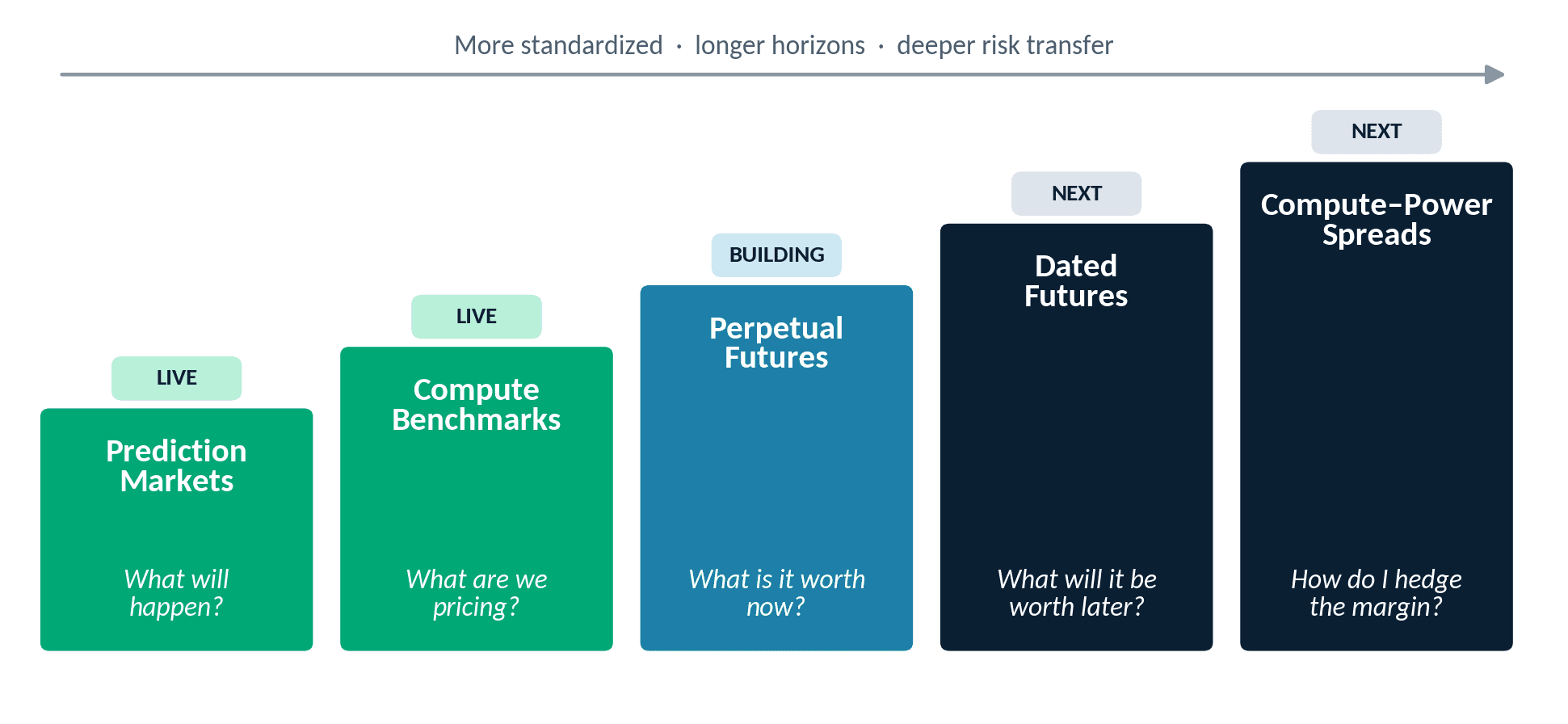
Kalshi is building the compute leg in three stages.
- Prediction markets let traders take positions on compute prices, data-center growth and power demand before anyone has agreed on a spot price. Kalshi first listed GPU compute markets in March 2026, and published the first market-implied GPU forward curve in July 2026. Several million fully collateralized contracts have traded in the space already.
- Perpetual futures give exposure to the current price of compute without owning GPUs or rolling contracts. Kalshi already runs regulated perpetuals on crypto and on precious metals.
- Dated futures give exposure to particular months and years. These are the contracts AI companies, GPU operators, developers and lenders would use to hedge in the way commodity producers and consumers already do.
More in our latest whitepaper: Read the whitepaper (PDF)
About Kalshi Research
Signal-rich analysis of prediction markets. Questions, data access (currently free for institutional clients), or collaboration: research@kalshi.com
Disclaimer
This report is published by Kalshi Inc. (“Kalshi,” “we,” or “us”) for informational and educational purposes only. It is not investment, legal, tax, or trading advice, and it does not constitute a recommendation or solicitation to buy, sell, or hold any event contract, security, or other financial instrument. Nothing in this report creates a fiduciary, advisory, or professional-client relationship between Kalshi and the reader.
Kalshi operates a CFTC-regulated exchange. The event contracts and forward curves referenced herein are traded on or derived from Kalshi’s platform. The market prices, forward curves, and implied probabilities cited in this report reflect what market participants thought at a given moment; such data is subject to change without notice. These figures are not guarantees or predictions of actual outcomes. Past and current prices do not indicate future results. Data sourced from third parties is believed to be reliable but has not been independently verified. Third-party projections and estimates cited herein are subject to significant uncertainty and may not be realized.
Trading event contracts carries risk, including the risk that you may lose some or all of your invested capital. Event contract outcomes are binary and can result in the total loss of the amount paid for a contract. Every figure and probability here is current only as of the date of publication. Kalshi undertakes no obligation to update, revise, or correct this report after publication.
Kalshi, its affiliates, officers, directors, and employees may have financial interests in the contracts or markets discussed herein and may trade them at any time without notice to readers.
This report is not directed at any person in any jurisdiction where its distribution or the offering of event contracts would be contrary to local law or regulation. Before acting on anything in this report, consult your own independent legal, tax, financial, or other professional advisor.
This report is not insurance advice and does not constitute a recommendation regarding the purchase, renewal, or cancellation of any insurance policy or program. Comparisons between event contracts and insurance products are illustrative only and do not account for differences in regulatory protections, counterparty credit risk, claims processes, coverage scope, or policyholder rights that may apply to traditional insurance. Readers should consult a licensed insurance professional before making decisions about their insurance or risk-transfer arrangements.
Get new Kalshi Research publications and insights as they are released.