
How Midterms Move Markets: S&P500 Futures
Published November 3, 2026
Download PDF- Markets move on electoral surprises, and on elections generally. S&P500 futures move most significantly on the back of surprise Presidential outcomes, but appear to move meaningfully (and predictably) in the leadup to other Midterm events.
- Repricing in real-time. Kalshi markets in the 2026 Midterms offer a window into the attribution of real-time market repricing as chances of candidate success move across the country. For the first time, the impact of particular state races will be mappable onto equity prices as movement is seen.
Equities, and the indices that they constitute, reflect claims on future earnings. Such earnings depend on a number of legislative and regulatory decisions: tax rates, tariffs, permitting, government borrowing, and agency control. Implicitly, then, market trading reflects both a view on an electoral outcome, and, naturally, the certainty of that outcome.
While markets move significantly on the back of surprises at the ballot box, index futures appear to move around large election days regardless. With the 2026 Midterms upon us today, we look at market responses to past cycles to assess discernible patterns in movement.
Futures Often Dip Going Into Elections, Recovering Once Results Are Known
The overlay below charts eight elections from 2010 to 2024, midterm and presidential, on one axis, indexed to 100 at the Tuesday a week prior to Election Day and running to the Tuesday one week after.
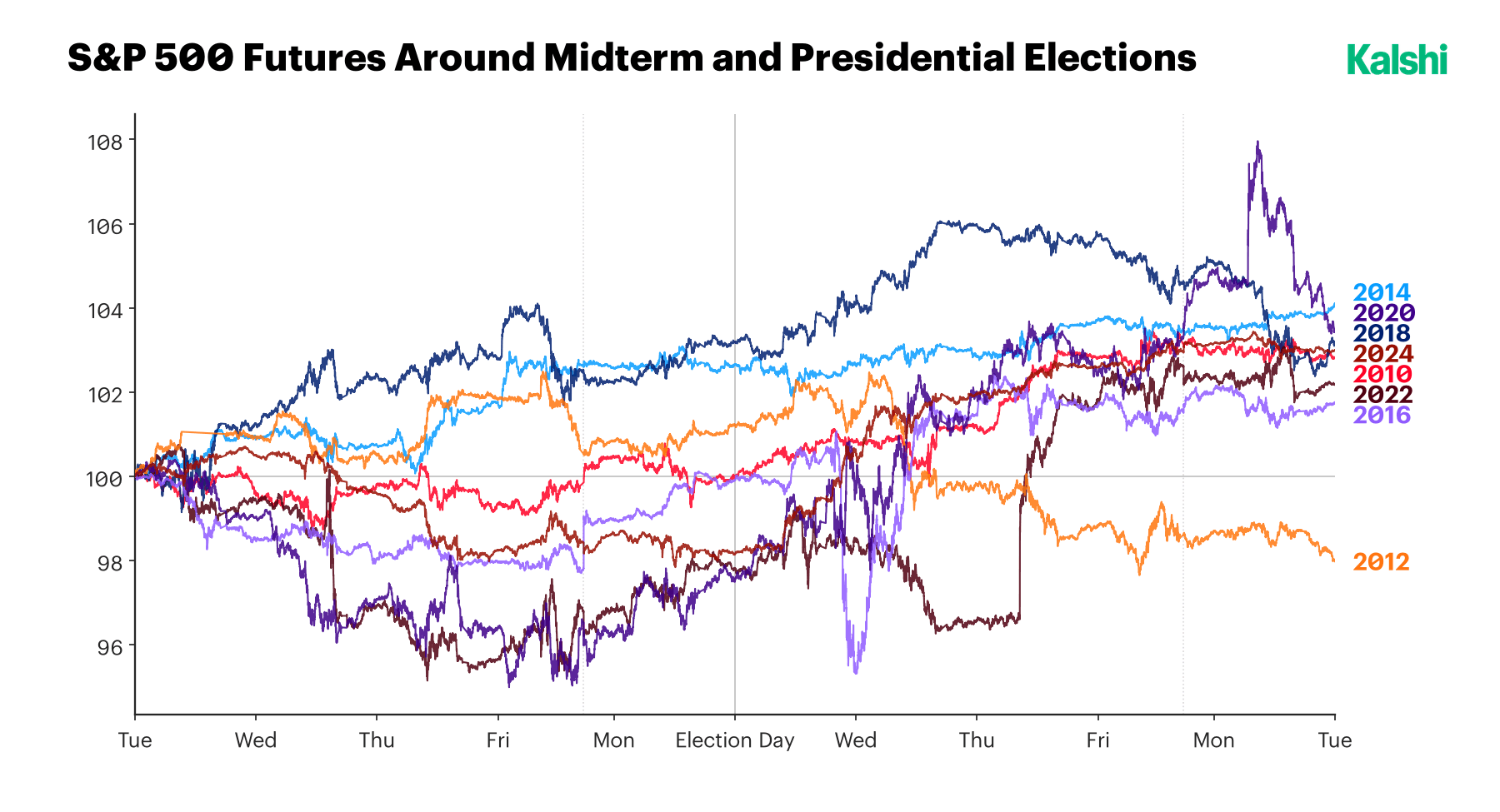
As can be seen above, markets appear to dip going into the vote, with several lines sagging below the indexation value and recovering once results are known - an ‘uncertainty penalty’, as we call it. In any case, the market action is significant and volatile, with the associated figures in the table below.
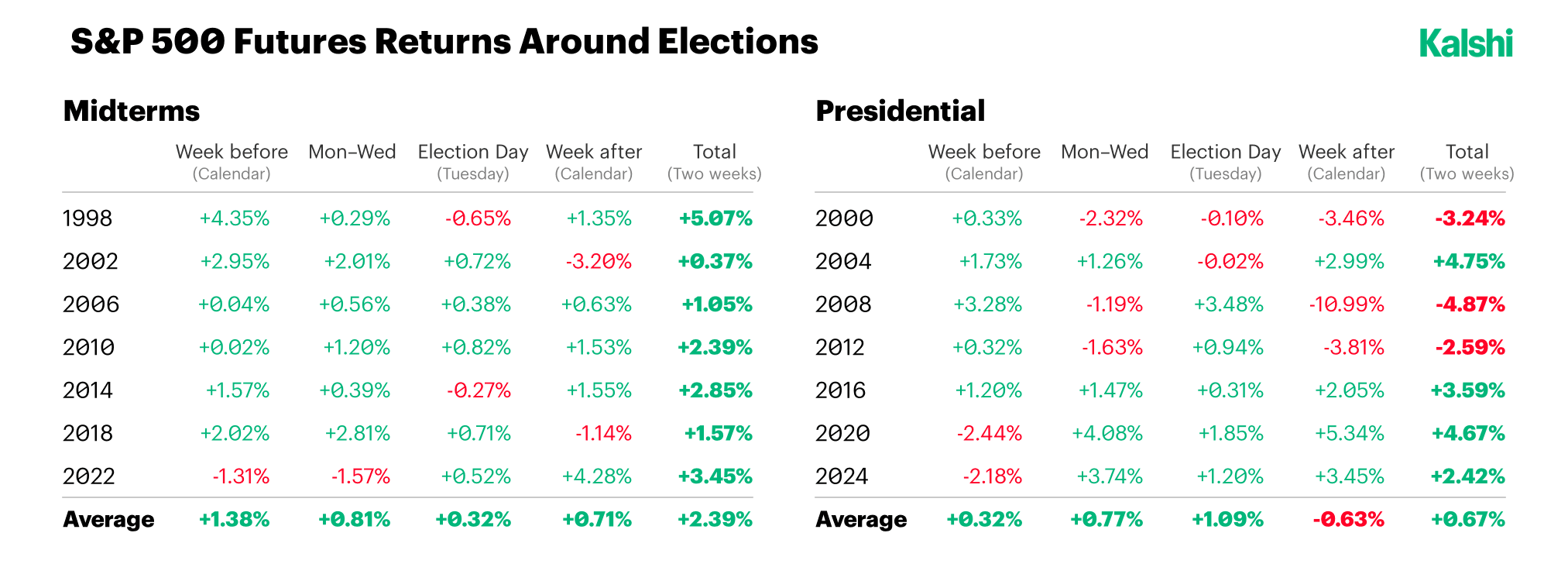
Extending back to 1998, non-presidential Midterm cycles are cleaner, with the one instance of a sell-off prior being in 2022. Presidential elections, on the other hand, attract more noise, with a roughly even split of positive and negative returns after a week following the elections. The week after the vote averages -0.63%, but that figure leans heavily on 2008, when futures fell 10.99% in the middle of the financial crisis. Without 2008, the average week after is about +1.09%. The other two negative weeks are 2000, the year of the Florida recount, and 2012. The last three presidential cycles all had a positive week after the vote.
Senate Results Come With No Fixed Sign
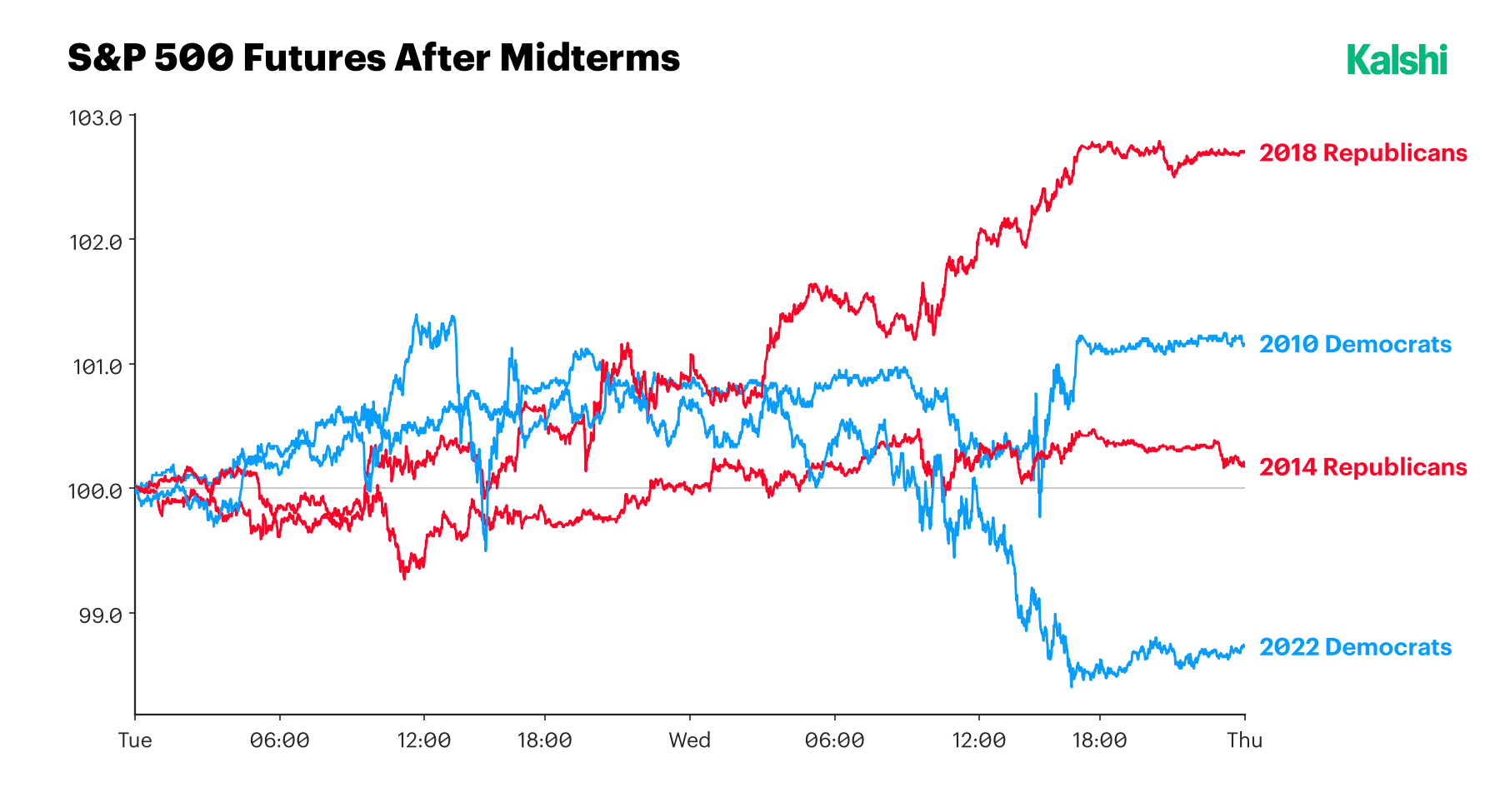
Drawing results back to election day and assessing outcomes over the past four election cycles shows a mixed bag for Senate outcomes. Republican control was followed by roughly +2.7% in 2018, when Republicans held the chamber, and +0.2% in 2014, when they flipped it. Democratic control was followed by +1.2% in 2010 and -1.3% in 2022. Both of the most significant moves are likely to have an explanation that sits at least in part outside the Senate. 2022’s decline coming on the back of a failed rescue of FTX, and a split result in 2018.
Markets Don’t Appreciate Surprises
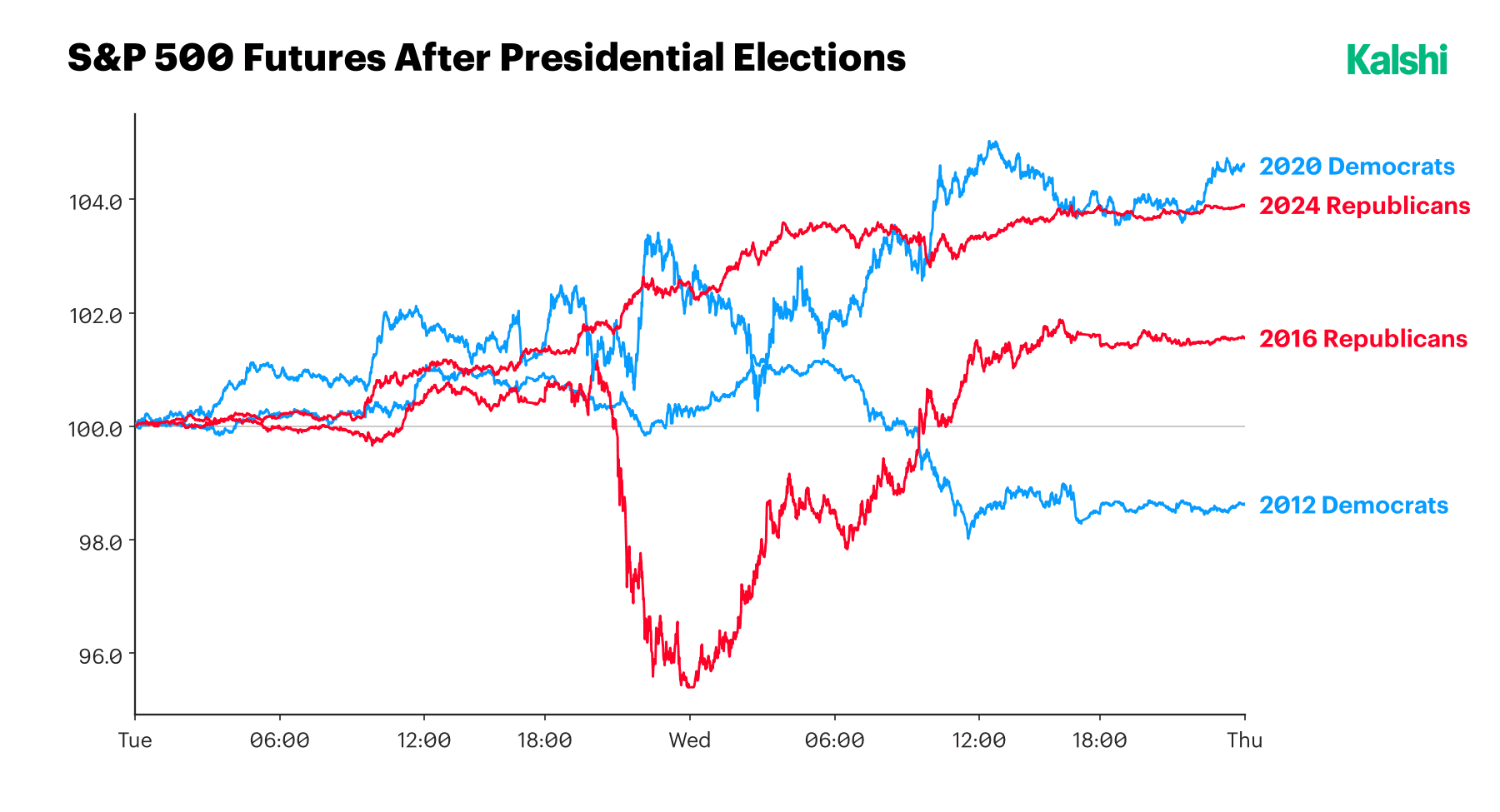
Indexing futures to 100 at the start of Election Day for the last four presidential elections tells us something of the market view on surprises. In 2016, futures fell to roughly 95.4 overnight, a drop of about 4.6% in an election where Hillary Clinton had been the favourite in the leading polls. In 2024, futures gave little ground, ending up at 103.9.
On the other side of this, the two Democratic wins are also split. 2020 ended near 104.6, while 2012 ended near 98.6. In 2020 this appeared to be less of a product of the elected President and more a function of the fact that the expected Democratic sweep was unlikely to happen and therefore that Congress was heading for division. Expecting tax increases to become less likely, strategists at the time attributed to this the S&P500’s 2.2% gain on November 4.
Putting Predictions In The Mix
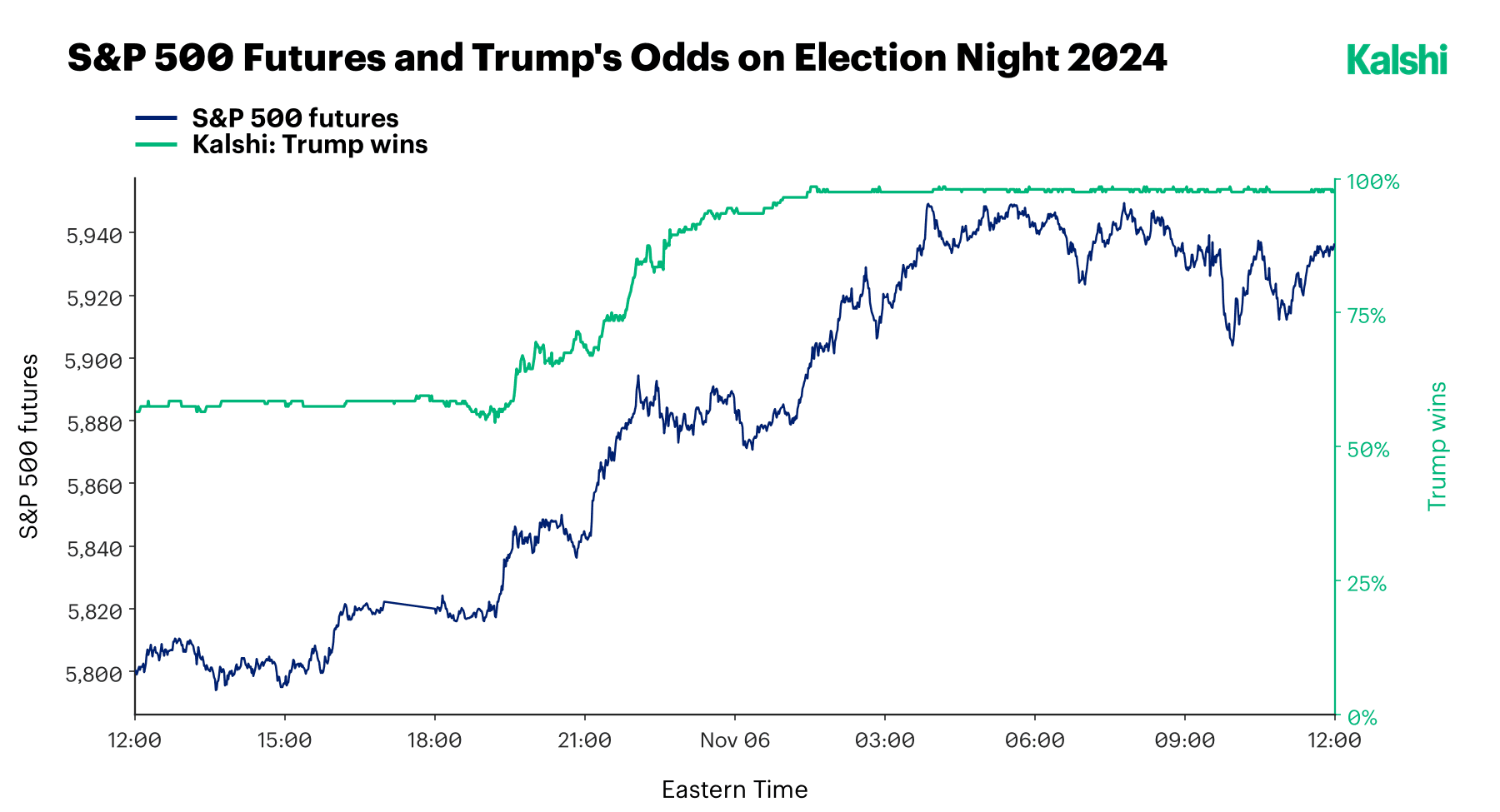
Zooming in on 2024, the cleanest example for the political narrative told by prediction markets is what happened on November 5. Through the afternoon, Kalshi’s Trump-wins contract sat at roughly 58%, and S&P 500 futures held a narrow range between ~5,800 and 5,820. A little after 7pm ET, the Contract started to climb. Reading from the chart below, it was near 75% by 9pm, above 90% shortly after 11pm, and settled around 97% by about 1:30am. Futures went from roughly 5,820 to near 5,895 by 10pm, gave some of that back through the late evening, and finished the climb to roughly 5,950 shortly before 4am.
The Projected Senate Flip of 2026
Kalshi traders have Democrats at a record 75% to take the Senate, up roughly ten points in a week, and they forecast a 53-seat Democratic majority. Democrats need a net gain of four seats, so Maine, Ohio and Texas together would not be enough. Those are the market’s strongest pickups: Maine at 73% for Jackson and Ohio at 71% for Brown, with Talarico trading at 73 to 75 cents in Texas. Michigan is a Democratic hold at about 80%, which leaves the fourth seat and the cushion to come from the next tier. Kansas leans Democratic at 63% for Hamilton, and Iowa is a near-tossup at 52% Turek to 48% Hinson. Alaska is priced near 70% for Democrats in a November 3 snapshot. The tail risk is a Republican Senate at roughly 25%, and it most likely arrives as the tier-two seats breaking the wrong way together: with Republicans at 53-47 and Vice President Vance breaking ties, losing Iowa and Kansas would leave Democrats stuck at a net gain of three, a 50-50 chamber and a Republican hold. Time will tell how public markets react.
About Kalshi Research
Signal-rich analysis of prediction markets. Questions, data access (currently free for institutional clients), or collaboration: research@kalshi.com
Disclaimer
This report is published by Kalshi Inc. (“Kalshi,” “we,” or “us”) for informational and educational purposes only. It is not investment, legal, tax, or trading advice, and it does not constitute a recommendation or solicitation to buy, sell, or hold any event contract, security, or other financial instrument. Nothing in this report creates a fiduciary, advisory, or professional-client relationship between Kalshi and the reader.
Kalshi operates a CFTC-regulated exchange. The event contracts and forward curves referenced herein are traded on or derived from Kalshi’s platform. The market prices, forward curves, and implied probabilities cited in this report reflect what market participants thought at a given moment; such data is subject to change without notice. These figures are not guarantees or predictions of actual outcomes. Past and current prices do not indicate future results. Data sourced from third parties is believed to be reliable but has not been independently verified. Third-party projections and estimates cited herein are subject to significant uncertainty and may not be realized.
Trading event contracts carries risk, including the risk that you may lose some or all of your invested capital. Event contract outcomes are binary and can result in the total loss of the amount paid for a contract. Every figure and probability here is current only as of the date of publication. Kalshi undertakes no obligation to update, revise, or correct this report after publication.
Kalshi, its affiliates, officers, directors, and employees may have financial interests in the contracts or markets discussed herein and may trade them at any time without notice to readers.
This report is not directed at any person in any jurisdiction where its distribution or the offering of event contracts would be contrary to local law or regulation. Before acting on anything in this report, consult your own independent legal, tax, financial, or other professional advisor.
This report is not insurance advice and does not constitute a recommendation regarding the purchase, renewal, or cancellation of any insurance policy or program. Comparisons between event contracts and insurance products are illustrative only and do not account for differences in regulatory protections, counterparty credit risk, claims processes, coverage scope, or policyholder rights that may apply to traditional insurance. Readers should consult a licensed insurance professional before making decisions about their insurance or risk-transfer arrangements.
Get new Kalshi Research publications and insights as they are released.