
Who Trades Prediction Markets?
Neighborhood Income, Background, and Probabilistic Reasoning Among Kalshi’s Most Profitable Traders
Published October 2026
Abstract
Prediction markets are often discussed as instruments and rarely as populations. The literature on market efficiency treats the trader base as an input whose composition is assumed rather than measured, while public commentary proceeds from a strong prior that the people profiting from these markets are finance professionals drawn from wealthy places. This paper measures the population directly, using two sources and a general-population comparison sample. The first is administrative: the residential ZIP code of every direct trader on Kalshi from January 2026 onward, crosswalked to American Community Survey median household income. The second is a survey of Kalshi’s highestPnL traders across all market categories excluding Sports and Exotics, fielded to 2,360 accounts in September 2026 with 325 surveys completed, representing a 13.8 percent response rate. We report three findings. First, the exchange is a middle-income population.
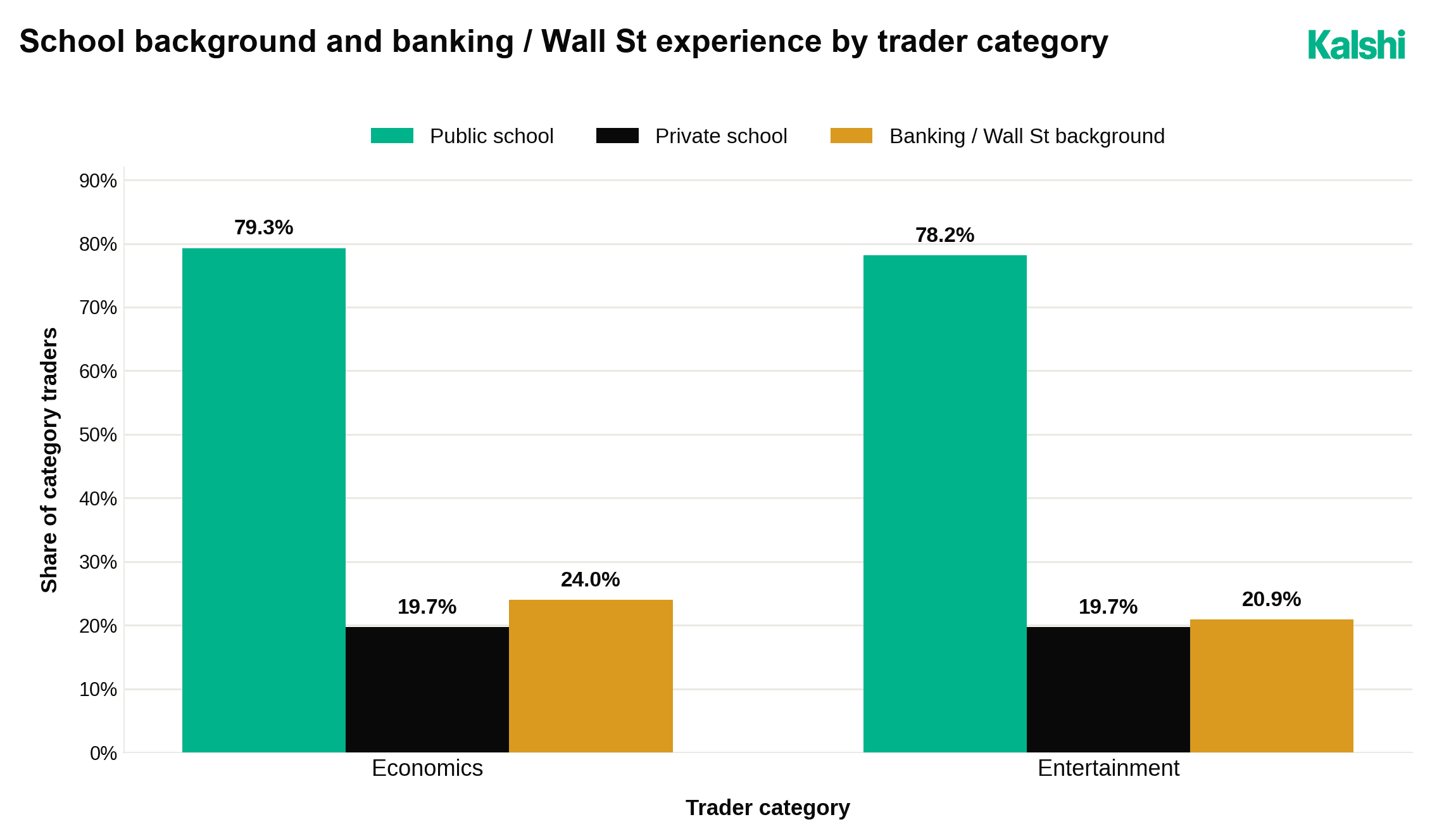
The ZIP codes of Kalshi traders reflect national median income, with the modal band straddling $80,734 and with only 6.3 percent living in ZIP codes above $150,000; excluding sports-primary traders shifts the distribution further down, not up. Second, profitability on the exchange does not run through a financial career. Eighty-two percent of the highest-PnL traders have never worked full time at an investment bank, hedge fund, private equity firm, or proprietary trading firm, falling only marginally to approx. 76 percent of those who specialize in trading “Economics” as a category, a figure that stands in sharp contrast to any professional trading venue, where such experience is effectively universal among those earning trading profits.
Seventy-nine percent attended public high school, 42 percent have worked six months or more in a customer-facing service or retail job, 65 percent describe themselves as mostly or entirely self-taught about markets and probability, and 91 percent are not full-time traders. Service-work experience is near-uniform across sixteen market categories, ranging from 33 to 53 percent, so this is a property of the whole exchange rather than of one recreational corner of it. Third, this group is distinctive in ways that are cognitive rather than professional. Benchmarked against a nationally weighted sample of 1,005 U.S. adults answering identical items, it scores a mean of 2.42 of 4 on the Berlin Numeracy Test against the public’s 0.62, achieves a perfect score roughly fifteen times as often, and resists the gambler’s fallacy at 93 percent against 57 percent.
Where the public is nearly as confident about an unannounced Grammy nomination as about control of Congress, confidence for the group of traders falls fourfold between the two. Within the survey cohort, research intensity, distance from 50 on lopsided questions, and the ability to discriminate knowable from unknowable questions all rise broadly with numeracy. This suggests, in line with the literature, that trading success is at least in part a product of reasoning style rather exclusively professional pedigree.
Keywords: Prediction Markets, Trader Composition, Numeracy, Probabilistic Reasoning, Kalshi